

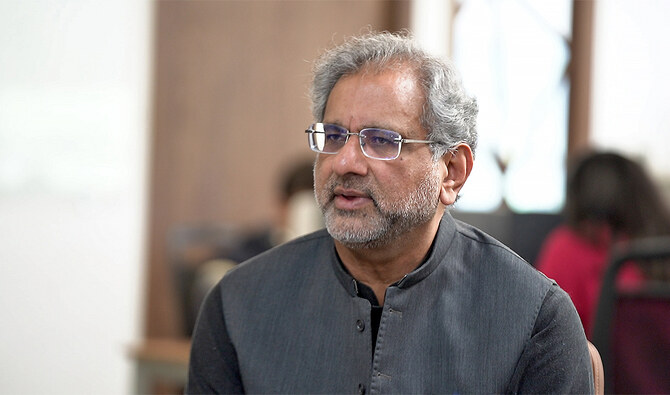

ISLAMABAD: Former prime minister Shahid Khaqan Abbasi said this week he was willing to meet jailed ex-premier Imran Khan to cool political instability in Pakistan provided that he had reflected on the mistakes of his four years in power and was willing to change.
Khan’s opponents including Abbasi, chairman of the newly formed Awaam Pakistan Party (APP), say he failed during his years in power from 2018-2022 to revive an economy battered by COVID-19 or fulfil promises to make Pakistan a corruption-free, prosperous nation respected on the world stage. They also say Khan victimized his political opponents by jailing them and launching court cases against them while in power. Khan denies the allegations.
Khan has been in jail since August 2023 and faces a slew of charges from corruption to treason that he says are politically motivated. Even from behind bars, he arguably remains the nation’s most popular politician, according to most polls.
Speaking to Arab News, Abbasi, a main leader in a joint opposition movement against the government of Prime Minister Shehbaz Sharif, said he was willing to meet with the jailed Khan to resolve the country’s long political stalemate.
“My first dialogue with him would be about whether he has reflected in jail, whether he has contemplated what he did in his four years [in office], and if he’s willing to change,” Abbasi said.
“If he’s not willing to change, if he thinks he can operate the same way he did for four years, run government and parliament and the country the same way, then I don’t see much hope.”
“NATIONAL DIAGLOGUE”
Khan, a cricketer-turned-politician, surged to power in 2018 with what is widely believed to be the support of the military, which maintains it is neutral in politics. He was ousted from power in a parliamentary vote of no confidence in 2022, which plunged the country into prolonged political uncertainty, with his Pakistan Tehreek-e-Insaf (PTI) emerging as a thorn in the side of the federal government and the military and keeping the country’s politics on razor’s edge by holding regular protests and speaking about the party’s alleged persecution and rights abuses at international platforms.
Khan, since his ouster, has faced dozens of legal cases, including charges of corruption, revealing state secrets and inciting mutiny during anti-government protests his party is accused of leading on May 9, 2023. The cases and a string of court convictions ruled the 71-year-old out of the Feb. 8 general elections last year and the PTI was also barred by the election commission from contesting as a party on the basis of a technicality, forcing members to run as independents.
Though the PTI-linked independents won the greatest number of seats, they did not have the majority to form a government, which was put together as a coalition administration led by Shehbaz Sharif as prime minister. Sharif is the younger brother of three-time prime minister Nawaz Sharif and led the successful bid by the opposition in parliament to topple Khan in the 2022 no-confidence vote.
The PTI and other opposition parties have alleged rigging in the Feb. 8 general elections, which were marred by nationwide Internet shutdowns and delayed results, and the PTI has since held multiple protests, including some that have turned violent, calling for fresh elections and demanding Khan’s release from prison.
Talks between the PTI and the government to resolve the political stalemate began in December but broke down earlier this year. Since then, the PTI has formed a joint front against the federal government along with other opposition parties, and former prime minister Abbasi has emerged as a main leader of that movement, called the Tehreek-e-Tahaffuz-e-Ayeen-e-Pakistan, or the Movement for the Protection of the Constitution of Pakistan.
“In our last opposition meeting, we gave the solution, the solution was new elections but before that, there is a need for a national dialogue with the national leadership,” Abbasi said, commenting on a grand moot of the opposition alliance last week.
“I advocated [for] the military to sit on that table, the judiciary to sit on that table.”
The purpose of the national dialogue, which could also include business leaders and top media house bosses, Abbasi said, was to develop a consensus on an “action plan.”
“And then implement it jointly. This is an extraordinary situation for Pakistan, it needs an extraordinary solution.”
Pakistan, a country of over 240 million people, narrowly avoided default in 2023 and has since been treading a tricky path to economic recovery, buttressed by a $7 billion IMF bailout approved last year and tied to tough reforms.
“Pakistan needs massive, massive reforms in every segment and then [stakeholders] need to work together to implement that,” the ex-premier said. “That is the need of the hour.”


