


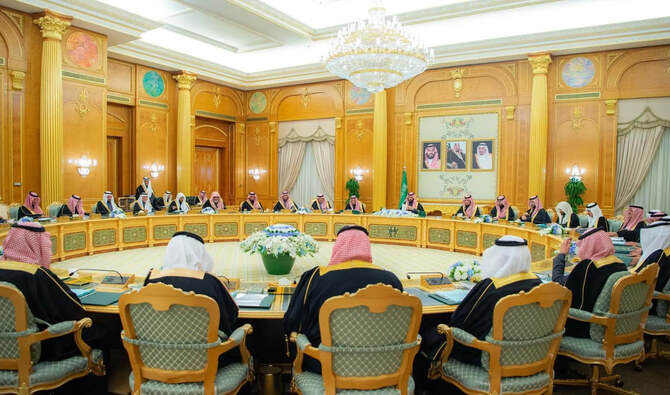
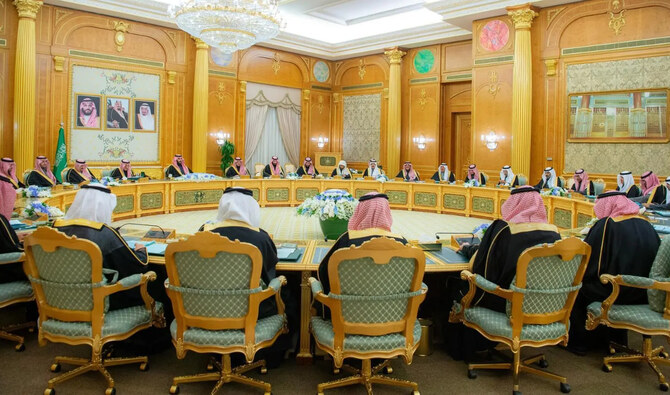


RIYADH: Saudi Arabia’s Cabinet on Tuesday affirmed full support for the decisions of the extraordinary Arab League summit in Cairo that rejected the displacement of Palestinians from their land, and aimed to end the disastrous repercussions resulting from the war.
It reiterated the right of the Palestinian people to self-determination and to obtain their legitimate rights, including their right to establish their independent state on the 1967 borders with East Jerusalem as its capital.
The final statement adopted by the summit called for the deployment of an international protection and peacekeeping force in the Palestinian territories.
It adopted the plan submitted by Egypt with regard to Gaza, in full coordination with Palestine and Arab countries.
It also emphasized the achievement of a just and comprehensive peace that fulfills the rights of the Palestinian people.
During the weekly Cabinet session chaired by Crown Prince Mohammed bin Salman in Riyadh, ministers condemned Israel’s decision to stop the entry of humanitarian aid into Gaza, calling on the international community to assume its responsibilities towards these serious violations, activate international accountability mechanisms, and ensure sustainable access to aid.
The Cabinet tackled the joint statement issued after President Joseph Aoun’s visit to Riyadh regarding the importance of fully implementing the Taif Agreement, which ended Lebanon’s civil war and was negotiated in Saudi Arabia in 1989, and relevant international resolutions.
The joint statement also stressed the importance of ensuring Lebanon’s sovereignty over all its territories, restricting weapons to the Lebanese state, supporting the Lebanese army’s national role, and calling for the withdrawal of the Israeli occupation forces from all Lebanese territories.
Aoun was welcomed at Al-Yamamah Palace in Riyadh on Monday, where discussions with the crown prince focused on strengthening bilateral relations.
During their talks, both leaders agreed to study obstacles affecting the resumption of exports from Lebanon to Saudi Arabia and procedures to facilitate Saudi travel to Lebanon. They also reaffirmed their commitment to Lebanon’s economic recovery and the implementation of reforms aligned with international standards.
In a diffident matter, the Cabinet affirmed the state’s continued support for the social services system and national initiatives that aim to provide adequate housing for qualifying families, praising in this regard the cooperation and integration of roles between government, private and non-profit entities, in addition to community members, to achieve the goals of the Jood Regions campaign.
The Jood Regions campaign was first launched during Ramadan 2024 to provide more than 10,000 housing units for the most needy families across the Kingdom’s 13 provinces.
King Salman and the crown prince have donated a total of SR150 million ($40 million) to the second Jood Regions campaign, launched at the start of this year’s Ramadan.
The Cabinet reviewed the progress of major development and service projects that aim to enhance the comprehensive development process in the Kingdom.
The ministers offered congratulation on the opening of the first phase of Sports Boulevard project in Riyadh, which will contribute to consolidating the position of the city among the best global cities.
The project, led by the Sports Boulevard Foundation, is now 40 percent complete, with 83 km of the route being accessible to visitors since Feb. 27.
The initiative, launched by King Salman in March 2019, aligns with the country’s Quality-of-Life Program, outlined in Saudi Vision 2030, by creating greener, more sustainable cities that encourage participation in activities like walking, cycling, and horse riding. It also aims to transform Riyadh into one of the world’s most livable cities by blending sports with cultural, artistic, and environmental opportunities.


