

Inflation, online platforms push traditional Ramadan calendars to extinction in Pakistan

A volunteer distributes Ramadan calendars in Quetta, Pakistan, on February 28, 2025. (AN Photo) 
Short Url
Updated 03 March 2025
Follow

Inflation, online platforms push traditional Ramadan calendars to extinction in Pakistan

  • Pinned to kitchen walls or mosque bulletin boards, Ramadan calendars helped Muslims track suhoor, iftar timings
  • Graphic designers and printers in Balochistan province report 70 percent decline in orders for printing of calendars

QUETTA: Traditionally pinned on kitchen walls inside homes or on mosque and community center bulletin boards, Ramadan calendars were once a staple in Pakistan, helping believers track suhoor and iftar times with precision during the holy month.

But inflation and the advent of the digital age have led to a decline in the printing and use of calendars that once provided access to the precise schedule for observing the holy month. Indeed, the calendars not only allowed Muslims to properly practice their religious duties like prayer and fasting, but also reminded them of key spiritual events like Laylat Al-Qadr, the night in Ramadan when Muslims believe the Qur’an was revealed, and Eid Al-Fitr, the celebration that caps the holy month.

Today, online platforms have significantly transformed Ramadan around the globe, making it easier for Muslims to access religious information on the Internet, connect with communities, manage their daily practices through apps, find recipes, and engage with Islamic content.

In southwestern Pakistan, the Fatima Jinnah Road in the city of Quetta has for decades been a hotspot for the designing and printing of religious calendars. This year, it was empty ahead of Ramadan, with printing press owners complaining they were facing an up to 70 percent decline in orders. 

“This trend [of Ramadan calendars] has decreased over the past two to three years,” 32-year-old pressman Kashif Riaz told Arab News, saying he had only received three orders this season. “Inflation and the use of social media are the prime causes of fading Ramadan calendar business in Balochistan [province].”
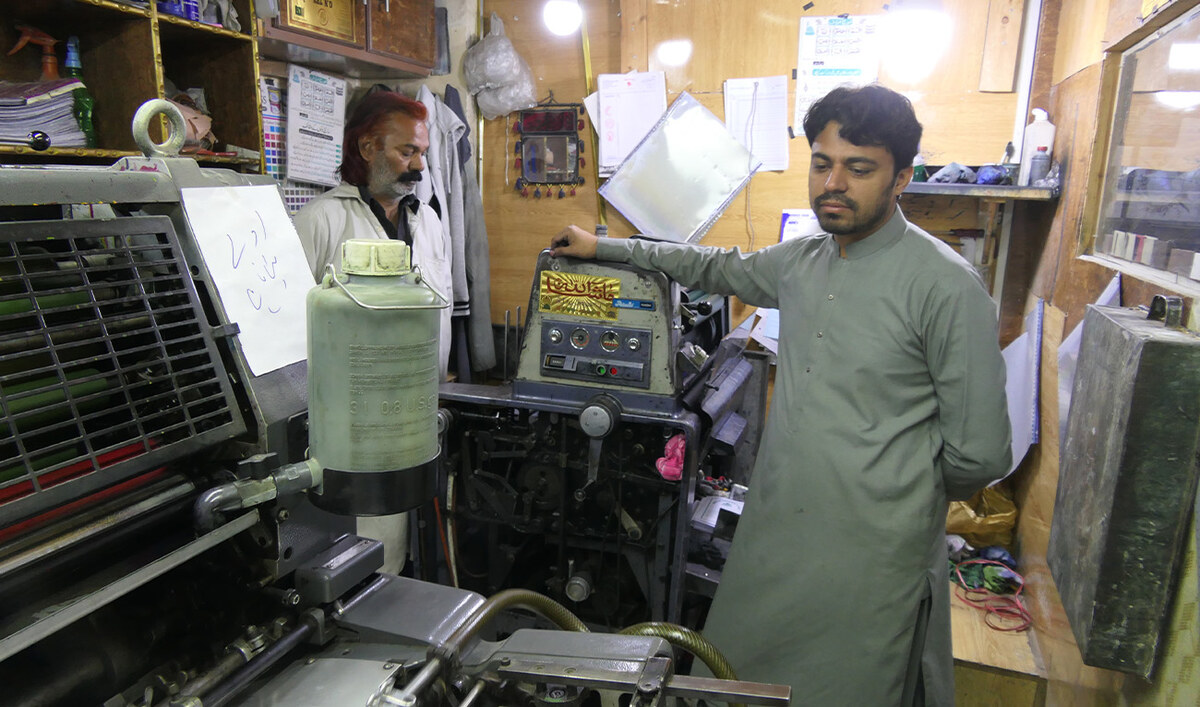


Kashif Riaz, a 32-year-old pressman, stands next to his printing machine in Quetta, Pakistan, on February 27, 2025. (AN Photo)

The shift makes sense in a country like Pakistan, which has more than 111 million active Internet users and 71 million social media users on websites like Facebook, WhatsApp, X, TikTok, YouTube and Instagram, according to independent Internet monitor DataReportal.

“Last year, we received just one order for the designing and printing of Ramadan calendars but for this season, we haven’t received any order,” Zakir Shah, who works at the Al-Subhan designing and printing firm in Quetta, told Arab News. 

“We used to consider Ramadan an earning season, we would wait for Ramadan calendar orders, but Internet and social media have impacted our business. Some designers and pressmen at this Quetta market hardly received a few [orders] this year, but the majority are sitting idle.”

Furqan Ahmed, a 42-year-old resident of Quetta, said he didn’t see people distributing the traditional calendars ahead of Ramadan this year. 

“We used to get Ramadan calendars from business communities and volunteers of religious seminaries standing outside mosques and at various spots of Quetta city, distributing Ramadan calendars,” he said as he stood on a busy street in the provincial capital of Balochistan. 


Inam-ul-Haque, a graphic designer, is seen designing a Ramadan calendar in Quetta, Pakistan, on February 27, 2025. (AN Photo)

“This year, I haven’t seen this practice because now we can receive Ramadan calendars on our smartphones and can check the fasting schedule on the Internet.”

Inam-ul-Haque, another graphic designer, 37, who didn’t receive any orders this Ramadan, said the culture of sharing Eid greeting cards had also declined in recent years:

“We used to send Eid greetings to our family and friends by posting Eid cards, but social media has replaced that culture.”


Pakistan offers Kyrgyzstan Arabian Sea access as two states sign 15 cooperation accords

Updated 05 December 2025
Follow

Pakistan offers Kyrgyzstan Arabian Sea access as two states sign 15 cooperation accords

  • Pakistan and Kyrgyzstan sign MOUs spanning trade, energy, agriculture, ports, education, security cooperation
  • Kyrgyz president is on first visit to Pakistan in 20 years as both sides push connectivity and CASA-1000 power links

ISLAMABAD: Pakistan on Thursday offered Kyrgyzstan the shortest and most economical route to the Arabian Sea as the two countries signed 15 agreements and memoranda of understanding aimed at boosting cooperation across trade, energy, agriculture, education, customs data-sharing and port logistics.

The accords were signed during a visit to Islamabad by President Sadyr Zhaparov, the first by a Kyrgyz head of state to Pakistan in two decades, and part of Islamabad’s renewed push to link South Asia with landlocked Central Asian economies through ports, power corridors and transport routes.

For Pakistan, Kyrgyzstan offers access to hydropower through CASA-1000, a $1.2 billion regional electricity transmission project designed to carry surplus summer electricity from Kyrgyzstan and Tajikistan through Afghanistan into Pakistan. For Bishkek, Pakistan provides overland access to warm-water ports on the Arabian Sea, creating a shorter commercial route to global markets.

“President Asif Ali Zardari has reiterated Pakistan’s readiness to offer Kyrgyzstan the shortest and most economical route to the Arabian Sea,” Radio Pakistan reported after Zhaparov met the Pakistani president. 

The two leaders also discussed expanding direct flights to deepen business, tourism and people-to-people ties.

Zardari welcomed Kyrgyzstan’s completion of its segment of the CASA-1000 project and “reaffirmed Pakistan’s commitment to completing its part of the project, which is now at an advanced stage,” the state broadcaster said. 

Zhaparov thanked Islamabad for supporting Bishkek’s candidacy for a non-permanent UN Security Council seat and invited Zardari to visit Kyrgyzstan at a time of his convenience. Both sides expressed satisfaction with progress under the Quadrilateral Traffic in Transit Agreement, designed to facilitate road movement between Pakistan, Kyrgyzstan, Kazakhstan and China.

Earlier, both governments exchanged 15 sectoral cooperation documents covering commerce, mining, geosciences, power, agriculture, youth programs, the exchange of convicted persons, customs electronic data systems and a sister-city linkage between Islamabad and Bishkek.

According to APP, the MOUs were signed by ministers representing foreign affairs, commerce, economy, energy, power, railways, interior, culture, health and tourism. Agreements also covered cooperation between Pakistan’s Foreign Service Academy and the Diplomatic Academy of Kyrgyzstan, as well as collaboration between universities, youth ministries and cultural institutions.

“Our present mutual trade, comprising of about $15–16 million will be enhanced to $200 million in the next two years,” Prime Minister Shehbaz Sharif said after the agreements were signed, calling them “a framework for structured, result-oriented engagement and closer institutional linkages.”

Sharif said Pakistan was ready to serve as a maritime outlet for the landlocked Central Asian republic, offering access to Karachi, Port Qasim and Gwadar to help Kyrgyz goods reach regional and global markets.