ROME: Nations cheered a last-gasp deal to map out funding to protect nature Thursday, breaking a deadlock at UN talks seen as a test for international cooperation in the face of geopolitical tensions.
Rich and developing countries hammered out a delicate compromise on raising and delivering the billions of dollars needed to protect species, overcoming stark divisions that had scuttled their previous meeting in Cali, Colombia, last year.
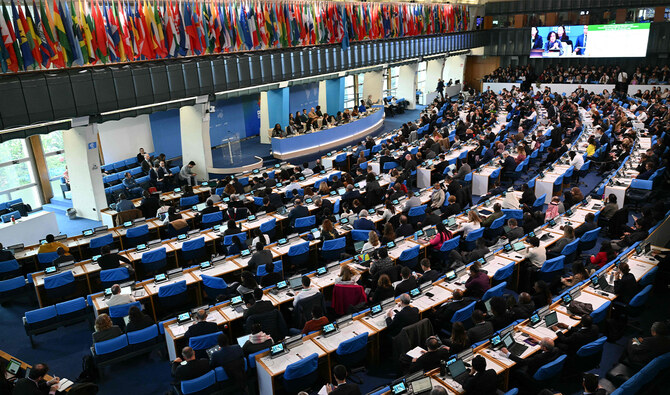
Delegates stood and clapped in an emotionally charged final meeting that saw key decisions adopted in the final minutes of the last day of rebooted negotiations at the UN’s Food and Agriculture Organization headquarters in Rome.
COP16 President Susana Muhamad of Colombia hailed the fact that countries worked together for a breakthrough, enabling progress “in this very fragmented and conflicted world.”
“This is something very beautiful because it’s around protecting life that we have come together, and there cannot be anything higher than that,” she added.
The decision comes more than two years after a landmark deal to halt the rampant destruction of nature this decade and protect the ecosystems and wildlife that humans rely on for food, climate regulation, and economic prosperity.
Scientists have warned that action is urgent.
A million species are threatened with extinction, while unsustainable farming and consumption destroys forests, depletes soils and spreads plastic pollution to even the most remote areas of the planet.
The agreement on Thursday is seen as crucial to giving impetus to the 2022 deal, which saw countries agree to protect 30 percent of the world’s land and seas.
Talks were also seen as a bellwether for international cooperation.
The meeting comes as countries face a range of challenges, from trade disputes and debt worries to the slashing of overseas aid — particularly by new US President Donald Trump.
Washington, which has not signed up to the UN’s Convention on Biological Diversity, sent no representatives to the meeting.
“Our efforts show that multilateralism can present hope at a time of geopolitical uncertainty,” said Steven Guilbeault, Canada’s Minister of Environment and Climate Change.
Ousseynou Kasse of Senegal, speaking on behalf of the Africa Group, also threw support behind global cooperation.
“We believe that this is the way that can save the world, and we must continue down this path,” he said.
Countries must be “accountable to our children, to the generations to come,” he added, saying he was thinking of what he would tell his own son when he returns home.
“I will give him good news that we have a compromise, we have a deal.”
The failure to finalize an agreement in Cali was the first in a string of disappointing outcomes at environmental summits last year.
A climate finance deal at COP29 in Azerbaijan in November was slammed by developing countries, while separate negotiations about desertification and plastic pollution stalled in December.
Muhamad, who has resigned as Colombia’s environment minister but stayed on to serve until after the Rome conference, was given a standing ovation as the talks drew to a close in the early hours of Friday.
Countries have already agreed a goal to deliver $200 billion a year in finance for nature by 2030, including $30 billion a year from wealthier countries to poorer ones.
The total for 2022 was about $15 billion, according to the OECD.
The main debate in Cali and later Rome was over developing countries’ calls for the creation of a specific biodiversity fund, which has seen pushback from the EU and other wealthy nations, who have argued against multiple funds.
Thursday saw intense closed-door talks based on a “compromise attempt” text that Brazil put forward on behalf of the BRICS country bloc that includes Russia, China and India.
The agreement reached in Rome leaves it to the 2028 COP to decide whether to set up a specific new fund under the UN biodiversity process, or to name a potentially reformed existing fund to play that role.
Georgina Chandler, Head of Policy and Campaigns at the Zoological Society of London, said the finance roadmap was a “key milestone,” but stressed that money is needed urgently.
Other decisions sought to bolster monitoring to ensure countries are held accountable for their progress toward meeting biodiversity targets.
One achievement in Cali was the creation of a new fund to share profits from digitally sequenced genetic data from plants and animals with the communities they come from.
The fund, officially launched on Tuesday, is designed for large firms to contribute a portion of their income from developing things like medicine and cosmetics using this data.
Delegates in Cali also approved the creation of a permanent body to represent the interests of Indigenous people.


![]()


World agrees hard-fought nature funding plan at UN talks
Short Url
https://arab.news/rv2x4
World agrees hard-fought nature funding plan at UN talks
- The agreement on Thursday is seen as crucial to giving impetus to the 2022 deal, which saw countries agree to protect 30 percent of the world’s land and seas
- Countries have already agreed to deliver $200 billion a year in finance for nature by 2030, including $30 billion a year from wealthier countries to poorer ones


Trump to remove Vietnam from restricted tech list: Hanoi
HANOI: US President Donald Trump told Vietnam’s top leader To Lam he would “instruct the relevant agencies” to remove the country from a list restricted from accessing advanced US technologies, Vietnam’s government announced Saturday.
The two leaders met in person for the first time at the White House on Friday, after Lam attended the inaugural meeting of Trump’s “Board of Peace” in Washington.
“Donald Trump said he would instruct the relevant agencies to soon remove Vietnam from the strategic export control list,” Hanoi’s Government News website said.
The two countries were locked in protracted trade negotiations when the US Supreme Court ruled many of Trump’s sweeping tariffs were illegal.
Three Vietnamese airlines announced nearly $37 billion in purchases this week, in a series of contracts signed with US aerospace companies.
Fledgling airline Sun PhuQuoc Airways placed an order for 40 of Boeing’s 787 Dreamliners, a long-haul aircraft, with an estimated total value of $22.5 billion, while national carrier Vietnam Airlines placed an $8.1 billion order for around 50 Boeing 737-8 aircraft.
When Trump announced his “Liberation Day” tariffs in April, Vietnam had the third-largest trade surplus with the US of any country after China and Mexico, and was targeted with one of the highest rates in Trump’s tariff blitz.
But in July, Hanoi secured a minimum 20 percent tariff with Washington, down from more than 40 percent, in return for opening its market to US products including cars.
Trump signed off on a global 10-percent tariff on Friday on all countries hours after the Supreme Court ruled many of his levies on imports were illegal.
The two leaders met in person for the first time at the White House on Friday, after Lam attended the inaugural meeting of Trump’s “Board of Peace” in Washington.
“Donald Trump said he would instruct the relevant agencies to soon remove Vietnam from the strategic export control list,” Hanoi’s Government News website said.
The two countries were locked in protracted trade negotiations when the US Supreme Court ruled many of Trump’s sweeping tariffs were illegal.
Three Vietnamese airlines announced nearly $37 billion in purchases this week, in a series of contracts signed with US aerospace companies.
Fledgling airline Sun PhuQuoc Airways placed an order for 40 of Boeing’s 787 Dreamliners, a long-haul aircraft, with an estimated total value of $22.5 billion, while national carrier Vietnam Airlines placed an $8.1 billion order for around 50 Boeing 737-8 aircraft.
When Trump announced his “Liberation Day” tariffs in April, Vietnam had the third-largest trade surplus with the US of any country after China and Mexico, and was targeted with one of the highest rates in Trump’s tariff blitz.
But in July, Hanoi secured a minimum 20 percent tariff with Washington, down from more than 40 percent, in return for opening its market to US products including cars.
Trump signed off on a global 10-percent tariff on Friday on all countries hours after the Supreme Court ruled many of his levies on imports were illegal.
Latest updates


Recommended


© 2026 SAUDI RESEARCH & PUBLISHING COMPANY, All Rights Reserved And subject to Terms of Use Agreement.