GENEVA: Sudan is facing the abyss and potentially hundreds of thousands of deaths unless the devastating war in the country ends and aid pours in, the United Nations warned Thursday.
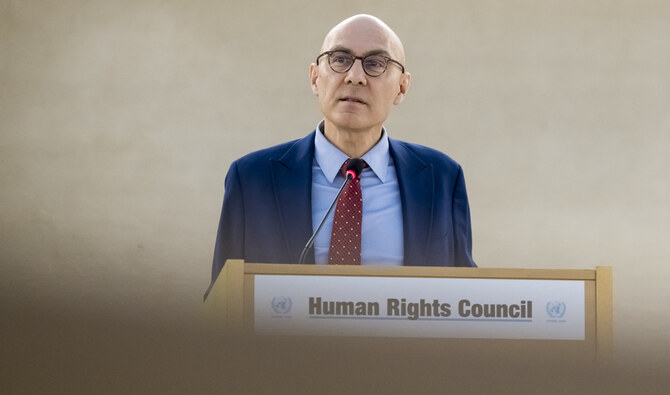
UN human rights chief Volker Turk painted a bleak outlook for Sudan, where famine has already taken hold and millions have fled their homes amid intense fighting between rival forces.
Since April 2023, Sudan has been locked in a brutal conflict between army chief Abdel Fattah Al-Burhan and his former deputy Mohamed Hamdan Dagalo, who leads the paramilitary Rapid Support Forces (RSF).
“Sudan is a powder keg, on the verge of a further explosion into chaos, and at increasing risk of atrocity crimes and mass deaths from famine,” Turk warned the UN Human Rights Council.
He called the country “the world’s largest humanitarian catastrophe.”
“We are looking into the abyss. Humanitarian agencies warn that without action to end the war, deliver emergency aid, and get agriculture back on its feet, hundreds of thousands of people could die.”
Turk said more than 600,000 people were “on the brink of starvation,” with famine reported to have taken hold in five areas, including the Zamzam displacement camp in North Darfur.
Turk said five more areas could face famine in the next three months, while a further 17 are considered at risk.
He said an estimated 8.8 million people had been forced from their homes within Sudan, while 3.5 million more have fled across borders.
“This is the biggest displacement crisis in the world,” he said.
“Some 30.4 million people need assistance, from health care to food and other forms of humanitarian support,” he said.
Presenting his annual report on the human rights situation in Sudan, Turk said some of the acts it documented may constitute war crimes and other atrocity crimes.
Turk said the Sudanese people had endured “unfathomable suffering and pain” since the conflict began, “with no peaceful solution in sight.”
Responding to the report, Sudanese justice minister Muawiya Osman blamed the RSF for starting the war and accused them of having “forced people out of their regions, humiliating them, and trying to cleanse specific regions from their original populations, just like West Darfur.”
He accused the RSF of “blocking humanitarian deliveries” and said the government was committed to “just peace and stability across the country, to address the needs of the Sudanese people, maintain their dignity and end the suffering.”
However, Adama Dieng, the African Union’s special envoy on the prevention of genocide and other mass atrocities, said extreme violence against civilians — by both sides in the conflict — was widespread.
“The war has been characterised by targeting of civilians, including executions, abduction, torture, sexual violence, slavery and sexual slavery, looting of private property, indiscriminate bombardment,” Dieng told the Human Rights Council in a video statement.
“Sexual assault has reached such proportions that there have been reports of women committing mass suicide as the only way to avoid rape.”
Ghana, speaking for the African group, called for a “single, coordinated international effort” to resolve the crisis, but said the “utmost priority is to silence the guns,” paving the way for uninterrupted aid flows.
France said both parties were refusing to respect the fundamental rules of international humanitarian and human rights law.
Britain said the conflict was “wholly unnecessary” and said the perpetrators of abuses needed to be brought to account.

Sudan facing ‘abyss’ unless war ends: UN
https://arab.news/v5ebp
Sudan facing ‘abyss’ unless war ends: UN
- Since April 2023, Sudan has been locked in a brutal conflict between army chief Abdel Fattah Al-Burhan and his former deputy Mohamed Hamdan Dagalo
Saad Hariri pledges to contest May election
- Beirut rally draws large crowds on anniversary of his father’s assassination
BEIRUT: Lebanon’s former Prime Minister Saad Hariri announced on Saturday that his movement, which represents the majority of Lebanon’s Sunni community, would take part in upcoming parliamentary elections scheduled for May.
The Future Movement had suspended its political activities in 2022.
Hariri was addressing a large gathering of Future Movement supporters as Lebanon marked the 21st anniversary of the assassination of his father and former Prime Minister Rafik Hariri, at Martyrs’ Square in front of his tomb.
He said his movement remained committed to the approach of “moderation.”
A minute’s silence was observed by the crowd in Martyrs’ Square at the exact time when, in 2005, a suicide truck carrying about 1,000 kg of explosives detonated along Beirut’s seaside road as Rafik Hariri’s motorcade passed, killing him along with 21 others, including members of his security guards and civilians, and injuring 200 people.
Four members of Hezbollah were accused of carrying out the assassination and were tried in absentia by the Special Tribunal for Lebanon.
The crowd waved Lebanese flags and banners of the Future Movement as they awaited Saad Hariri, who had returned to Beirut from the UAE, where he resides, specifically to commemorate the anniversary, as has been an annual tradition.
Hariri said that “after 21 years, the supporters of Hariri’s approach are still many,” denouncing the “rumors and intimidation” directed at him.
He added: “Moderation is not hesitation … and patience is not weakness. Rafik Hariri’s project is not a dream that will fade. He was the model of a statesman who believed, until martyrdom, that ‘no one is greater than their country.’ The proof is his enduring place in the minds, hearts and consciences of the Lebanese people.”
Hariri said he chose to withdraw from political life after “it became required that we cover up failure and compromise the state, so we said no and chose to step aside — because politics at the expense of the country’s dignity and the project of the state has no meaning.”
He said: “The Lebanese are weary, and after years of wars, divisions, alignments and armed bastions, they deserve a normal country with one constitution, one army, and one legitimate authority over weapons — because Lebanon is one and will remain one. Notions of division have collapsed in the face of reality, history and geography, and the illusions of annexation and hegemony have fallen with those who pursued them, who ultimately fled.”
Hariri said the Future Movement’s project is “One Lebanon, Lebanon first — a Lebanon that will neither slide back into sectarian strife or internal fighting, nor be allowed to do so.”
He added that the Taif Agreement is “the solution and must be implemented in full,” arguing that “political factions have treated it selectively by demanding only what suits them — leaving the agreement unfulfilled and the country’s crises unresolved.”
He said: “When we call for the full implementation of the Taif Agreement, we mean: weapons exclusively in the hands of the state, administrative decentralization, the abolition of political sectarianism, the establishment of a senate and full implementation of the truce agreement. All of this must be implemented — fully and immediately — so we can overcome our chronic problems and crises together.
“Harirism will continue to support any Arab rapprochement, and reject any Arab discord. Those who seek to sow discord between the Gulf and Arab countries will harm only themselves and their reputation.
“We want to maintain the best possible relations with all Arab countries, starting with our closest neighbor, Syria — the new Syria, the free Syria that has rid itself of the criminal and tyrannical regime that devastated it and Lebanon, and spread its poison in the Arab world.”
Hariri said he saluted “the efforts of unification, stabilization and reconstruction led by Syrian President Ahmad Al-Sharaa.”
When asked about the Future Movement’s participation in parliamentary elections following his withdrawal from politics, he said: “Tell me when parliamentary elections will be held, and I will tell you what the Future Movement will do. I promise you that, when the elections take place, they will hear our voices, and they will count our votes.”
The US Embassy in Lebanon shared a post announcing that Ambassador Michel Issa laid a wreath at the grave of Rafik Hariri.
Hariri’s legacy “to forge peace and prosperity continues to resonate years later with renewed significance,” the embassy said.


