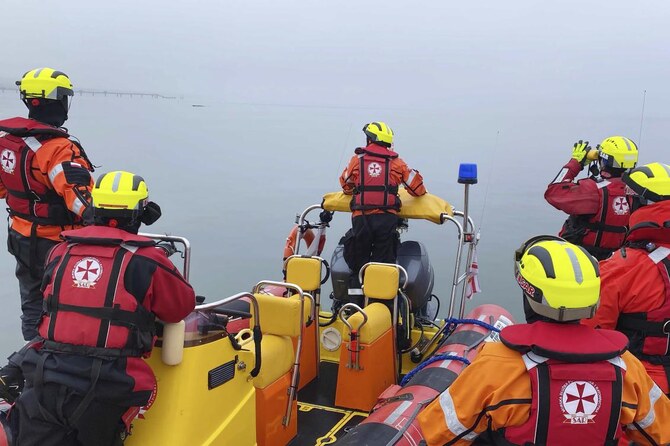
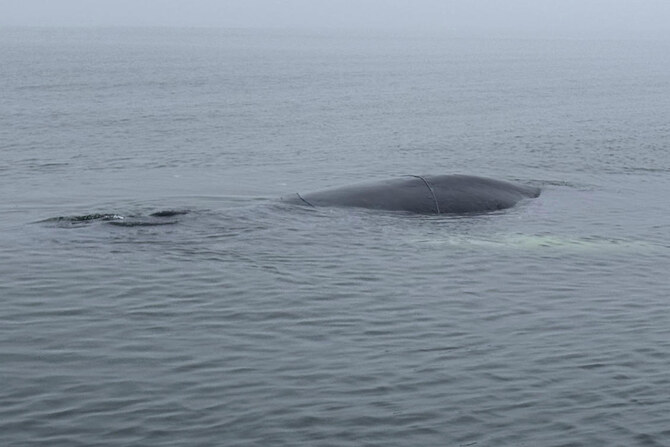
WARSAW: Teams of sea rescuers and wildlife experts on Wednesday successfully freed a whale that got caught in fishing nets near a popular Baltic Sea resort in Poland.
It took about an hour for the rescuers to cut and remove the nets and allow the whale to swim into the open sea, close to the popular summer resort and beach in Miedzyzdroje, where the stranded animal was spotted in the morning.
Konrad Wrzecionkowski from WWF Poland, a conservation organization, said the whale made a “great and positive impression” on him but the action was potentially dangerous for the rescuers and was very stressful.
“You have to approach these animals with a lot of respect and we knew that if it chose to wave its tail, we would all find ourselves in the water,” Wrzecionkowski told The Associated Press.
“The situation was very stressful for him, but with time, when the nets were getting looser, he seemed to understand that we were trying to help him and the untangling became easier. And then he swam off into the sea,” Wrzecionkowski said.
He said the boat he was in was some 3 meters (10 feet) long and the animal was at least twice as long. The rescuers used boathooks on long poles, rather than knives, to loosen and remove the nets, rather than cutting them with knives, in order to avoid harming the animal.
Whales normally live in the open waters of oceans, but sometimes individual animals swim from the Atlantic Ocean into the Baltic Sea through the Danish Straits.
The rescuers hope the whale will find its way back to the Atlantic because the Baltic is not a suitable environment for whales.


![]()
![]()

A whale caught in fishing nets has been freed off Poland’s Baltic coast
Short Url
https://arab.news/ptyvx
A whale caught in fishing nets has been freed off Poland’s Baltic coast
- It took about an hour for the rescuers to cut and remove the nets and allow the whale to swim into the open
- The rescuers used boathooks on long poles, rather than knives, to loosen and remove the nets


Latest updates



© 2026 SAUDI RESEARCH & PUBLISHING COMPANY, All Rights Reserved And subject to Terms of Use Agreement.