BERLIN: Left-wing parties in the German parliament reacted with consternation on Wednesday after the conservatives, fresh from their election win, demanded more scrutiny of a list of government-funded projects.
The CDU/CSU alliance of Friedrich Merz, which won Sunday’s election with 28.5 percent of the vote, submitted a set of written questions to the outgoing government of Chancellor Olaf Scholz on Monday.
The hundreds of questions demanded more clarity on the funding of campaign groups such as Omas Gegen Rechts (“Grannies Against the Right“), Greenpeace and other environmental organizations, and a wide range of other NGOs.
The questions were grouped under the heading “political neutrality of state-funded organizations.”
The party said it had tabled them in response to recent “protests against the CDU in Germany, some of which were organized or supported by non-profit or state-funded organizations.”
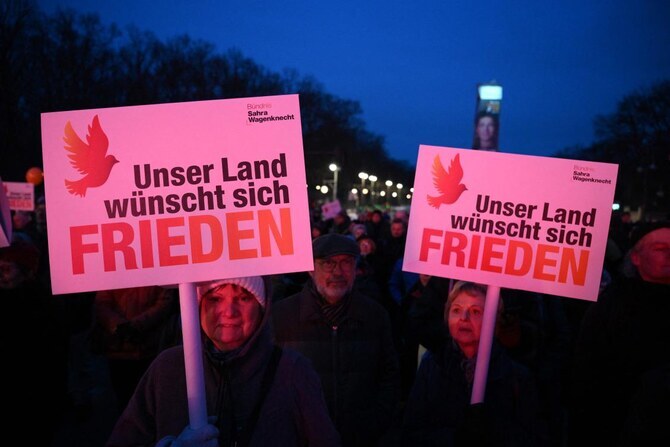
Thousands of people took part in demonstrations after the CDU in January controversially accepted the support of the far-right AfD to push through a parliamentary vote on migration.
Lars Klingbeil of Scholz’s Social Democrats (SPD) on Wednesday accused the CDU/CSU of targeting “precisely those organizations that protect our democracy, which it is denigrating and calling into question.”
Following the election on Sunday, Merz has reached out to the center-left SPD with hopes of forming a coalition.
But Klingbeil, newly elected as head of the SPD parliamentary group, accused the conservatives of “foul play” and urged them to “quickly reflect” on whether they wanted to pursue the questions.
Other parties have also reacted angrily to the move, with the far-left Die Linke calling it “an unprecedented attack on democratic civil society.”
“This is reminiscent of authoritarian states and, given that the CDU/CSU will in all likelihood lead the next federal government, is extremely worrying,” Die Linke’s Clara Buenger said.
Sergey Lagodinsky, a member of the European Parliament for the Greens, said it was a “very bad omen for the next four years” and “almost Trump-like.”
US President Donald Trump has enlisted tech billionaire Elon Musk to lead federal cost-cutting efforts under the so-called Department of Government Efficiency (DOGE).
Musk has spearheaded program and personnel cuts across a wide range of federal agencies and departments, including the US Agency for International Development (USAID).
Matthias Middelberg, a spokesman for the CDU, said public funding “must not be used for party political purposes.”
No organization should be “eligible for support if it is used to influence political decision-making and public opinion in line with the organization’s own views,” he said.


![]()

Anger as German conservatives question NGO funding
Short Url
https://arab.news/b3qfn
Anger as German conservatives question NGO funding
- The hundreds of questions demanded more clarity on the funding of campaign groups such as “Grannies Against the Right,” Greenpeace and other organizations
- The questions were grouped under the heading “political neutrality of state-funded organizations“


Latest updates



Recommended


© 2026 SAUDI RESEARCH & PUBLISHING COMPANY, All Rights Reserved And subject to Terms of Use Agreement.