

Saudi envoy gives travel documents to 30 Pakistanis invited as state guests for Umrah

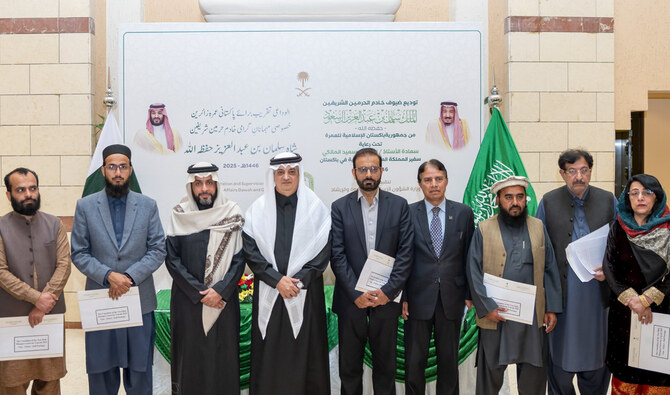
In this handout photo, released by the Royal Embassy of Saudi Arabia on February 26, 2025, Saudi Ambassador to Pakistan Nawaf bin Said Al-Malki (4L) gestures for a group photograph with Pakistani pilgrims, invited by the Kingdom as state guests to perform Umrah this year, during a ceremony at the Saudi Embassy in Islamabad. (Photo courtesy: X/@KSAembassyPK)
Short Url
Updated 26 February 2025
Follow

Saudi envoy gives travel documents to 30 Pakistanis invited as state guests for Umrah

  • Saudi Arabia’s King Salman last year approved hosting of 1,000 pilgrims from 66 countries as part of a special program 
  • Saudi Arabia’s government to supervise guests’ travel, lodging and logistical arrangements in Makkah and Madinah

ISLAMABAD: Saudi Ambassador to Pakistan Nawaf bin Said Al-Malki on Wednesday formally handed over travel documents to 30 Pakistani pilgrims invited by the Kingdom as state guests to perform Umrah this year, state-run media reported, vowing to facilitate them during their journey. 
Saudi Arabia’s King Salman last year approved the hosting of 1,000 pilgrims from 66 countries to perform Umrah as part of the Custodian of the Two Holy Mosques Program for Hajj, Umrah, and Visit. The pilgrims will be hosted in four groups during the current Islamic year, which ends in the final week of June 2025.
At a ceremony held in Islamabad, Malki expressed the Kingdom’s “deep commitment” to facilitate the pilgrims, underscoring the strong fraternal ties between Saudi Arabia and Pakistan, state-run Associated Press of Pakistan (APP) reported. 
“These guests of the Custodian of the Two Holy Mosques will have the opportunity to perform Umrah with all necessary arrangements i.e. travel, lodging, and logistical support during their stay in the holy cities of Makkah and Madinah under the supervision of the Saudi Ministry of Islamic Affairs, Dawah, and Guidance,” APP said. 
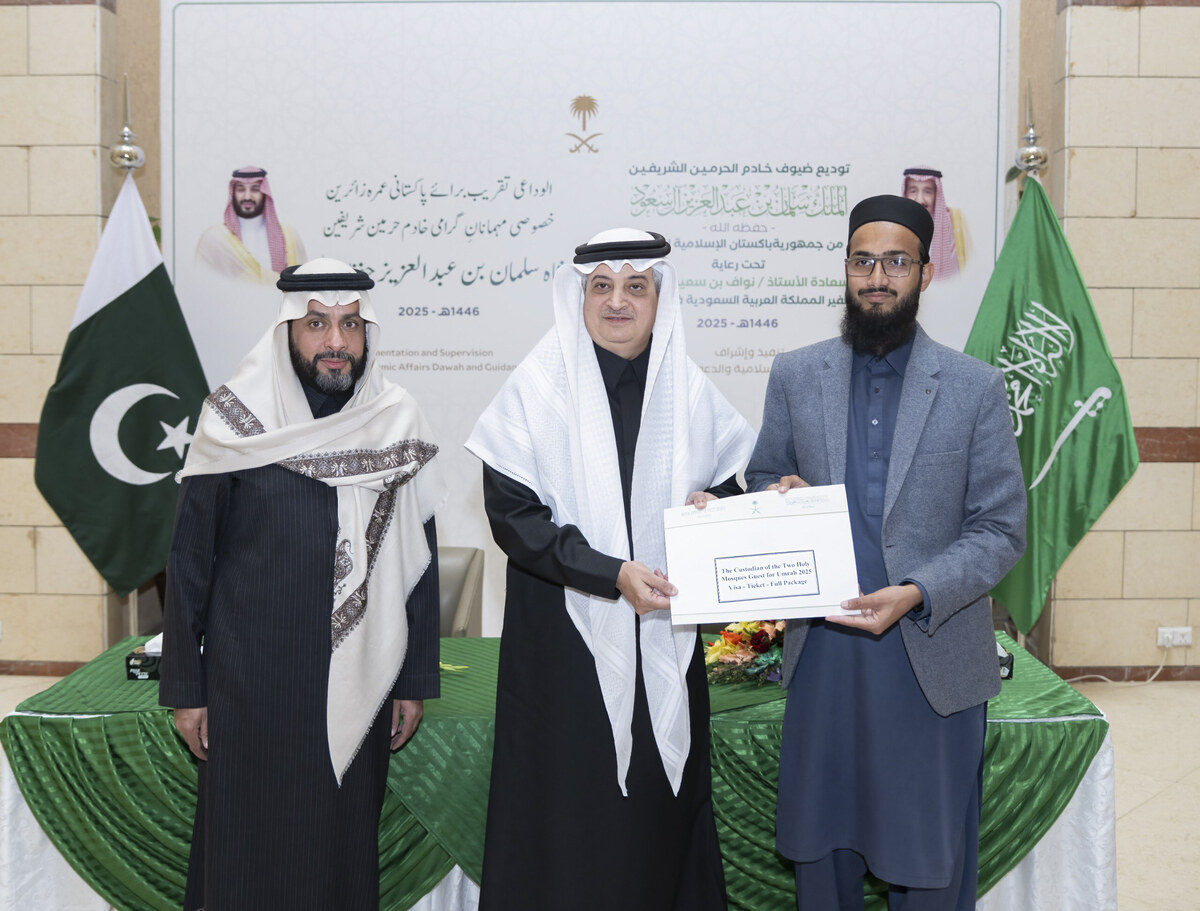


In this handout photo, released by the Royal Embassy of Saudi Arabia on February 26, 2025, Saudi Ambassador to Pakistan Nawaf bin Said Al-Malki (C) hands over the documents to a Pakistani pilgrim, invited by the Kingdom as state guests to perform Umrah this year, during a ceremony at the Saudi Embassy in Islamabad. (Photo courtesy: X/@KSAembassyPK)

The Pakistani beneficiaries of the program expressed gratitude to King Salman and the Saudi government for their hospitality.
The APP said thousands of Pakistani citizens have benefitted from similar programs over the years, reflecting the deep-rooted religious and historical ties between the two nations.
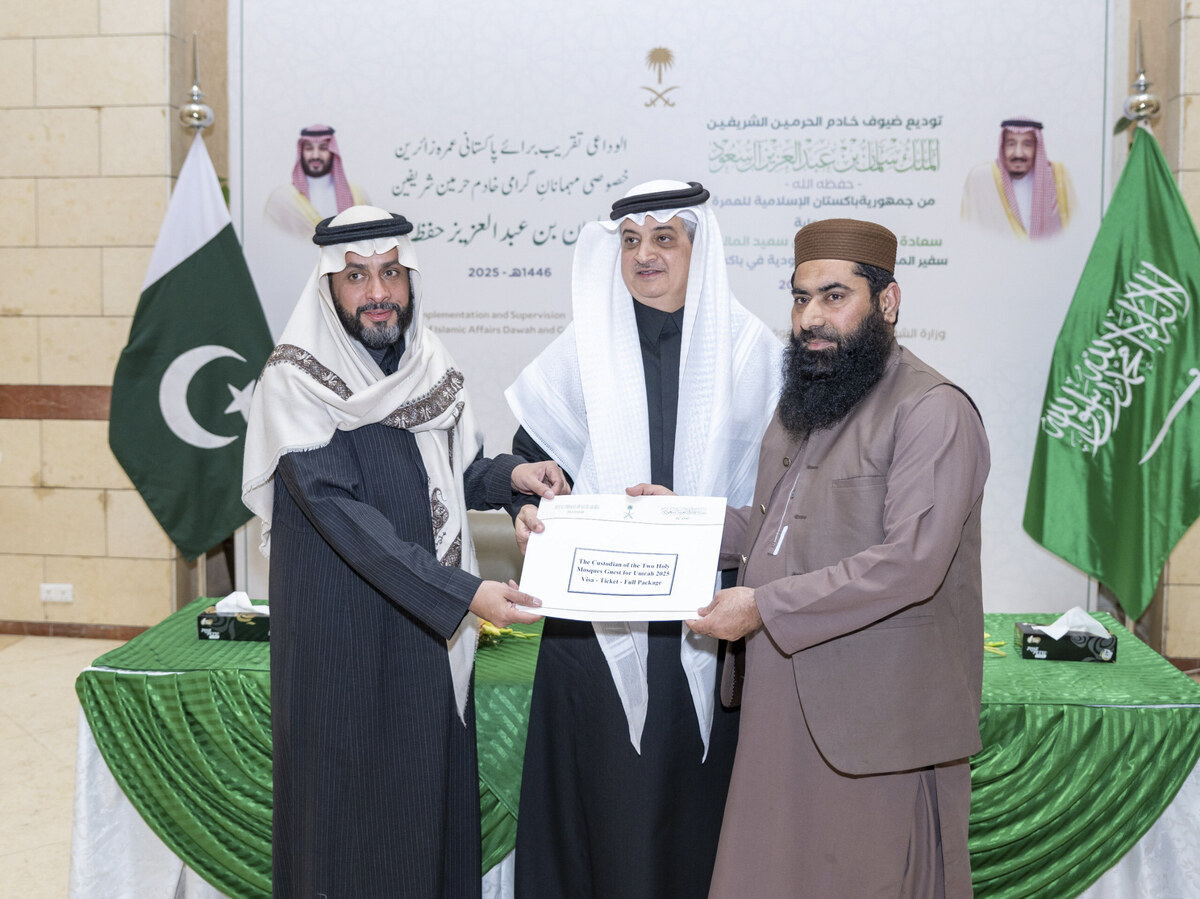


In this handout photo, released by the Royal Embassy of Saudi Arabia on February 26, 2025, Saudi Ambassador to Pakistan Nawaf bin Said Al-Malki (C) hands over the documents to a Pakistani pilgrim, invited by the Kingdom as state guests to perform Umrah this year, during a ceremony at the Saudi Embassy in Islamabad. (Photo courtesy: X/@KSAembassyPK)

“This latest gesture reaffirms Saudi Arabia’s unwavering commitment to facilitating the spiritual journeys of Muslims worldwide, particularly those from Pakistan, a country with one of the largest contingents of Umrah and Hajj pilgrims annually,” the state-run media said. 
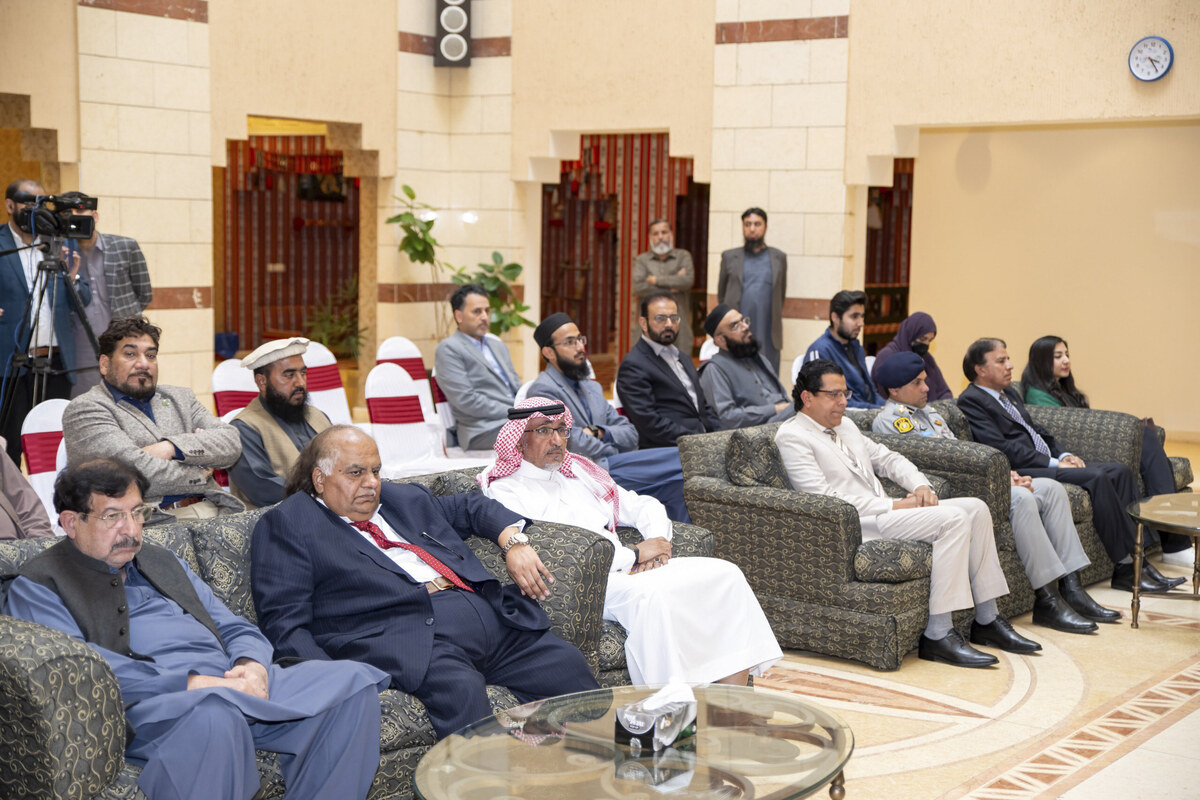


In this handout photo, released by the Royal Embassy of Saudi Arabia on February 26, 2025, Pakistani pilgrim, invited by the Kingdom as state guests to perform Umrah this year, attend a ceremony at the Saudi Embassy in Islamabad. (Photo courtesy: X/@KSAembassyPK)

Thousands of Pakistanis travel to Saudi Arabia every year to perform the voluntary Umrah pilgrimage, visiting holy Islamic places of worship in Makkah and Madinah.



Pakistani minister urges universal rights, dialogue at UN civilizations forum in Riyadh

Updated 14 sec ago
Follow

Pakistani minister urges universal rights, dialogue at UN civilizations forum in Riyadh

  • Musadik Malik warns selective application of human rights and weakening multilateralism risk deepening global divisions
  • The minister also mentions water rights and urges equitable sharing by upper riparian states to support regional stability

ISLAMABAD: Pakistan’s climate change minister said principles of justice and human rights must be applied universally, according to an official statement released on Monday, warning against selective enforcement as he addressed a United Nations forum in Saudi Arabia focused on dialogue among civilizations.

The remarks came at the 11th Global Forum of the United Nations Alliance of Civilizations (UNAOC), held in Riyadh to mark the body’s 20th anniversary. The forum brings together political leaders, policymakers, and civil society groups to promote dialogue, mutual understanding, and cooperation across cultures and religions.

Its latest edition comes at a time of growing geopolitical fragmentation and conflict.

“I am firmly committed to women’s rights, minority rights, environmental rights, and children’s rights,” Musadik Malik said while addressing the gathering. “These rights are fundamental and non-negotiable.”

He said the global order was increasingly marked by weakening multilateralism, rising conflicts, and declining international funding for development and environmental priorities, cautioning that unilateral actions were replacing collective approaches with consequences for global peace and justice.

Malik questioned what he described as the selective application of human rights principles, drawing attention to the situations in Palestine and Kashmir, and said the rights of people in those regions must be recognized and protected in line with international norms.

The minister also highlighted water rights as a growing source of regional tension, emphasizing the responsibility of upper riparian states to ensure equitable and just sharing of water resources with downstream countries to support stability and sustainable development.

His statement comes months after India said unilaterally it was holding the Indus Waters Treaty “in abeyance,” a move described as illegal by the administration in Islamabad and as “an act of war.”

The 1960 agreement between India and Pakistan, brokered by the World Bank, divides the rivers of the Indus basin between the two countries and sets rules for how they can use and manage shared water resources to avoid conflict.

Malik said the UNAOC’s 20th anniversary was a timely reminder of the need to recommit to dialogue, peace, and mutual respect in an increasingly divided world.