

Malaysia yet to finalise MH370 search contract, as ship heads to new zone

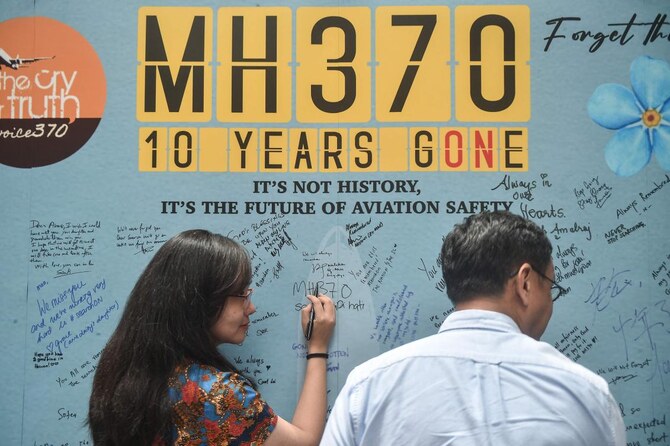
A woman writes a message during an event held by relatives of the passengers and supporters to mark the 10th year since the Malaysia Airlines flight MH370 carrying 239 people disappeared from radar screens on March 8, 2014 while en route from Kuala Lumpur to Beijing, in Subang Jaya on March 3, 2024. (AFP)
Short Url
Updated 26 February 2025
Follow

Malaysia yet to finalise MH370 search contract, as ship heads to new zone

KUALA LUMPUR: A ship that will hunt for missing Malaysia Airlines Flight MH370 has deployed to its Indian Ocean search zone, according to Malaysia's transport minister and ship tracking data, raising hopes of solving one of aviation's greatest mysteries.
In December, Malaysia agreed to resume the search for the Boeing 777 that was carrying 227 passengers and 12 crew when it vanished en route from Kuala Lumpur to Beijing on March 8, 2014.
Malaysia has not yet signed off on the contract to search the seabed for wreckage, however, casting uncertainty over whether a search has begun.
Contacted by Reuters, U.S. exploration firm Ocean Infinity, which conducted the last search for the plane that ended in 2018, said it had no information to provide at this stage.
Malaysia had not yet signed the contract with Ocean Infinity, Transport Minister Anthony Loke said on Tuesday, but he welcomed the company's "proactiveness" to deploy its ships to that area to begin the search.
"Since Ocean Infinity already started to mobilise their ships, of course we welcome it because we have given the principle approval for the search to resume and just need to finalise the contract," Loke told a press conference.
The search would not be open-ended, however, he warned.
"It is not indefinite; there is a certain timeframe given for the contract. These are the details that we need to finalise before we sign," Loke added.
Refinitiv ship tracking data shows one of Ocean Infinity's ships, Armada 78 06, began tracking on Sunday a part of the Southern Indian Ocean, about 2,000 km (1,200 miles) off Australia's west coast.
Ocean Infinity's proposal to resume the search will see it expand the previous search area by 15,000 sq km (5,790 sq miles) in an effort lasting 18 months, with the period from January to April offering the best window, Malaysia said in December.
No precise location of the new search area was given at the time.
Ocean Infinity was "very confident that the current search area is more credible ... This is the area that they have missed in the past," Loke added.

DECADE-LONG HUNT
Malaysia engaged Ocean Infinity in 2018 to search in the southern Indian Ocean, but two attempts failed.
They followed an underwater search by Australia, China and Malaysia over an area of 120,000 sq km (46,332 sq mile) of the southern Indian Ocean, based on records of automatic connections between an Inmarsat satellite and the aircraft.
MH370's last transmission was about 40 minutes after it took off from Kuala Lumpur for the Chinese capital. The pilots signed off as the plane entered Vietnamese air space over the Gulf of Thailand and soon after its transponder was turned off.
Military radar showed the plane left its flight path to fly back over northern Malaysia and then out into the Andaman Sea before turning south, when all contact was lost.
Debris, some confirmed and some believed to be from the aircraft, has since washed up along the coast of Africa and on islands in the Indian Ocean.
Victims' relatives have demanded compensation from Malaysia Airlines, Boeing, aircraft engine maker Rolls-Royce and the Allianz insurance group, among others.
A 495-page report into the disappearance in 2018 said the Boeing 777's controls were probably deliberately manipulated to go off course, but investigators could not determine who was responsible and stopped short of offering a conclusion on what happened, saying that depended on finding the wreckage.
Investigators have said there was nothing suspicious in the background, financial affairs, training and mental health of both the captain and co-pilot.


Afghan government says Pakistan strikes Kabul and border provinces

Updated 4 min 47 sec ago
Follow

Afghan government says Pakistan strikes Kabul and border provinces

  • A Pakistani security official, speaking on condition of anonymity, confirmed that Pakistan struck overnight
  • Islamabad last month launched a wave of air strikes on its neighbor, an operation it says is targeting militancy

KABUL: Afghan authorities said on Friday that Pakistan had carried out new strikes on Kabul and border provinces, killing four people in the capital.

A Pakistani security official, speaking on condition of anonymity, confirmed that Pakistan struck overnight, adding their forces targeted the Pakistani Taliban militant group, known as TTP.

Islamabad last month launched a wave of air strikes on its neighbor, an operation it says is targeting militancy following growing attacks in Pakistan.

But the Taliban government has denied any involvement or the use of Afghan territory for militancy.

Khalil Zadran, the spokesman for Kabul police, said four people had been killed and 15 wounded in the bombardment that hit homes in the capital, with women and children among the victims.

Taliban government spokesman Zabihullah Mujahid posted on X that Pakistani strikes also hit the southern province of Kandahar, as well as eastern Paktia and Paktika, which border Pakistan.

In Kandahar, which is home to the administration’s supreme leader Hibatullah Akhundzada, air strikes hit a fuel depot for airline Kam Air, near the airport.

This company supplies fuel to civilian airlines and United Nations aircraft.

Pakistan insists it has not killed any civilians in the conflict. Casualty claims from both sides are difficult to verify independently.

Afghan and Pakistani forces have also clashed repeatedly at the border in recent weeks, hampering trade and forcing nearby residents to leave their homes.

‘Open war’

The United Nations’ mission in Afghanistan (UNAMA) has said that 56 civilians have been killed in Afghanistan, including 24 children, by Pakistani military operations between February 26 and March 5.

About 115,000 people were forced to leave their homes, according to the UN refugee agency.

Fighting between the two countries intensified on February 26, when Afghanistan launched an offensive along the frontier, in retaliation for earlier Pakistani air strikes targeting the TTP.

Pakistan then declared “open war” against the Taliban authorities, bombing the capital, Kabul, on February 27.

Since then, clashes have increased in border regions, including overnight Wednesday to Thursday that the Afghan authorities said killed four members of the same family in Khost province.

The Taliban government said on Thursday that four members of the same family, including two children, were killed by Pakistani artillery and mortar fire in eastern Afghanistan.

Seven people had been killed in Afghanistan since Tuesday as a result of cross-border clashes between the two sides, according to the authorities in Kabul.

Deputy government spokesman Hamdullah Fitrat said the latest deaths happened early Thursday in the village of Sadqo in Khost province, accusing Pakistan of deliberately targeting civilian homes and nomads’ tents.