Israelis mass for funeral of Bibas hostages killed in Gaza

1 / 3
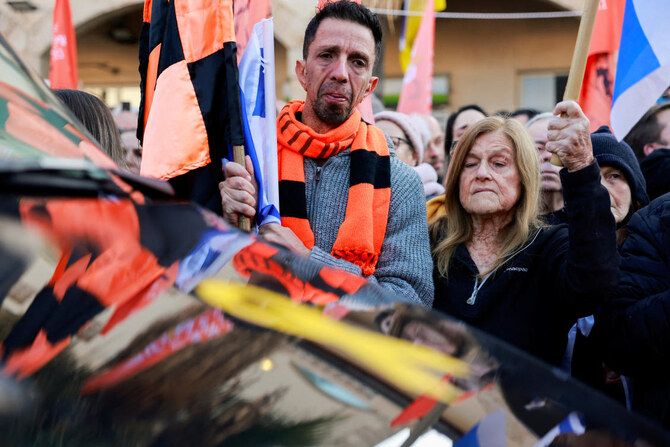
Israelis react during a funeral procession for Shiri, 32, and her two children Kfir, 9 months old, and Ariel, 4, of the Bibas family, who were kidnapped from their home in Kibbutz Nir Oz during the deadly October 7, 2023 attack by Hamas and then killed in Gaza, in Rishon Le'Zion, Israel February 26, 2025. (Reuters)
2 / 3
Israelis gather as a convoy carrying the coffins of Shiri, 32, and her two children Kfir, 9 Months Old, and Ariel, 4, of the Bibas family, who were kidnapped from their home in Kibbutz Nir Oz during the deadly October 7, 2023 attack by Hamas and then killed in Gaza, makes its way to be buried as part of their funeral procession in Rishon Le'Zion, Israel February 26, 2025. (Reuters)
3 / 3
Israelis reacts during a funeral procession for Shiri, 32, and her two children Kfir, 9 months old, and Ariel, 4, of the Bibas family, who were kidnapped from their home in Kibbutz Nir Oz during the deadly October 7, 2023 attack by Hamas and then killed in Gaza, in Rishon Le'Zion, Israel February 26, 2025. (Reuters)
Short Url
Updated 26 February 2025
Follow

Israelis mass for funeral of Bibas hostages killed in Gaza

  • Thousands line route to kibbutz Nir Oz, where Bibas family lived
  • Bodies of Shiri Bibas and her children returned to Israel last week by Hamas

RISHON LE’ZION: Thousands of mourners, carrying flags and orange balloons, gathered Wednesday for the funeral procession of Shiri Bibas and her sons, who were killed in Gaza captivity.
The bodies of Shiri Bibas and her children — Kfir and Ariel — were returned to Israel last week by Hamas as part of the ongoing ceasefire that has halted the more than 15 months of fighting in Gaza.
Israel’s national anthem was played as the black vehicle convoy passed through the crowd of mourners in the central city of Rishon LeZion, where the remains of the three hostages had been prepared for burial.
Thousands of people lined the route to kibbutz Nir Oz, where the Bibas family lived before their abduction by Palestinian militants on October 7, 2023, and where their burial was set to take place later.
“I think if I stop to think about it for more than a split second, I feel so sickened, so sickened,” said Simi Polonasky, 38, who traveled from Miami to support hostage families.
“It’s not a regular situation: if you’re not feeling numb, you’re feeling so shattered and broken that it almost feels hard to continue,” she told AFP, starting to weep as she spoke.
Dozens of people lit candles at the roadside.
“We’re here to give a hug and receive a hug, to be strengthened and to give as much strength as possible,” said Mottel Gestetner, 41, who traveled from Australia.
Shiri Bibas and her two children were taken from their kibbutz by Palestinian militants during their unprecedented attack on Israel.
Her husband, Yarden Bibas, was also abducted but was released alive earlier this month in a hostage-prisoner exchange with Palestinian militant group Hamas.
“From the window (of the car) today, I see a broken country. We won’t be able to get up or to heal until the last of the hostages is back home. Thank you everyone,” his sister Ofri Bibas said on her Facebook page.
The remains of the three Bibas family members were among the first to be returned under the truce deal.
The handover sparked anger in Israel when the remains of Shiri Bibas were not initially returned, prompting Hamas to admit a possible “mix-up of bodies” and finally hand over hers.
Yarden Bibas and his sister-in-law said in a statement last week that while the funeral would “only be for members of the family and close friends,” they wanted to let “whoever wishes to pay their respects and be a part of this moment to do so.”
Crowds of people were expected to line up along the route from Risho LeZion to Nir Oz as the funeral procession heads to the kibbutz.
Hamas has long insisted that an Israeli air strike killed Shiri, Kfir and Ariel Bibas early in the war, but an Israeli autopsy said there was no evidence of injuries caused by a bombing.
Since their abduction Shiri Bibas and her two sons, Ariel who was then aged four, and Kfir, then only nine months, had become symbols of Israel’s hostage ordeal.


Israeli settlers burn tents, vehicles in West Bank village

Updated 8 sec ago
Follow

Israeli settlers burn tents, vehicles in West Bank village

  • Videos show masked men rampaging into the Palestinian village of Susiya near Hebron and burning vehicles and property
  • Similar attacks have become common as settlers ‌seek to control large swathes of ​land in the West Bank
SUSIYA, West Bank: Israeli settlers set ‌fire to vehicles and tents in the Palestinian village of Susiya on Tuesday night, residents said, in the latest incident of settler violence against Palestinians ​in the Israeli-occupied West Bank.
Videos verified by Reuters showed a masked group of men, who residents said were Israeli settlers, approaching the village near the city of Hebron, and later burning vehicles and Palestinian property.
“They attack us almost every day, repeatedly, because we live near the main road...Last night they burned everywhere,” Halima Abu Eid, a Susiya resident told Reuters on Wednesday.
The ‌Israeli military ‌said they had dispatched soldiers to deal ​with ‌reports ⁠of “deliberate ​burnings of ⁠Palestinian property” and had opened an investigation into the incident.
Violence by Israeli settlers against Palestinians in the West Bank has increased sharply since the beginning of the war in Gaza in October 2023, with over 800 Palestinians displaced due to settler attacks in 2026 according to United Nations data.
Attacks where masked settlers arrive ⁠at night to destroy Palestinian property or attack ‌residents have become common, as Israeli settlers ‌seek to control large swathes of ​land in the West Bank.
An ‌Israeli official previously blamed settler violence on a “fringe minority,” although ‌Reuters reporting has shown well-organized plans to take Palestinian land in public settler social media channels.
The United Nations has documented at least 86 instances of settler violence from February 3 to 16, leading to the displacement ‌of 146 Palestinians and the injury of 64.
Israeli indictments of settler violence are rare. At ⁠the end of ⁠2025, Israeli monitoring group Yesh Din said of the hundreds of cases of settler violence it had documented since October 7, 2023, only 2 percent resulted in indictments. Israel’s far-right governing coalition has enabled the rapid spread of settlements, with some ministers openly stating they want to “bury” a Palestinian state.
Most world powers deem Israel’s settlements, on land it captured in a 1967 war, illegal, and numerous UN Security Council resolutions have called on Israel to halt all settlement activity.
Israel disputes the view that its ​settlements are unlawful and it ​cites biblical and historical ties to the land.