

MLS fines Inter Miami’s Lionel Messi for placing hand on New York City FC assistant coach’s neck

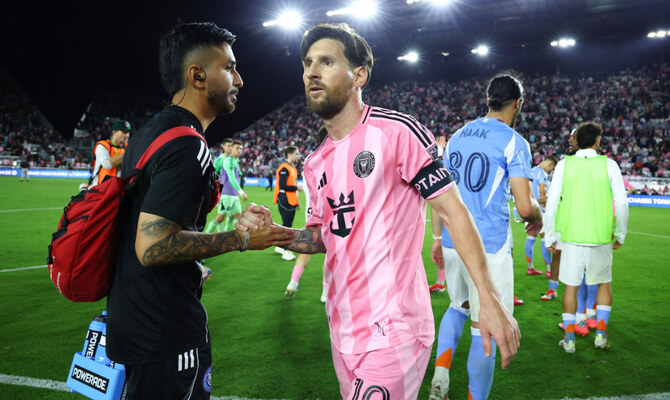
Lionel Messi of Inter Miami CF exits the pitch after their MLS match against New York City FC at Chase Stadium on Feb. 22, 2025 in Fort Lauderdale, Florida. (AFP)
Short Url
Updated 26 February 2025
Follow

MLS fines Inter Miami’s Lionel Messi for placing hand on New York City FC assistant coach’s neck

  • The reigning league MVP had some words with New York assistant coach Mehdi Ballouchy and covered his mouth as two Miami assistants intervened
  • The league also fined Inter Miami forward Luis Suarez an undisclosed amount for violating the hands to the face/head/neck of an opponent policy in a separate incident in that match

NEW YORK: Major League Soccer fined Inter Miami captain Lionel Messi an undisclosed amount on Tuesday for placing his hand on a New York City FC assistant coach’s neck.

The incident happened during Saturday’s 2-2 draw.

Messi was exiting the pitch following the full-time whistle after receiving a yellow card for a verbal exchange with referee Alexis Da Silva.

The reigning league MVP had some words with New York assistant coach Mehdi Ballouchy and covered his mouth as two Miami assistants intervened.

Messi started to walk away, then turned back toward Ballouchy. He put his right hand on the back of Ballouchy’s neck and squeezed hard enough that it appeared to stun him.

The league also fined Inter Miami forward Luis Suarez an undisclosed amount for violating the hands to the face/head/neck of an opponent policy in a separate incident in that match.

He grabbed New York defender Birk Risa by the back of the neck during a skirmish following the halftime whistle.

Chicago Fire midfielder Brian Gutierrez was suspended one match and fined an undisclosed amount for knocking down Columbus’ Yevhen Cheberko with a high elbow to the head in 4-2 season-opening loss on Saturday. He will miss the home opener against D.C. United on March 1.

The league also fined Portland Timbers defender Kamal Miller an undisclosed amount for failing to leave the field in a timely manner against the Vancouver Whitecaps on Sunday after getting sent off with a red card in the 11th minute.


Morocco banish any doubts about ability to host World Cup 2030

Updated 19 January 2026
Follow

Morocco banish any doubts about ability to host World Cup 2030

  • Impressive stadiums, easy transportation links and a well-established tourism infrastructure ensured the 24-team tournament went off without any major hitch and will assuage any doubters about the World Cup in four years’ time

RABAT: Morocco’s successful staging of the Africa Cup of Nations means there should be no skepticism about its ability to co-host the World Cup with Portugal and Spain in 2030, even if Sunday’s final was clouded by a walk-off and defeat for the home team.

Impressive stadiums, easy transportation links and a well-established tourism infrastructure ensured the

24-team tournament went off without any major hitch and will assuage any doubters about the World Cup in four years’ time.

Morocco plans to use six venues in 2030 and five of them were used for the Cup of Nations, providing world-class playing surfaces and a spectacular backdrop.

The Grande Stade in Tangier with a 75,000 capacity is an impressive facility in the northern coastal city, less than an hour’s ferry ride from Spain.

Meanwhile, FIFA President Gianni Infantino condemned "some Senegal players" for the "unacceptable scenes" which overshadowed their victory in the final when they left the pitch in protest at a penalty awarded to Morocco.

African football's showpiece event was marred by most of the Senegal team walking off when, deep into injury time of normal play and with the match locked at 0-0, Morocco were awarded a spot-kick following a VAR check by referee Jean-Jacques Ndala for a challenge on Brahim Diaz.

security personnel at the other end of the stadium, Senegal's players eventually returned to the pitch to see Diaz shoot a soft penalty into the arms of their goalkeeper Edouard Mendy.

The match was played at the Stade Moulay Abdellah in the capital Rabat, which has a capacity of 69,500. The attendance for the final was 66,526.

Stadiums in Agadir, Fes and Marrakech were also more than adequate and will now be renovated over the next few years.

But the crowning glory is the proposed 115,000-capacity Stade Hassan II on ⁠the outskirts of Casablanca which Morocco hope will be chosen to host the final over Madrid’s Santiago Bernabeu Stadium.

In all, Morocco will spend $1.4 billion on the six stadiums. Also planned is extensive investment in airports, with some 10 Moroccan cities already running direct air links to Europe and many budget airlines offering flights to the country.

An extension of Africa’s only high-speed rail service, which already provides a comfortable three-hour ride from Tangier to Casablanca, further south to Agadir and Marrakech is also planned. Morocco hopes all of this will modernize its cities and boost the economy.

On the field, Morocco will hope to launch a credible challenge for a first African World Cup success, although on Sunday they continued their poor return in the Cup of Nations, where their only triumph came 50 years ago.

They surprised with a thrilling run to the last four at the Qatar 2022 World Cup as the first African nation to get that far and will hope for a similar impact at this year’s finals in North America. They are in Group C with Brazil, Scotland and Haiti.