

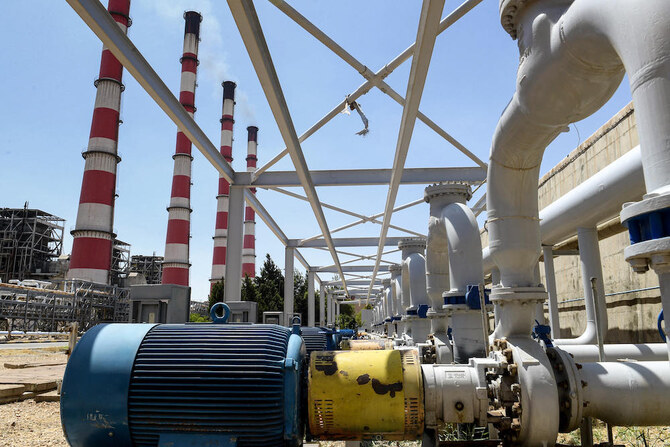

BRUSSELS: The EU on Monday began easing energy and transport sanctions and banking restrictions against the Syrian Arab Republic, aiming to help breathe life into the conflict-torn country’s economy if its new leaders work toward a peaceful future.
The EU started to impose asset freezes and travel bans on Syrian officials, banks, agencies, and other organizations in 2011 in response to then-President Bashar Assad’s actions against protesters, which festered into a civil war.
But after Assad was toppled in a lightning offensive in December, Hayat Tahrir Al-Sham, the main former militant group now in control of Syria, set up an interim administration, saying that a new government would be formed through an inclusive process by March.
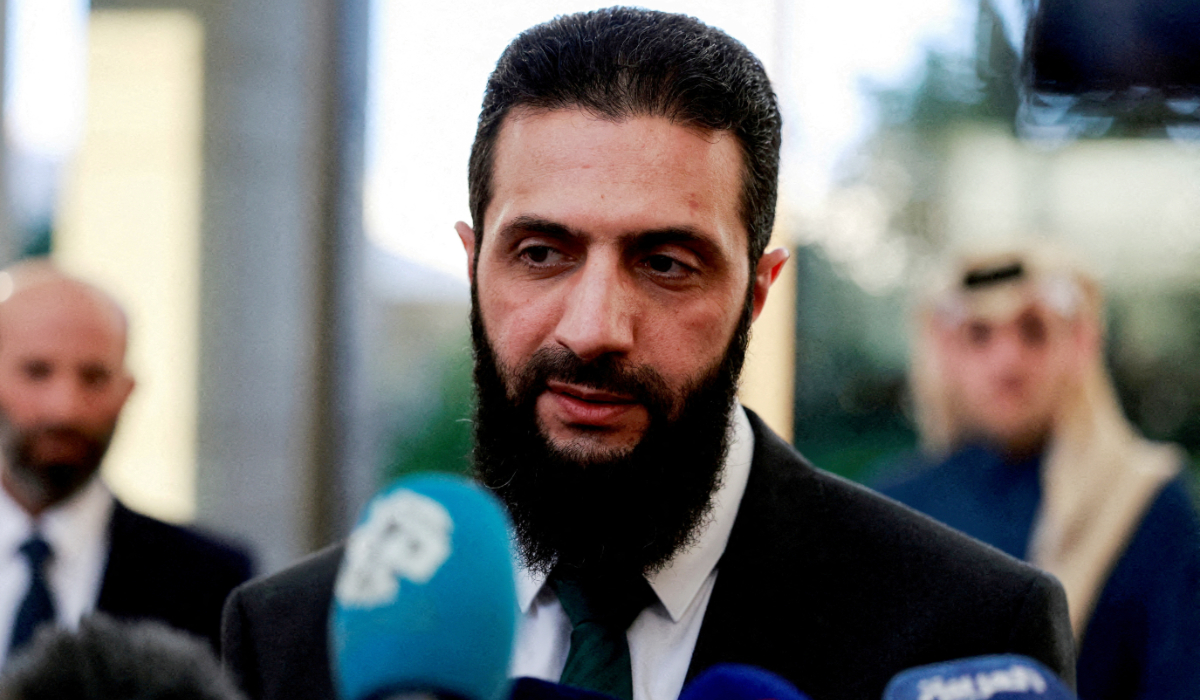
Syria's de facto leader Ahmed Al-Sharaa. (REUTERS)
Eager to encourage the new leadership, the EU said it was suspending measures targeting oil, gas and electricity, transport, and notably the aviation sector.
The possibility of funding and providing certain economic resources to five banks will be reinstated.
Restrictions on the export of luxury goods to Syria for personal use will also be eased.
The decision to lift the sanctions was taken by EU foreign ministers and was made as part of efforts “to support an inclusive political transition in Syria, and its swift economic recovery, reconstruction, and stabilization,” a statement said.
FASTFACT
UN special envoy for Syria Geir Pedersen has said that forming a ‘new inclusive government’ by March 1 could help determine whether Western sanctions are lifted.
The EU said that it would monitor developments in Syria to see whether other economic sanctions could be lifted, but it has also kept open the possibility of slapping the sanctions back on should the new leaders take the country in the wrong direction.
In January, former HTS leader Ahmad Al-Sharaa was named Syria’s president after a meeting of most of the country’s former rebel factions.
The groups agreed to dissolve the country’s constitution, the former national army, the security service, and official political parties.
International pressure has mounted for Al-Sharaa to follow through on promises of an inclusive political transition.
UN special envoy for Syria Geir Pedersen has said that forming a “new inclusive government” by March 1 could help determine whether Western sanctions are lifted.
Two Jordanian officials said Al-Sharaa would visit Jordan on Wednesday and meet King Abdullah to discuss boosting ties between neighboring countries.
The visit is the president’s third foreign trip with Saudi Arabia and Turkiye since he came to power.
Al-Sharaa is expected to hold wide-ranging talks over border security and ways of expanding commercial ties.
Assad’s relationships with most of the Arab world and his neighbors were strained throughout the nearly 14-year Syrian war.
Al-Sharaa has pledged to stamp out rampant drug smuggling along the two countries’ borders, which proliferated during the rule of toppled Assad and whom Jordan blamed on militias that held sway in southern Syria.
Jordan, which hosted the first international conference on Syria a week after Assad was forced to flee, wants to see a peaceful political transition in Syria, fearing a return of chaos and instability along its borders.
Officials have said they were ready to help Syria rebuild and promised to help it ease its acute power shortages by supplying it with electricity and gas.
Al-Sharaa received an invitation on Sunday to attend an Egyptian-hosted Arab League meeting on Gaza.
The Cairo meeting would be the first time Al-Sharaa represents Syria in the Arab League.
“The president of the Syrian Arab Republic, Mr Ahmed Al-Sharaa, received an official invitation from the president of Egypt ... to participate in the extraordinary Arab League summit” on March 4 in Cairo, the presidency’s statement said.
Syria under Assad was suspended from the Arab League in 2011. Damascus was allowed to return to the regional bloc in 2023.
The end of Assad’s rule has upended the geopolitics of the Middle East, clearing the way for other states to build new ties with a country at the crossroads of the region.
A long-awaited national dialogue conference intended to help chart Syria’s political future was being launched on Monday.
The main session will be held on Tuesday, with participants holding workshops to discuss transitional justice, the structure of a new constitution, reforming and building institutions, personal freedoms, the role of civil society and the country’s economy.
The outcome of the national dialogue will be nonbinding recommendations to the country’s new leaders.


