Pakistan at risk of Champions Trophy exit as Kohli helps India thump archfoes in Dubai

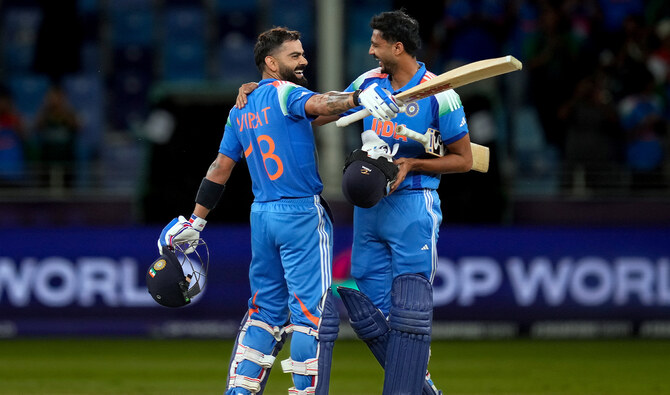
India’s Virat Kohli (left) and Axar Patel celebrate after winning against Pakistan during the ICC Champions Trophy cricket match between India and Pakistan at Dubai International Cricket Stadium in Dubai, United Arab Emirates, on February 23, 2025. (AP)
Short Url
Updated 23 February 2025
Follow

Pakistan at risk of Champions Trophy exit as Kohli helps India thump archfoes in Dubai

  • Chasing 242, Kohli hit a boundary to seal the match with 45 balls to spare and register his 51st ODI ton which also saw him pass 14,000 runs
  • Pakistan have lost both their matches and will need Bangladesh to beat New Zealand on Monday to have any chance of staying in the tournament

DUBAI: Star batsman Virat Kohli struck an unbeaten 100 to lead India to a six-wicket win over arch-rivals Pakistan on Sunday and push the title holders to the brink of elimination from the Champions Trophy.
Chasing 242 for victory, Kohli hit a boundary to seal the match with 45 balls to spare and register his 51st ODI ton after an innings which also saw him pass 14,000 runs in one-day international cricket.
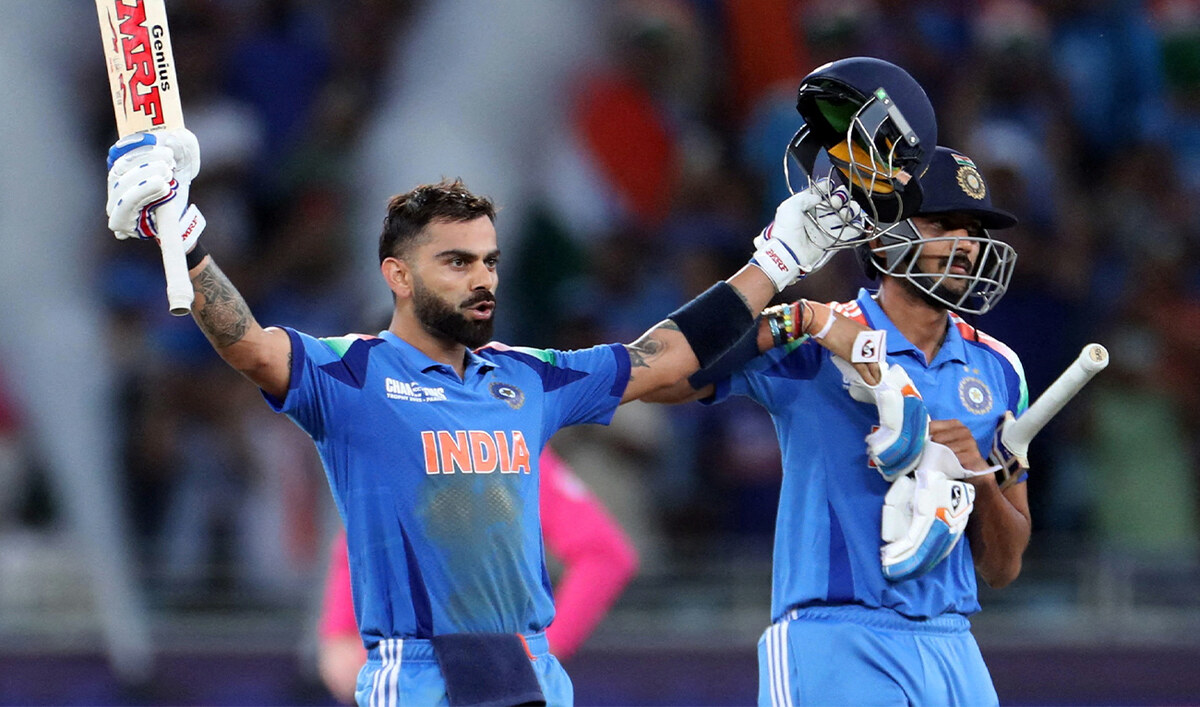


India’s Virat Kohli celebrates after hitting four runs to reach his century and win the ICC Champions Trophy cricket match against Pakistan at Dubai International Cricket Stadium in Dubai, United Arab Emirates, on February 23, 2025. (Reuters)

Kohli, 36, removed his helmet and raised his bat to the Dubai International Stadium crowd after taking India closer to the semifinals with two wins in two outings in Group A.

Pakistan have lost both their matches and will need Bangladesh to beat New Zealand on Monday to have any chance of staying in contention for a last-four spot.


Pakistan players walk after their loss to India in the ICC Champions Trophy cricket match at Dubai International Cricket Stadium in Dubai, United Arab Emirates, on February 23, 2025. (AP)

The top two teams from the two groups will make the semifinals.
“My job was clear — to control the middle overs, not take risks against the spinners and take on the pacers,” said Kohli.
“I was happy with the template, it’s how I play in ODIs. I have a decent understanding of my game.
“It’s about keeping the outside noise away, take care of my energy levels and thoughts. It’s easy for me to get pulled into expectations and frenzy around games like these.”
Favourites India remained clinical in their chase despite losing skipper Rohit Sharma for 20 off Shaheen Shah Afridi.



Pakistan’s Shaheen Afridi celebrates the wicket of India’s captain Rohit Sharma during the ICC Champions Trophy cricket match between India and Pakistan at Dubai International Cricket Stadium in Dubai, United Arab Emirates, on February 23, 2025. (AP)

In-form Shubman Gill, who made 46 after his century in the opening win over Bangladesh, put on 69 runs with Kohli.
India superstar Kohli started cautiously but reached 14,000 ODI runs with a trademark punch through cover off Haris Rauf.
He is just the third man to break the 14,000-run barrier after India icon Sachin Tendulkar (18,426) and Sri Lankan great Kumar Sangakkara (14,234)
Former captain Kohli raised his fifty with a boundary off Naseem Shah to loud cheers from the crowd.
His hundred came in 111 balls, a knock that rolled back the years for the veteran who has 82 centuries across all formats but whose previous ODI ton came in the 2023 ODI World Cup semifinal.
Kohli and Shreyas Iyer, who made 56, put the chase back on track with a stand of 114 after Gill’s departure when leg-spinner Abrar Ahmed bowled the opener.
India bowled out Pakistan for 241 in 49.4 overs as left-arm wrist spinner Kuldeep Yadav returned figures of 3-40.
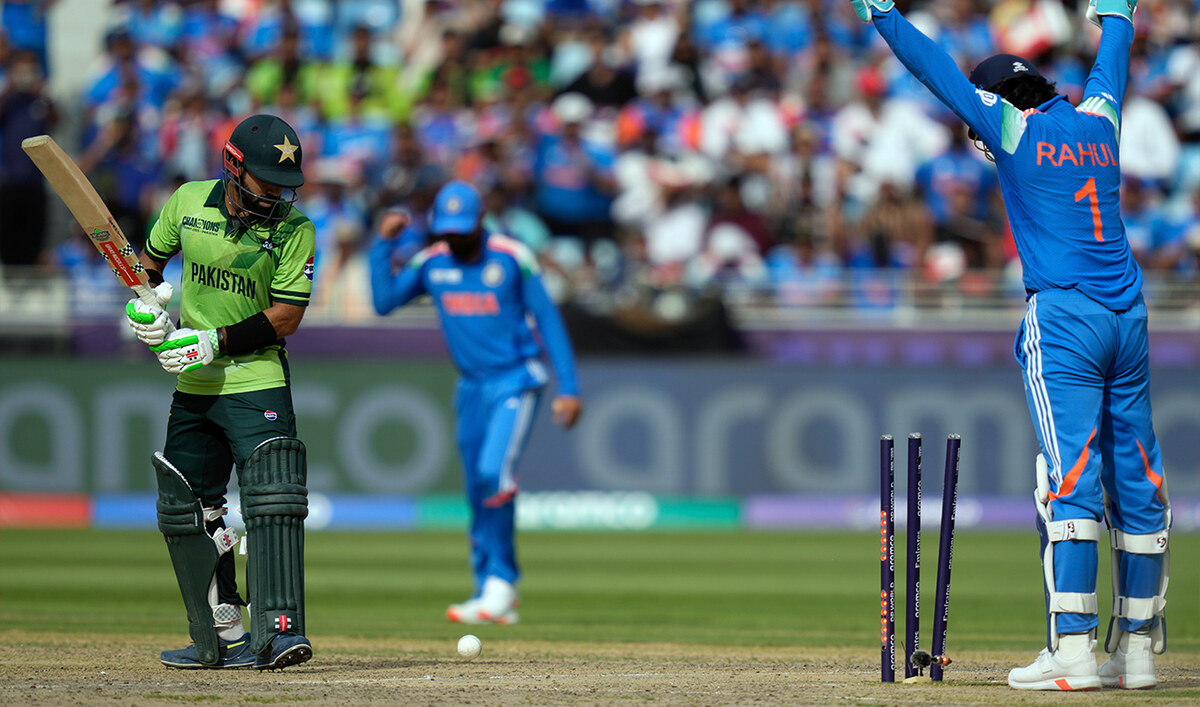


Pakistan’s captain Mohammad Rizwan (left) looks on after being bowled out during the ICC Champions Trophy cricket match between India and Pakistan at Dubai International Cricket Stadium in Dubai, United Arab Emirates, on February 23, 2025. (AP)

Pakistan elected to bat first on what seemed a sluggish pitch but a slow approach from the batsman rarely threatened the Indian attack despite a 104-run partnership between Saud Shakeel (62) and Mohammad Rizwan (46).
Khushdil Shah’s late cameo of 38 added some runs to the total before the innings folded with his wicket.
The Pakistan openers began cautiously despite a wayward start by Indian pace spearhead Mohammed Shami who bowled five wides in an 11-ball first over.
Shami, who returned figures of 5-53 in the win over Bangladesh, seemed to struggle with his ankle in his third over and left the field, returning soon after to India’s great relief.
Babar Azam score 23 and fellow opener Imam-ul-Haq was run out on 10 before Shakeel and Rizwan got their heads down as Pakistan managed just one boundary in nearly 10 overs.



India’s Harshit Rana bowls a delivery during the ICC Champions Trophy cricket match between India and Pakistan at Dubai International Cricket Stadium in Dubai, United Arab Emirates, on February 23, 2025. (AP)

“When Saud and I were batting, we wanted to go deep. But our shot selection was bad and we lost wickets, which is why we were kept to 240,” said Rizwan.
A full house was expected at the venue but there were empty seats on view during the match.
Pakistan next face Bangladesh on Thursday in Rawalpindi while India take on New Zealand in Dubai on March 2.


Pakistan considers shift to net billing for rooftop solar to ease power sector losses

Updated 4 sec ago
Follow

Pakistan considers shift to net billing for rooftop solar to ease power sector losses

  • As per new proposal, solar consumers will sell electricity to national grid at around 60 percent lower rates, buy power at prevailing commercial rates
  • Solar associations warn consumers will suffer if plan is approved, alleging it is aimed at benefiting Pakistan’s power distribution companies

ISLAMABAD: Pakistan’s government is considering replacing its net metering policy for rooftop solar with a net billing mechanism for solar consumers across the country, an official confirmed on Wednesday, as Islamabad looks to ease financial strain on the struggling power sector. 

Under the proposed framework for the net billing system, electricity generated by rooftop solar systems and exported to the national grid by consumers would be bought at a rate 60 percent lower than the previous price of electricity. Consumers, on the other hand, will continue to buy power from the national grid at the prevailing commercial rates. Net metering, on the other hand, allows power consumers to offset exported units directly against imported electricity at the same price.

Government officials say the policy change is aimed at easing mounting financial pressure on Pakistan’s power sector, where rapid solar adoption has reduced revenues for distribution companies even as fixed capacity payments to power producers continue to rise.

Pakistan has seen a surge in residential and commercial solar systems in recent years as soaring electricity prices drive inflation and power outages increase in the country. 

“Under the proposed regulations, net billing will apply to both old and new customers who will have to pay full commercial tariffs for all imported units,” a National Electric Power Regulatory Authority (NEPRA) official told Arab News on condition of anonymity as he was not authorized to speak to the media. 

However, he clarified the new rules would be implemented after a public hearing and NEPRA obtains feedback from stakeholders.

Commercial electricity tariffs range between Rs30 and Rs50 per unit depending on consumption slabs, taxes, fixed charges and Time of Use (TOU) rates. The official said the average energy price stands at Rs10–12 per unit, while the average Power Purchase Price (PPP) stands at around Rs25 per unit.

As per the government’s proposal, which is available on NEPRA’s website, new solar consumers would get the lower average energy price while existing customers would continue receiving the higher PPP rates until the expiry of their seven-year contracts.

Pakistan Energy Minister Sardar Awais Leghari told Arab News the government would present its position during NEPRA’s public hearing expected next month.

“Contractual obligations will be fulfilled for existing consumers while new consumers will receive energy rates for their produced units as per NEPRA’s proposal,” Leghari said, adding that consultations would continue for at least a month.

Asked whether the policy could be revised, Leghari said: “Only if the regulator approves.”

The government’s proposal has sparked strong concerns among consumers, energy experts and industry stakeholders, who warn the plan could slow the adoption of renewable energy as Pakistan struggles with climate vulnerability, rising fuel import bills and deepening circular debt in the power sector.

Hasnat Ahmad Khan, senior vice president of the Pakistan Solar Association (PSA), told Arab News that consumers would suffer if the new regulations are approved.

“People have invested their hard-earned money to install solar systems and many have even taken loans,” Khan noted. “The new rules will make it difficult for them to recover their investment.”

Khan said industry representatives recently met NEPRA officials, urging them to protect existing consumers and allow new solar users to sell surplus electricity at the PPP rates of around Rs25 per unit instead of lower energy rates.

“This is green energy and it should be encouraged,” he said. “If change is unavoidable, existing consumers must be protected and new consumers should at least be given PPP rates.”

Khan warned that the new regulations would benefit only power distribution companies. 

“They will buy solar energy at very low rates and sell it to non-solar neighbors at much higher tariffs,” he noted. 
The PSA official said utilities should pay more for solar power since it is supplied without transmission losses.

Pakistan, one of the countries most affected by climate change, has repeatedly pledged to increase its share of renewable energy in its power mix. 

Critics argue that weakening incentives for rooftop solar risks undermining those commitments and could place an additional burden on consumers already suffering from inflation and rising utility costs.