PM Sharif in Baku to discuss Pakistan-Azerbaijan cooperation in defense, trade and energy

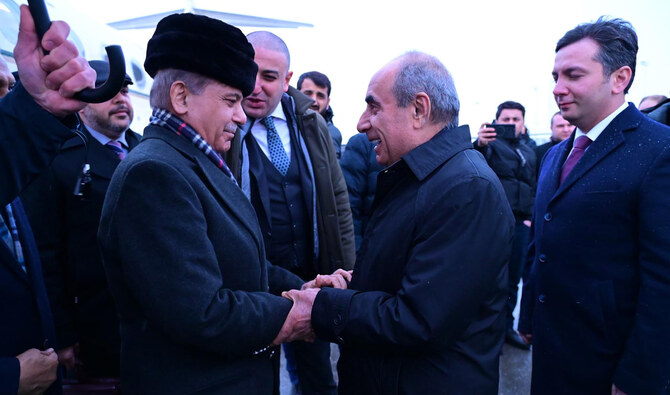
First Deputy Prime Minister of Azerbaijan, Yaqub Abdulla oghlu Eyyubov (second right), receives Pakistan’s Prime Minister, Shehbaz Sharif (left), upon arrival at Heydar Aliyev International Airport in Baku, Azerbaijan, on February 23, 2025. (PID)
Short Url
Updated 23 February 2025
Follow

PM Sharif in Baku to discuss Pakistan-Azerbaijan cooperation in defense, trade and energy

  • The visit comes as part of Pakistan’s broader economic diplomacy with landlocked Central Asian states
  • Last year, Pakistan agreed to supply JF-17 fighter jets to Baku, highlighting bilateral defense cooperation

ISLAMABAD: Prime Minister Shehbaz Sharif on Sunday arrived in Baku, Azerbaijan on a two-day official visit to discuss enhanced bilateral cooperation in areas like defense, trade and energy, the Pakistani government said.
The visit comes as part of Pakistan’s broader economic diplomacy with landlocked Central Asian states, to which it has offered access to its southern ports in Karachi and Gwadar for international trade.
Pakistan’s economic engagement with Azerbaijan has also gained momentum more recently. Last year in July, the top leaders of both countries discussed investment and trade projects worth $2 billion during Azerbaijani President Ilham Aliyev’s state visit to Pakistan.

Upon arrival at Heydar Aliyev International Airport, the Pakistan prime minister was warmly received by senior Azerbaijani officials, including First Deputy Prime Minister, Yaqub Abdulla oghlu Eyyubov, and Pakistan’s Ambassador to Azerbaijan Qasim Mohiuddin.

“During the visit, the Prime Minister will hold high-level meetings with the President of Azerbaijan, H.E. Ilham Aliyev and other senior Azerbaijani officials,” Pakistan’s Press Information Department (PID) said in a statement.

“The discussions will focus on further strengthening bilateral relations, expanding trade and investment, enhancing cooperation in the energy sector, synergize efforts to deal with climate change, deepening defense collaboration, and fostering cultural exchanges.”

The prime minister is accompanied by Pakistani Deputy Prime Minister Ishaq Dar, federal ministers Jam Kamal Khan, Abdul Aleem Khan, Chaudhry Salik Hussain and Attaullah Tarar, and his special assistant on foreign affairs, Tariq Fatemi, according to the PID.
Several agreements and memoranda of understanding are expected to be signed in multiple areas of cooperation during the visit.

“As part of his engagements, the Prime Minister and the Azerbaijani leadership will also address the Pakistan-Azerbaijan Business Forum, scheduled for Monday,” the PID said.
“The forum will bring together business leaders from both countries to explore avenues for joint ventures and trade and investment opportunities, emphasizing business-to-business (B2B) collaboration.”

Pakistan was among the first nations to recognize Azerbaijan’s independence in the early 1990s, though their ties have strengthened significantly in recent years. In September last year, Pakistan signed a contract to supply JF-17 Block III fighter jets to Azerbaijan, highlighting their deepening defense cooperation.
Beyond government-level collaboration, people-to-people exchanges between the two nations have also increased, with a growing number of Pakistanis traveling to Azerbaijan for tourism and business.

“This visit underscores the commitment of both nations to deepening their bilateral ties, enhancing economic cooperation, and fostering regional collaboration,” the PID added.


Pakistan says Indian minister initiated handshake in Dhaka, first contact since May conflict

Updated 58 min 5 sec ago
Follow

Pakistan says Indian minister initiated handshake in Dhaka, first contact since May conflict

  • Pakistan’s Ayaz Sadiq and India’s Subrahmanyam Jaishankar met on the sidelines of Khaleda Zia’s funeral
  • The National Assembly of Pakistan says Islamabad has consistently emphasized dialogue with New Delhi

ISLAMABAD: Pakistan said on Wednesday Indian External Affairs Minister Subrahmanyam Jaishankar initiated a brief handshake with Speaker of the National Assembly Sardar Ayaz Sadiq in Dhaka, marking the first high-level contact between the two nuclear-armed rivals since their military conflict in May.

The encounter took place on the sidelines of the funeral of former Bangladeshi prime minister Khaleda Zia, attended by senior officials and diplomats from multiple countries.

Ties between India and Pakistan have remained frozen since a four-day military confrontation in May, during which both sides exchanged missile, drone and air strikes before a ceasefire brokered by Washington.

“During Speaker NA Sardar Ayaz Sadiq’s visit to the Parliament of Bangladesh ... the Indian External Minister Dr. S. Jaishankar approached the Speaker National Assembly and [shook] hands,” Pakistan’s National Assembly said in a post on social media platform X.

It added that Jaishankar introduced himself to Sadiq during the brief interaction. India has not commented publicly on the exchange.

“It is noteworthy that Pakistan has consistently emphasized dialogue, restraint, and cooperative measures, including proposals for peace talks,” the post continued.

Tensions between the two neighbors escalated in April after a militant attack in Indian-administered Kashmir killed more than 20 tourists. New Delhi blamed Pakistan for supporting the attack, an allegation Islamabad denied, calling instead for an independent and transparent investigation.

Officials from both countries have largely avoided public interactions since the conflict, with senior figures refraining from handshakes or exchanges at international gatherings.

Sadiq was in Dhaka to attend Zia’s funeral and to convey condolences from Pakistan’s leadership and people. He also met Zia’s son Tarique Rahman, the acting chairman of the Bangladesh Nationalist Party, according to Pakistan’s high commission in Bangladesh.

Speaking to Pakistan’s Geo TV, Sadiq confirmed that Jaishankar approached him in full media glare and exchanged pleasantries.

Responding to a question about being photographed with the Indian minister, he said: “Cameras arrived with them. Our people took the photographs later.”