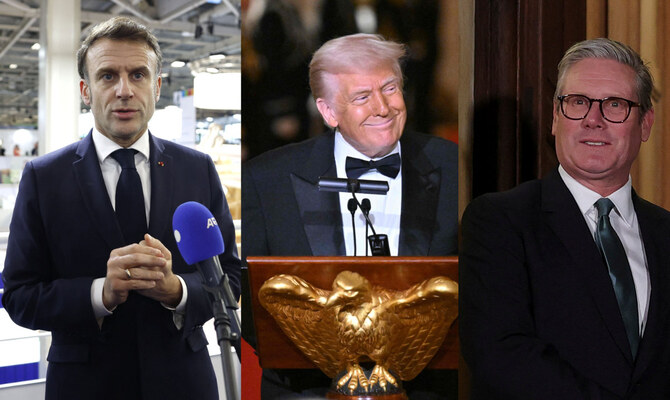

LONDON/PARIS: French President Emmanuel Macron and British Prime Minister Keir Starmer will travel to Washington next week amid alarm in Europe over US President Donald Trump’s hardening stance toward Ukraine and overtures to Moscow on the three-year conflict.
The leaders of Europe’s two nuclear powers, who will be traveling separately, are expected to try to convince Trump not to rush to a ceasefire deal with Vladimir Putin at any cost, keep Europe involved and discuss military guarantees to Ukraine.
Macron, who is trying to capitalize on a relationship with Trump built during their first presidential terms, has said agreeing to a bad deal that would amount to a capitulation of Ukraine would signal weakness to the United States’ foes, including China and Iran.
“I will tell him: deep down you cannot be weak in the face of President (Putin). It’s not you, it’s not what you’re made of and it’s not in your interests,” he said in an hour-long answer and question session on social media ahead of Monday’s visit to the White House.
The visits come amid a rift between Trump and Ukrainian President Volodymyr Zelensky, whom Trump described as a “dictator,” that has alarmed Kyiv’s European allies, already reeling from a more aggressive US posture on trade, diplomacy and even domestic European politics.
Philip Golub, a professor in international relations at the American University in Paris, said Trump’s rapid-fire moves in his first weeks in office, as well as the rhetoric from other US officials, had been a major shock for the Europeans.
“They could not have expected that somehow within the United States would emerge this ultra-nationalist coalition of forces that would actually challenge Europe’s voice in world affairs in such a stark and strong way,” he told Reuters.
He said Macron believed he had a “historic role to play” in going to Washington to ensure Europe can weigh in on the ultimate negotiations on Ukraine. “Whether he can actually achieve something, however, in this visit is an entirely different matter,” he added.
Starmer, who has also warned the end of the war cannot be a “temporary pause before Putin attacks again,” will be in Washington on Thursday.
Speaking on a Fox News podcast on Friday, Trump said Macron and Starmer had not “done anything” to end the war. “No meetings with Russia!” he said, although he described Macron as “a friend of mine” and Starmer as “a very nice guy.”
Milittary guarantees
However, the two countries are keen to show Trump they are ready to take on a bigger burden for European security.
Britain and France are firming up ideas with allies for military guarantees for Ukraine and their two leaders will seek to convince Trump to provide US assurances in any post ceasefire deal, Western officials said.
Their respective militaries began initial planning last summer for the post-war scenario, but the discussions accelerated in November after Trump secured the US presidency, a French military official and two diplomats said.
They have also been supported in putting together an array of options by countries like Denmark and the Baltic states as Europeans discuss what they would be ready to do should there be an accord and peacekeepers required, officials said.
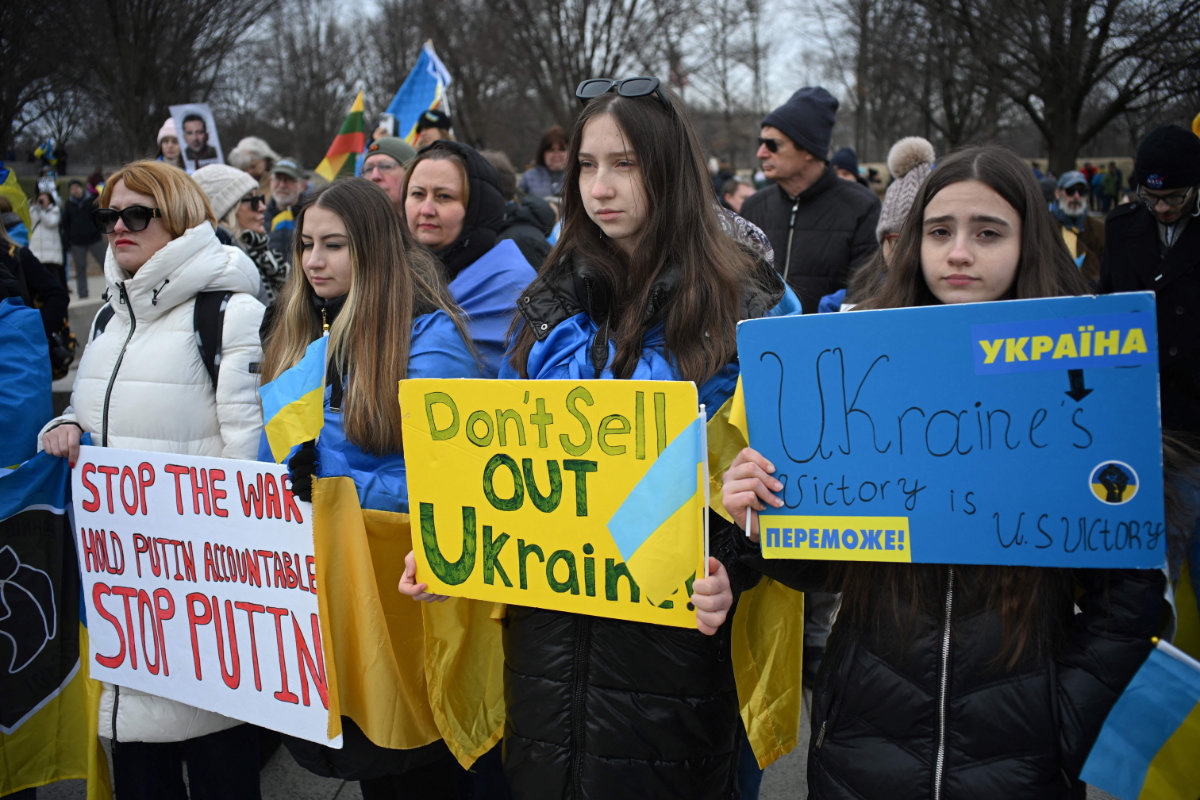
Protesters demonstrate at the Lincoln Memorial in Washington, DC, on Feb. 22, 2025, in support of Ukraine ahead of the third anniversary of the war with Russia. (AFP)
While both Britain and France have ruled out sending troops to Ukraine immediately, the plans, still in concept stage, center around providing air, maritime, land and cyber support that would aim to deter Russia from launching any future attacks, Western officials said.
Air and sea assets could be based in Poland or Romania, restoring safe international air space and ensuring the Black Sea remained safe for international shipping, the official said.
Part of the British and French talks center around the possibility of sending European peacekeepers. While US boots on the ground may not be necessary, deterrence in the form of US medium-range missiles and ultimately nuclear weapons will remain crucial.
The options being discussed would center not on providing troops for the frontline or the 2,000-km (1,243-mile) border which would remain secured by Ukrainian forces, but further to the West, three European diplomats and the military official said.
Those troops could be tasked with protecting key Ukrainian infrastructure such as ports or nuclear facilities to reassure the Ukrainian population. However, Russia has made it clear it would oppose a European presence in Ukraine.
A French military official said there was little sense in talking numbers at this stage because it would depend on what was finally agreed, what international mandate was given and whether non-European troops would also be involved.
“It’s not about the numbers of troops in Ukraine. It’s the ability to mobilize and the ability to arrange everything into a package of interoperability units,” the French official said.
A Western official said that even 30,000 troops could be on the “high side.”