

AP sues Trump aides for restricting access over Gulf of Mexico name

A poster depicting the Gulf of Mexico as the newly renamed "Gulf of America" is visible at the White House in Washington, DC, during a swearing in ceremony for Tulsi Gabbard as Director of National Intelligence on February 12, 2025. (Getty Images via AFP)
Short Url
Updated 22 February 2025
Follow

AP sues Trump aides for restricting access over Gulf of Mexico name

  • Lawsuit claims the White House’s decision retaliated against the AP over coverage decisions, which are protected under the Constitution
  • White House Communications Director Steven Cheung called the lawsuit “a blatant PR stunt masquerading as a first amendment case”

WASHINGTON: The Associated Press on Friday sued senior aides to President Donald Trump over a decision by the White House to restrict the news outlet’s access to the president and other officials for continuing to refer to the Gulf of Mexico in its coverage.
The lawsuit, filed in US District Court in Washington D.C., alleges that the White House’s decision to bar AP reporters from the Oval Office and Air Force One violates the US Constitution, including First Amendment protections for free speech, by trying to control the language that it uses to report the news.
“The press and all people in the United States have the right to choose their own words and not be retaliated against by the government,” the complaint states.
Responding to questions about the lawsuit posed by conservative commentator Mercedes Schlapp, White House press secretary Karoline Leavitt, speaking during an appearance at the Conservative Political Action Conference, said: “We feel we are in the right in this position. We are going to ensure that truth and accuracy is present at that White House every single day.”
White House Communications Director Steven Cheung, in a statement, called the lawsuit “a blatant PR stunt masquerading as a first amendment case.”
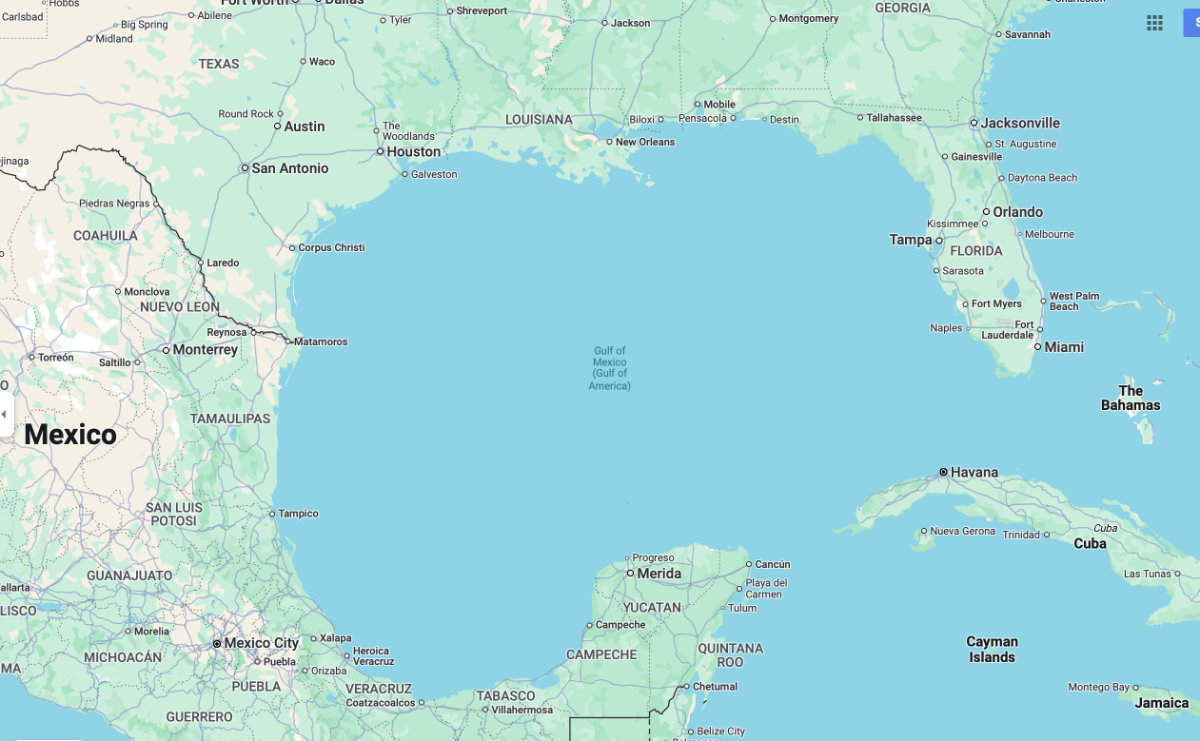


To avoid getting caught in the crossfire, Google now uses both Gulf of Mexicio and Gulf of America on its online map.

Trump signed an executive order last month directing the Interior Department to change the name of the body of water long known as the Gulf of Mexico to the Gulf of America.
The AP, citing editorial standards, said it would continue to use the gulf’s established name, while acknowledging Trump’s move to change it.
The AP says in its stylebook that the Gulf of Mexico has carried that name for more than 400 years and that it must use identifiers that are easily recognizable for global audiences.
The White House in response barred AP reporters from the Oval Office, where Trump has held several press events since returning to the presidency, and the presidential plane, Air Force One.
Trump’s ban prevents the AP’s journalists from seeing and hearing him and other top White House officials as they take newsworthy actions or respond in real time to news events.
The move has been criticized by several press freedom groups and the White House Correspondents’ Association. Reuters released a statement in support of the AP.
The lawsuit claims the White House’s decision retaliated against the AP over coverage decisions, which are protected under the Constitution. It also alleges the AP did not have an opportunity to challenge the White House’s decision to bar its access.
The lawsuit names Leavitt, chief of staff Susie Wiles and deputy chief of staff Taylor Budowich as defendants.
Wiles and Budowich did not immediately respond to requests for comment.
The AP is seeking a temporary restraining order declaring the restrictions unlawful and immediately restoring its access to all areas available to the White House press pool. (Reporting by Andrew Goudsward; Additional reporting by Jasper Ward; Editing by Scott Malone and Rosalba O’Brien)


Semafor targets Gulf expansion after first profitable year

Updated 09 January 2026
Follow

Semafor targets Gulf expansion after first profitable year

  • Digital news brand generates $2m in earnings on $40m of revenue in 2025, and raises $30m in new financing
  • Platform aims to be the ‘business and financial news brand of record for the Gulf,’ CEO says, and to ‘blanket the world’ within 2 years

DUBAI: Digital news platform Semafor generated $2 million in earnings in 2025 before interest, taxes, depreciation and amortization, on revenue of $40 million, marking its first year of profitability.

It also closed $30 million in new financing, which it plans to use to grow its editorial operations and live events business.

These achievements are particularly notable at a time when the global news industry is facing declining revenues and the erosion of audience trust, the company said.

Justin B. Smith, the company’s co-founder and CEO, told Arab News that Semafor’s model and approach is distinguished by several factors, which can be encapsulated by its vision of building a news product to “serve consumers that are increasingly not trusting news, but also designed with a business model that could deliver sustainable economic advantage.”

Following its first profitable year and armed with new funding, Semafor, founded in 2022, now plans an accelerated phase of global expansion with a focus on scaling editorial output and global convenings.

The company said it will broaden its publication schedule in the year ahead. Semafor Gulf and Semafor Business will become daily publications as the platform increases the frequency of its “first-read” services, which are daily briefings designed to showcase “front page” news and intended to serve as the “first read” for audiences, Smith said.

The Gulf edition of Semafor launched in September 2024, with former Dow Jones reporter Mohammed Sergie as editor. In 2025 Matthew Martin was appointed its Saudi Arabia bureau chief.

Semafor’s brand slogan is “intelligence for the new world economy” and “the Gulf is the epicenter of the new world economy,” Smith said. Currently, its Gulf operation employs eight journalists, based in the UAE and Saudi Arabia, and as it moves to a daily publishing schedule it plans to significantly bolster its editorial team, both in existing markets and new ones, such as Qatar.

Semafor is “obsessed with the business, financial and economic story” in the region and aims to become “the business and financial news brand of record for the Gulf,” Smith said.

In the US, Semafor DC, currently published daily, will move to a twice-a-day format in March. In addition, the company’s flagship annual Semafor World Economy platform in Washington will expand this year from a three-day event to five days, with extended programming. The event, in April, is expected to attract more than 400 global CEOs, more than double the number that took part in 2025.

In addition to the US and the Gulf, Semafor currently operates in Africa. It held its first event in the Gulf region last month, during Abu Dhabi Finance Week, and said it is now looking to grow its events footprint across the Gulf, and into Asia. It will launch a China edition next month, its first foray into Asia, and plans to launch in Europe in 2027, followed eventually by Latin America.

Within the next two years, Semafor aims to have “blanketed the whole world” and become a mature, global intelligence and news brand competing with the “greatest legacy business and financial news brands in the world,” Smith said.

“Our goal is to become the leading global intelligence and news company for the world, founded on independent, high-quality content and convenings,” he added.