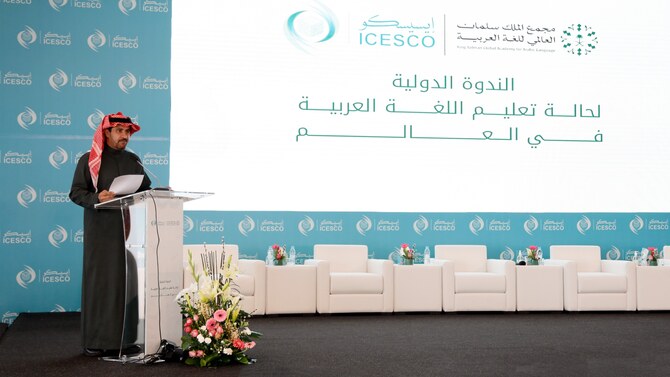

RIYADH: The King Salman Global Academy for Arabic Language and the Islamic World Educational, Scientific and Cultural Organization (ICESCO) have published a report titled “The Status of Arabic Language Education in the World.”
The launch of the report came during a two-day international symposium on the status of Arabic language education on Feb. 18 and 19 at ICESCO’s headquarters in Rabat.
Dr. Abdullah Al-Washmi, secretary-general of KSGAAL, said in a press release that the report is part of the academy’s ongoing efforts to promote Arabic language education around the world, and “to drive a transformative shift in Arabic language education as a second language globally.”
It “focuses on shaping policies and strategies that elevate teaching standards while conducting an in-depth assessment of Arabic learning institutions” and “aims to broaden the language’s reach, overcome key challenges, and foster stronger partnerships with regional and international organizations dedicated to Arabic language education,” Al-Washmi added.
The report “represents a significant step toward establishing a comprehensive knowledge base on Arabic language education, serving as a key reference for policymakers and academic institutions in developing curricula and educational programs,” he continued.
Dr. Salim M. AlMalik, director-general of ICESCO, commended Saudi Arabia’s “pioneering vision in advancing the Arabic language and its mission to preserve and promote its status.”
He said in the press release: “Strengthening the Arabic language within its Islamic context and on the global stage is a shared duty and a historic responsibility—one that calls for unified efforts and sustained collaboration.”
According to the press release, the report is the first to assess “the realities of Arabic language education in non-Arabic-speaking countries. It provides “in-depth analysis” of more than 300 educational institutions across 30 countries, includes an analysis of graduates’ employment prospects, and “identifies key challenges facing Arabic language education and proposes practical solutions to enhance educational policies and strengthen coordination among relevant stakeholders.”
Dr. Mahmoud Al-Mahmoud, head of the Planning and Language Policy Sector at KSGAAL, told Arab News that the report aims to “drive a paradigm shift in the Arabic language education as a second language,” adding that it will provide “educational institutions, researchers, and relevant stakeholders with the opportunity to strengthen areas in need of development.”
Dr. Khaled Al-Qousi, director of the Language Policy Department at KSGAAL, said the report includes research about the employment prospects and hiring rates for graduates of Arabic language programs in various countries, and assesses the “accessibility of employment opportunities for graduates of Arabic language programs within the global job market.”
The findings, the press release stated, “underscore the necessity of fostering strategic partnerships between Arabic language programs and key sectors, including education, diplomacy, commerce, and media, to ensure that graduates can fully leverage these opportunities.”