

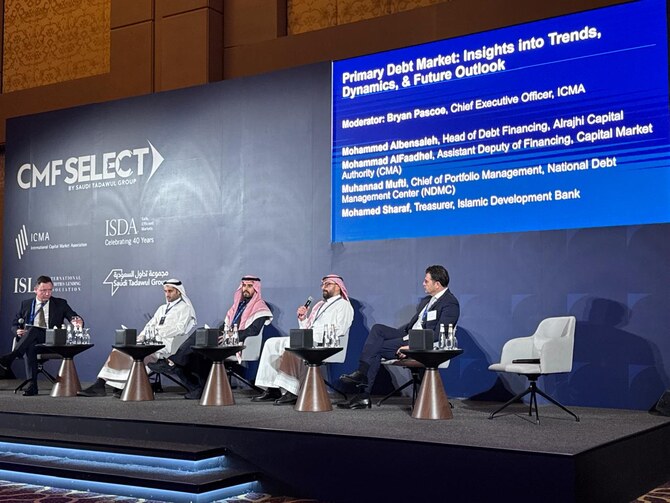

RIYADH: Saudi Arabia’s National Debt Management Center is considering issuing green bonds in international markets after finalizing its green framework in 2024, a senior official said.
At the Capital Markets & the Kingdom of Saudi Arabia event, Muhannad Mufti, chief of portfolio management at NDMC, highlighted that the Kingdom has introduced key debt programs to ensure sustainable access to capital markets and strengthen the yield curve.
Mufti explained: “The NDMC launched the GMT program in 2016, which focused on international issuances. We also introduced a local sukuk program to help with price discovery and expand the yield curve, with maturities ranging from 7 to 30 years. Additionally, we launched the international sukuk program.”
He added, “In 2024, we finalized the green framework, and throughout this year, we are exploring opportunities to issue in the green market.”
Debt market evolution
Saudi Arabia's debt market has seen significant growth, with experts noting a surge in investor interest in debt instruments amid rising interest rates.
Mohammed Al-Bensaleh, head of debt financing at Al Rajhi Capital, emphasized the local debt capital market’s expansion, which has consistently outpaced the equity market in recent years.
“The local debt capital market has historically been larger than the equity market. Some corporates initially issued in the local capital market but later shifted focus to other funding sources for reasons such as process, currency requirements, cost, or flexibility,” Al-Bensaleh explained.
He pointed out that despite liquidity pressures, the loan market remains significantly larger than the capital market, creating opportunities for issuers.
“Especially in the current environment, we’re seeing more investors focusing on debt instruments as an investment avenue, which wasn’t the case just three years ago when interest rates were very low,” he added.
Mohammad Al-Faadhel, assistant deputy of financing at the Capital Market Authority, discussed the structured evolution of Saudi Arabia’s financing landscape and how the debt capital market is poised for further acceleration, especially following Vision 2030 reforms.
“I want to take a step back and look at how financing evolves. Typically, in other markets, it starts with bank loans, progresses to the equity market, then to bond markets, and eventually more complex instruments like derivatives and structured products,” Al-Faadhel said.
He highlighted the influence of Vision 2030 in transforming the Kingdom from a capital exporter to a market where credit outpaces deposits, creating an ideal environment for the debt market to grow.
“We haven’t left this to chance. Together with other stakeholders, we’ve proactively established the Sukuk and Development Capital Market Committee to remove obstacles and support the market’s growth,” he concluded.
Key challenges and future outlook
While Saudi Arabia’s debt market is rapidly maturing, several challenges remain. Al-Bensaleh highlighted three key obstacles: liquidity for government sukuk, expanding corporate debt issuances, and introducing securitization.
“To address liquidity for government sukuk, we’ve implemented several measures, including the introduction of a market-making framework by the exchange in January, the launch of the omnibus account structure in November, and the near completion of licensing an alternative trading system,” he explained.
On the corporate side, efforts are underway to simplify listing requirements and encourage broader participation.
“We’ve reduced some requirements by 50 percent without compromising investment protection. As a result, we’ve seen increased activity and expect a strong pipeline of approvals in 2025,” Al-Bensaleh added.
The push toward green and sustainable finance is another critical area, with regulatory bodies set to introduce new guidelines for green, social, and sustainability-linked bonds by the end of March.
Looking ahead, Al-Faadhel outlined the Kingdom’s ambitions for the debt market, aiming to increase the debt-to-bank loan ratio from the current 11 percent debt-to-89 percent bank loan split to the mid-20s within five years, and closer to G20 averages in the next decade.
“Currently, the split between bank loans and the debt capital market is far below G20 levels. In five years, we aim to move from 11 percent to the mid-20s, and hopefully, within 10 years, align closer with G20 averages. That’s our goal,” he concluded.
With strategic reforms, growing investor interest, and proactive regulatory bodies, Saudi Arabia’s debt market is set for substantial growth, positioning the Kingdom as a key player in regional and global capital markets.


