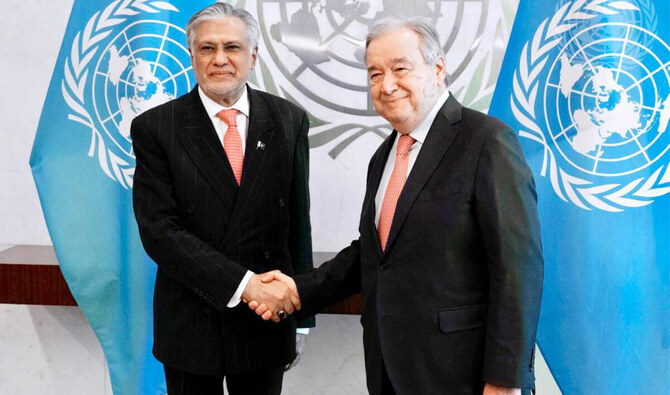
ISLAMABAD: Pakistan’s Deputy Prime Minister Ishaq Dar, who also holds the foreign affairs portfolio, on Wednesday sought the United Nations’ support to curb “cross-border terrorism” from Afghanistan during a meeting with Secretary-General António Guterres, according to an official statement.
Dar traveled to New York this week to address a Security Council debate on multilateralism and global governance convened by China. A day earlier, he called for an immediate ceasefire in Gaza and the urgent delivery of humanitarian aid to people affected by Israel’s war.
He also mentioned a surge in militancy in its two western provinces of his country bordering Afghanistan since a fragile truce between the banned Tehreek-e-Taliban Pakistan (TTP) and Islamabad broke down in November 2022.
The government has frequently blamed the spike in militant activities on Afghanistan, accusing it of sheltering and supporting militant groups that launch cross-border attacks. Afghan officials deny involvement and insist that Pakistan’s security issues are an internal matter for Islamabad.
“The Deputy Prime Minister and Foreign Minister highlighted cross-border terrorism from Afghanistan and called for the UN’s support in countering terrorism within and from Afghanistan,” the foreign office said in a statement released after Dar’s interaction with Guterres.
“He also reaffirmed Pakistan’s desire to provide humanitarian support to the millions of destitute people in Afghanistan and to promote its economic development, including through implementing connectivity projects between Central Asia and Pakistan through Afghanistan,” it added.
During his conversation with the UN chief, the deputy prime minister reaffirmed Pakistan’s support for the UN’s central role in addressing global challenges, including peace and security, development and climate change.
Dar highlighted Pakistan’s commitment to multilateralism and UN peacekeeping efforts, saying Islamabad remained dedicated to promoting international peace and security as a non-permanent member of the UN Security Council.
He also welcomed the UN chief’s Summit of the Future initiative, designed to strengthen global governance and improve multilateral cooperation, expressing hope it would help address financing gaps for developing countries to achieve Sustainable Development Goals and climate targets.
Guterres thanked Pakistan for its contributions to UN peacekeeping and its active engagement in multilateral forums, according to the statement.
TALKS WITH SAUDI MINISTER
Later, the deputy prime minister met with Saudi Vice Minister of Foreign Affairs Eng. Waleed Abdul Karim El-Khereiji, according to a separate statement by the foreign office.
Dar praised the long-standing ties between the two countries and reaffirmed Islamabad’s commitment to strengthening economic and security cooperation with the Kingdom.
“Recognizing the deep-rooted strategic and economic ties between the two countries, the two leaders reiterated their resolve to expand economic cooperation and explore avenues for broad-based collaboration in trade, investment, and commercial sectors, emphasizing the vast investment opportunities available in Pakistan,” the statement said.
The two leaders also discussed the humanitarian crisis in Gaza and the West Bank, calling for the full implementation of the ceasefire, unhindered humanitarian assistance to Gaza and an early start to reconstruction efforts leading to a two-state solution.
They further underscored the critical role of the Organization of Islamic Cooperation in addressing issues concerning the Muslim world.
The meeting reaffirmed the shared commitment of Pakistan and Saudi Arabia to strengthening their strategic partnership for mutual prosperity and regional stability.


![]()

Pakistan’s deputy PM seeks UN support to curb ‘cross-border terrorism’ from Afghanistan
Short Url
https://arab.news/w2ecs
Pakistan’s deputy PM seeks UN support to curb ‘cross-border terrorism’ from Afghanistan
- Ishaq Dar meets Secretary-General António Guterres, says Pakistan will support the destitute in Afghanistan
- Th deputy PM stresses OIC’s role in addressing issues facing the Muslim world in meeting with Saudi minister
Latest updates


© 2026 SAUDI RESEARCH & PUBLISHING COMPANY, All Rights Reserved And subject to Terms of Use Agreement.