

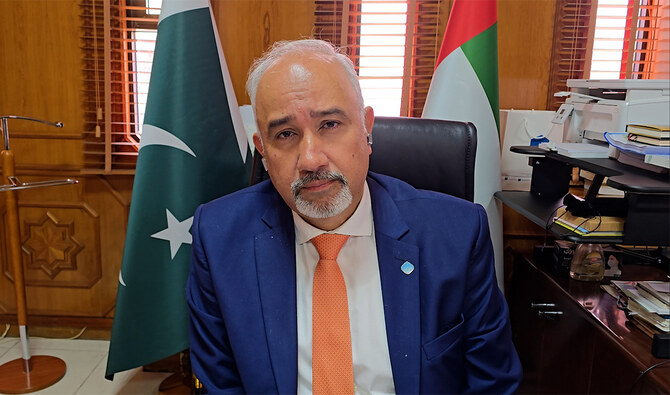

ISLAMABAD: Pakistan’s Ambassador to the United Arab Emirates (UAE), Faisal Niaz Tirmizi, on Tuesday described the Gulf country’s refusal of visas to Pakistani nationals as a “serious and significant” issue, saying both countries are working to resolve it.
The envoy’s comments follow media reports about a decline in visa approvals for Pakistanis by the UAE, particularly over the past year, and a decrease in overall employment opportunities for Pakistani nationals, allegedly due to their lack of respect for local laws and customs, as well as their participation in political activities and sloganeering.
In an interview with Arab News, Ambassador Tirmizi said he had recently held several meetings with UAE officials at the Emirati ministries of foreign affairs and human resource development to resolve the issue.
“This is a very serious issue and it has been raised at the highest level in all the interactions,” he said. “We are working to resolve the issue and hopefully they will be resolved, but the issue is quite significant and I cannot deny that.”
When asked about the outcome of his meetings with UAE authorities, the ambassador said only “slight improvement” had been observed so far, despite raising the matter at the “highest level.”
He said there were a number of factors involved, mainly issues with documents and “criminal record” of the applicants, behind the visa refusals.
“There was a major issue on the authenticity of education and qualification documents from Pakistan that has to be addressed,” he said, adding the UAE was now verifying documents through artificial intelligence (AI) and any discrepancy could result in rejection.
“If they find a dichotomy somewhere, even if the document is genuine but the attestation either in Pakistan or in the UAE is not genuine, it could cause major rejections.”
The envoy said people with a criminal record should not be allowed to travel abroad, not just to the UAE but to any country.
“We have to improve systems within the country to ensure that only genuine travelers, genuine workers with a clean record, are allowed to travel outside and find jobs outside the country,” he said.
Speaking about the lack of employment opportunities for Pakistanis, Tirmizi said the UAE no longer needed unskilled labor as most of its physical infrastructure development was complete.
“We have to train people now for high-skill jobs, like well-trained IT experts, people who are trained in artificial intelligence, people who are trained in accounting, people who have the skills, doctors, physiotherapists and laboratory technicians,” he said.
Tirmizi said he had requested the Pakistani government to launch a four-year nursing program recognized in the UAE and the entire Gulf Cooperation Council (GCC).
“Pakistan has a surplus of labor and we have to improve the quality of education within Pakistan and we have to make sure that those people have the necessary technical, cultural, soft skills and language skills to compete in the international market,” he explained.
Blue-collar workers earn a monthly salary of $272-816 (1,000-3,000 Emirati dirhams), while skilled professionals have salaries ranging between $10,000 and $20,000 (36,730 and 73,460 dirhams), according to the Pakistani envoy.
Yet, Pakistan’s remittances from the UAE, the second biggest source of foreign inflows after Saudi Arabia, has seen a significant growth in recent years.
According to Pakistan’s diplomatic mission in the UAE, year-on-year remittance statistics for the July to December period show a steady trend, with $2.61 billion in FY2023, $2.33 billion in FY2024 and approximately $3.58 billion in FY2025, reflecting a 53.9 percent year-on-year increase.
“That’s a very significant development,” Tirmizi said. “If you have high-skill workers, the level of remittances to Pakistan will increase manifolds.”
About the impact of Pakistan’s participation in recent exhibitions and trade events in the UAE, Tirmizi said it had led to a “significant increase” in the export of Pakistani products, particularly in the IT and food sectors.
“We registered an increase of almost 40 percent in export of our IT [products and services] as the UAE is right now the third biggest destination of IT exports from Pakistan after the United States and the United Kingdom,” he said.
“Similarly, our exports in terms of food products have also increased around 28 percent in the last one year and the UAE has become a major destination for our rice, sesame seeds and pink salt.”
The UAE is Pakistan’s third-largest trading partner after China and the United States, and policymakers in Pakistan consider the Gulf nation an optimal export destination due to its geographical proximity, which minimizes transportation and freight costs while facilitating commercial transactions.
The volume of bilateral trade between Pakistan and the UAE was nearly $5.6 billion in the fiscal year 2023-24 that ended in June, with Pakistani exports to the UAE reaching $1.59 billion and imports totaling $4 billion, according to the Pakistani embassy in the UAE.
Pakistan’s exports to the Emirates rose by 31 percent to $873 million in the first six months of the current financial year (July till December 2024), compared to $670 million during the same period last financial year.


