

Senior UK judge slams political leaders over Gaza asylum verdict response

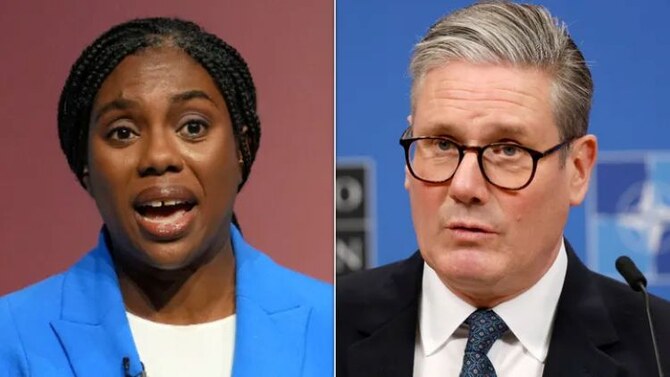
Kemi Badenoch and Keir Starmer. (AP Photo)
Short Url
Updated 18 February 2025
Follow

Senior UK judge slams political leaders over Gaza asylum verdict response

  • PM, opposition leader criticized decision to allow in Palestinian family under Ukraine refugee scheme 
  • Sue Carr: ‘It is really dangerous to make any criticism of a judgment without a full understanding of the facts and the law’

LONDON: The most senior judge in England and Wales has described as “unacceptable” comments by Prime Minister Keir Starmer and opposition leader Kemi Badenoch about a Palestinian family being given asylum in Britain.

Lady Chief Justice Baroness Sue Carr said she was “deeply troubled” after both leaders denounced a decision to take in the family from Gaza under a scheme originally set up for Ukrainian refugees.

At a press conference, Carr added that fears among the judiciary for their safety in the UK is at an “all-time high,” and it is not for politicians to question judges’ decisions made in accordance with the law.

The family of six, who are political opponents of Hamas, planned to stay in the country with a British relative who could provide shelter and financial support.

The two tribunal judges adjudicating the case made clear that their decision would not set a precedent for a Palestinian resettlement scheme in the UK.

However, the case was raised by Badenoch in Parliament last week, saying the decision to allow the family asylum in the UK is “completely wrong and can’t be allowed to stand.”

Starmer replied: “I don’t agree with the decision. The leader of the opposition is right that it’s the wrong decision.

“She hasn’t quite done her homework, however, because the decision in question was taken under the last government, according to their legal framework.”

He added: “It should be Parliament that makes the rules on immigration. It should be the government who make the policy. That’s the principle.

“The home secretary is already looking at the legal loophole that we need to close in this particular case.”

Carr said she had written to Starmer to express her feelings that “both the question and the answer were unacceptable.”

She added: “It is for the government visibly to respect and protect the independence of the judiciary. Where parties, including the government, disagree with their findings, they should do so through the appellate process.”

Carr said: “It is not acceptable for judges to be the subject of personal attacks for doing no more than their jobs.

“Their job is to find the facts on the evidence before them and apply the law as it stands to those facts.”

She added: “If they get it wrong, the protection is a challenge on appeal. If the legislation is wrong, it is Parliament’s prerogative to legislate.

“It is really dangerous to make any criticism of a judgment without a full understanding of the facts and the law.”


’Weak by design’ African Union gathers for summit

Updated 3 sec ago
Follow

’Weak by design’ African Union gathers for summit

ADDIS ABABA: The African Union (AU) holds its annual summit in Ethiopia this weekend at a time of genocide, myriad insurgencies and coups stretching from one end of the continent to the other, for which it has few answers.
The AU, formed in 2002, has 55 member states who are often on opposing sides of conflicts. They have routinely blocked attempts to hand real enforcement power to the AU that could constrain their action, leaving it under-funded and under-equipped.
It has missed successive deadlines to make itself self-funding — in 2020 and 2025. Today, it still relies for 64 percent of its annual budget on the United States and European Union, who are cutting back support.
Its chairman, Mahmoud Ali Youssouf, is reduced to expressing “deep concern” over the continent’s endless crises — from wars in Sudan and the Democratic Republic of Congo to insurgencies across the Sahel — but with limited scope to act.
“At a time when the AU is needed the most, it is arguably at its weakest since it was inaugurated,” said the International Crisis Group (ICG) in a recent report.

- Ignoring own rules -

With 10 military coups in Africa since 2020, the AU has been forced to ignore the rule in its charter that coup-leaders must not stand for elections. Gabon and Guinea, suspended after their coups, were reinstated this past year despite breaking that rule.
Meanwhile, there has been no “deep concern” over a string of elections marred by rigging and extreme violence.
Youssouf was quick to congratulate Tanzania’s President Samia Suluhu Hassan after she won 98 percent in a vote in October in which all leading opponents were barred or jailed and thousands of protesters were killed by security forces.
The AU praised the “openness” of an election in Burundi in June described by Human Rights Watch as “dominated by repression (and) censorship.”
The problem, said Benjamin Auge, of the French Institute of International Relations, is that few African leaders care about how they are viewed abroad as they did in the early days after independence.
“There are no longer many presidents with pan-African ambitions,” he told AFP.
“Most of the continent’s leaders are only interested in their internal problems. They certainly don’t want the AU to interfere in domestic matters,” he added.

- AU ‘supports dialogue’ -

AU representatives point out that its work stretches far beyond conflict, with bodies doing valuable work on health, development, trade and much more.
Spokesman Nuur Mohamud Sheekh told AFP that its peace efforts went unnoticed because they were measured in conflicts that were prevented.
“The AU has helped de-escalate political tensions and support dialogue before situations descend into violence,” he said, citing the work done to prevent war between Sudan and South Sudan over the flashpoint region of Abyei.
But African states show little interest in building up an organization that might constrain them.
Power remains instead with the AU Assembly, made up of individual heads of state, including the three longest-ruling non-royals in the world: Teodoro Obiang Nguema of Equatorial Guinea (46 years), Paul Biya of Cameroon (44) and Yoweri Museveni of Uganda (40).
“The African Union is weak because its members want it that way,” wrote two academics for The Conversation last year.
This weekend, the rotating presidency of the AU assembly passes to Burundi’s President Evariste Ndayishimiye, fresh from his party’s 97-percent election victory.
Coups, conflicts and rights abuses may get discussed, but the main theme is water sanitation.