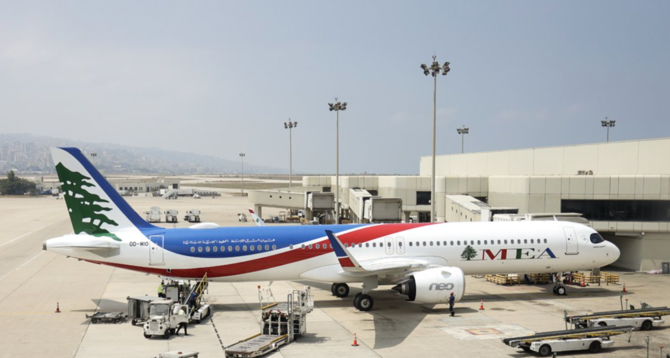
BEIRUT: Beirut airport will close for four hours on Sunday during the funeral of slain Hezbollah leader Hassan Nasrallah, Lebanon’s civil aviation authority has announced.
“The airport will be closed, and takeoffs and landings... will halt on February 23, 2025, from 12:00 p.m. (1000 GMT) until 4:00 pm,” the authority said in a statement carried by official media on Tuesday.
Nasrallah was killed in a huge Israeli air strike on Beirut’s southern suburbs on September 27, as Israel scaled up its campaign against the Iran-backed group following almost a year of cross-border hostilities.
Sunday’s funeral will also be for Hashem Safieddine, a senior Hezbollah figure who had been chosen to succeed Nasrallah, before he too was killed in an Israeli raid in October.
The funeral is to begin at 1:00 p.m. at a sports stadium in Beirut’s southern suburbs, a Hezbollah stronghold.
It will include a speech by current Hezbollah chief Naim Qassem, and is to be followed by a procession to Nasrallah’s burial site.
Iranian foreign ministry spokesman Esmaeil Baqaei said on Monday that Iran “will participate in this ceremony at a high level,” without specifying who would attend.
Qassem at the weekend called for broad participation as a demonstration of the group’s strength.
“We want to transform this funeral into a show of support and an affirmation of (Hezbollah’s) plan and approach, and hold our heads high,” Qassem said.
After decades at the helm of the group once seen as invincible, the killing of the charismatic Nasrallah sent shock waves across Lebanon and the wider region.
Hezbollah has said 79 countries would be involved in the commemoration, whether at an official or “popular” level.
Earlier this month in a security alert about the funeral, the US embassy urged its nationals to avoid the area “which includes the airport.”
Qassem has said Nasrallah would be buried on the outskirts of Beirut “in a plot of land we chose between the old and new airport roads.”
Safieddine will be buried in his hometown of Deir Qanun in southern Lebanon, he added.
Nasrallah had been temporarily buried elsewhere because of security concerns, Qassem said, and the group had also put off the public funeral for security reasons.
A November 27 ceasefire deal put a halt to two months of all-out war between Israel and Hezbollah that saw the group weakened and numerous senior commanders killed.


![]()

Beirut airport to close Sunday during funeral of slain Hezbollah leader
Short Url
https://arab.news/gte4b
Beirut airport to close Sunday during funeral of slain Hezbollah leader
- “The airport will be closed, and takeoffs and landings... will halt on February 23, 2025, from 12:00 p.m. (1000 GMT) until 4:00 pm,” the authority said
- Qassem at the weekend called for broad participation as a demonstration of the group’s strength


Latest updates


Recommended


© 2026 SAUDI RESEARCH & PUBLISHING COMPANY, All Rights Reserved And subject to Terms of Use Agreement.