MANCHESTER: It’s been a year since one of Britain’s richest men bought into its most famous soccer team and vowed to bring the good times back.
So far, it hasn’t gone to plan for Manchester United or Jim Ratcliffe.
The record 20-time English champion are languishing in the bottom half of the Premier League, losing vast sums of money every year and facing fan unrest.
Even head coach Ruben Amorim said recently that this might be the worst team in the club’s storied history.
That’s not all on Ratcliffe, the billionaire owner of petrochemicals giant INEOS, but it has been a rocky start since he paid $1.3 billion for an initial 25 percent stake in United and assumed control of their soccer operations.
There have been high profile hirings and firings, brutal cost cutting, a hike in ticket prices and new lows on the field for a team that had been in decline for more than a decade before he became minority owner.
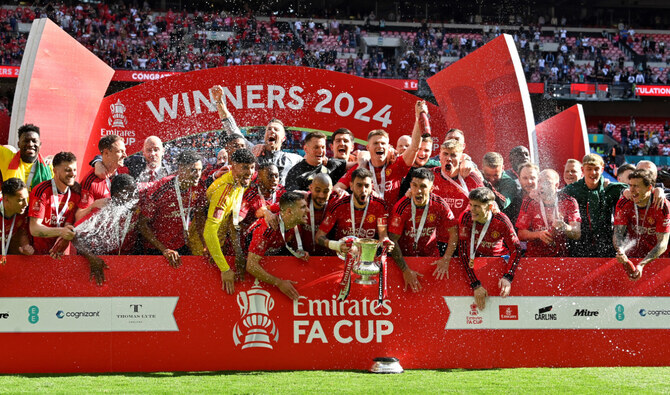
While there was triumph in the FA Cup last year, that success has been overshadowed by supporter protests, job losses, unconvincing transfers and humbling defeats.
Bold plans
Ratcliffe said his investment was “just the beginning of our journey to take Manchester United back to the top of English, European and world football.”
Those ambitions feel further away now than they have in decades, with United 15th in the standings and closer to the relegation zone than the top six after a woeful campaign. Sunday’s 1-0 loss to Tottenham was the 12th in the league this season and an eighth under Amorim, who only took charge in November.
Amorim said: “I have a lot of problems, my job is so hard, but I am here to continue my job to the next week with my beliefs.”
Major overhaul
He was one of a number of key hires made as part of Ratcliffe’s overhaul of United’s soccer operations.
Omar Berrada was lured away from Manchester City to become CEO and Dan Ashworth left Newcastle to take up the role of sporting director. Jason Wilcox, formerly director of City’s academy, became technical director.
Key figures at Ratcliffe’s Ineos Sport, Dave Brailsford and Jean-Claude Blanc, were appointed to the board and Amorim became the final piece of a new leadership team after former manager Erik ten Hag was fired in October.
But that restructuring has been far from a smooth process.
Ten Hag was fired three months after being handed a one-year contract extension with United having lost four of their opening nine league games.
Ashworth left the club less than six months after taking up his role, and after months of negotiations to take him away from Newcastle.
They were expensive missteps.
In total it cost United 10.4 million pounds ($13.09 million) to pay off Ten Hag and his staff and another 11 million pounds ($13.85 million) to trigger Amorim’s release from Sporting Lisbon.
It was reported it cost between 2 and 3 million pounds ($2.5-3.78 million) to hire Ashworth, who spent five months on gardening leave during negotiations with Newcastle.
Cost cutting
Those numbers make uncomfortable reading at a time when United has implemented cost-saving initiatives that they said included staff redundancies of around 250 roles. More could be on the way, according to reports.
In October it emerged that managerial great Alex Ferguson was not beyond the reach of those measures. He will step down from his lucrative role as club ambassador at the end of the season.
In addition to cuts, United raised their lowest-priced tickets to 66 pounds ($81) partway through the season, up from 40 pounds ($49).
They defended that decision by telling fans it could not sustain their current financial losses and were in danger of breaching league rules if they did not act. United reported losses last year of 113.2 million pounds ($140 million).
“We will get back to a cash positive position as soon as possible and we will have to make some difficult choices to get there,” they said in a letter to fans.
Fan protests
That explanation has not gone down well with supporters.
“Fans should not be paying the price for previous bad ownership & bad management,” Manchester United Supporters Trust posted on X. “The supporters bring far more value than the simple collective ticket revenue.”
Supporters spent years trying to drive out the American Glazer family, which is still majority owner, and there continues to be anger toward them after Ratcliffe’s investment.
There have been jeers for the team while United’s performances on the field have continued to slide.
New lows
Ratcliffe’s first season as co-owner saw United endure their worst league campaign in 34 years when they finished in eighth place.
The end of his first full season could be even worse.
The last time they lost 12 of their first 25 games in a league season was in the 1973-74 campaign when they were relegated from the top flight.
Transfer strategy
United have spent around $260 million on players in the two transfer windows under Ratcliffe, but the squad still looks well short of the quality required to challenge for the title.
Forward Joshua Zirkzee has struggled to adapt to the Premier League and defender Leny Yoro missed a large part of the season through injury.
The pressure of complying with the league’s financial rules has placed uncertainty on United’s ability to spend big in the summer to bring in players to suit Amorim’s preferred system, and there is unlikely to be a quick fix.
Stadium rebuild
Ratcliffe wants a world class stadium, either by way of redeveloping United’s iconic Old Trafford or building one from new.
His plans, which include an ambitious redevelopment of the surrounding area, have been backed by the UK government. Financing them, however, is another issue and it is not yet clear where that money will come from.
The modernization of United’s Carrington training ground is well underway after 50 million pounds ($63 million) of investment.
The future
United haven’t lifted the league title since Ferguson’s last season in 2013 and behind the scenes the focus is on winning it for a record-extending 21st time. But with Liverpool on course to equal United’s haul of 20 this season, it is the club’s great rival from Merseyside that could set that new bar first.
Ratcliffe is a hugely successful businessman but, as he is discovering, that does not guarantee success in soccer.

Billionaire Jim Ratcliffe’s first year at Man United has not gone to plan
https://arab.news/8ffhu
Billionaire Jim Ratcliffe’s first year at Man United has not gone to plan
- Ratcliffe said his investment was “just the beginning of our journey to take Manchester United back to the top of English, European and world football”
- “Fans should not be paying the price for previous bad ownership & bad management,” Manchester United Supporters Trust posted on X
A journey to Cambridge reveals surprise cricket heritage
- It is a sign of changing times that the university’s cricket ground, a pitch famed for generating high-aggregate first-class match scores, has been left behind by shifts in the game’s geography, structure and power base
After attending eight T20 World Cup matches in Sri Lanka, I traveled to the UK to join a conference on cricket organized by the Cricket Research Network, or CRN.
It was held on Feb. 25 at one of the University of Cambridge colleges, Hughes Hall, sited next to Fenners, historically the university’s cricket ground. In 1846, Francis Fenner leased land from Gonville and Caius College. Two years later, he sub-let the newly constructed ground to the University Cricket Club, which, together with the Athletics Club, bought the freehold in 1894.
One of the conference presentations was on the topic of “town versus gown,” covering the history of cricket in Cambridge at both university and club level. I was aware that Fenners once had a reputation as a pitch that favored batting. When I mentioned this to the presenter, he asked if I knew that the highest aggregate number of runs scored in a first-class match, in which both sides only batted once, had occurred there. My interest was piqued. A quick search revealed that 1,324 runs were scored in a three-day match between May 17 and May 19, 1950, when the University of Cambridge hosted the West Indian touring team.
On winning the toss, the university chose to bat first, amassing 507 for the loss of only three wickets on the first day, declaring on the second day, having reached 594 for the loss of four wickets. By the end of day two, the West Indies had responded with 379 for two. They continued to bat throughout the third day, ending with 730 for three wickets, Frank Worrell scoring 160 and Everton Weekes, an unbeaten 304, at an average of four runs per over.
In today’s world of instant T20 cricket, in which the average number of runs scored per over is typically eight or more, the scoring frequency at Fenners would be regarded as pedestrian. However, in the context of the times, four runs per over was almost double that which was achieved in the four Test matches between England and the West Indies in 1950. The University of Cambridge team contained five players who would go on to represent England. One of them, Peter May, captained England on 41 occasions. Neither Weekes nor Worrell were impressed by the match, calling it “a farce of a game, just a bore, a little match practice,” adding that “unless you have to work for your runs, there is no fun making them.”
Away from the local Cambridge topic, the other themes at the conference were wide-ranging. The CRN is a group of researchers and writers working on cricket-related matters, having an aim to inform change in the game with critical and empirical research.
Five main themes were covered. The first was gender, the second was history, both weighted toward the women’s game, while the third looked forward to the 2026 Women’s T20 World Cup, which is to be held in England and Wales in June. Inclusion was the fourth theme, which included fandom and using AI to identify talent. This was followed by representations of cricket, including its defining stories. The final session dealt with governance and sustainability, covering illegal betting, climate justice and cricket in the public interest.
As regular readers will know, the last subject area has been addressed a number of times in this column, usually with a level of despair about the unsatisfactory standards and practices displayed by those who are vested with the responsibility for cricket’s governance. These have been in evidence before and during the current T20 World Cup, centring on Pakistan, India and Bangladesh. The day after my visit to Cambridge, Pakistan failed to qualify for the semifinals and rumors circulated that the Pakistan Cricket Board, or PCB, was proposing to fine all members of the squad the equivalent of $18,000. If true, this would be an egregious example of misguided management, effectively fining players for losing matches.
Allegedly, the fines were imposed after Pakistan’s defeat by India in a group-stage match, with a rider that the fines might be waived if semifinal qualification was achieved. Although the PCB’s action is unusual in professional cricket, it is not the first time that the PCB has imposed punitive measures. After a narrow defeat by India in the Asia Cup Final on Sept. 28, 2025, the board briefly blocked its players from playing in T20 franchise leagues. There have been past fines for indiscipline and insurrection. This latest action runs the risk of alienating players and further impacting their desire to perform well. How the players who performed well are going to respond is unknown. Remarkably, there have been later rumors that not all players will be fined or that different levels will apply.
It would seem grossly unfair to fine Sahibzada Farhan, who broke the record for the most runs scored at a T20 World Cup, as well as becoming the only player to score two hundreds in the same tournament. Farhan and Fakhar Zaman, who played in only two games, constructed the highest opening partnership in men’s T20 World Cup history. Two players were not selected at all. What have they done to deserve being fined? Media and social media reactions have focussed on the board, administrators, selectors, coaches, advisers, domestic structures and inadequate development pathways. There has been churn in all of these areas for years. The outcome is a failure to reach the semifinals in four successive ICC tournaments and a loss of patience among the country’s hierarchy.
There is a world of difference between the high pressure, politically charged international game of today and the metronomically compiled 1,324 runs on a placid Fenners pitch in Cambridge, 76 years ago. Yet cricket’s social tensions are a common theme throughout these years, albeit with variations. The West Indian team of 1950 was led by a white Barbadian, John Goddard, born into a family that controlled a leading trading company on the island. His leadership abilities were praised as the West Indies won its first Test match and series in England, but his star fell in the following series in Australia. Throughout the 1950s, white men continued to be chosen as captains. It was not until 1960 that a black man, Frank Worrell, was appointed to lead a series. This heralded an era in which the West Indies came to dominate international cricket for three decades, at times relishing their defeats of England.
One of the presentations at the CRN conference revealed the struggle and obstacles that women’s cricket faced in trying to establish itself in the West Indies. This was also a feature in other countries during the past 76 years, certainly as far as equality of opportunity and treatment was concerned. Research undertaken by members of the CRN has explored this, and the conference panel discussions at Cambridge focussed on the progress that has been made leading into the 2026 Women’s World Cup.
Inevitably, change is accompanied by casualties. One of these appears to be Fenners. In July 2024, Hughes Hall acquired two pieces of land at the edge of Fenner’s, leading to concerns about access to facilities. The number of matches being played there has fallen, along with the quality of pitches, now maintained on a shoestring budget. It is a sign of changing times in cricket that a ground and a pitch famed for generating high-aggregate first-class match scores has been left behind by shifts in the game’s geography, structure and power base.


