ISLAMABAD: Petroleum Minister Musadik Malik on Tuesday said that Pakistan was offering foreign investors 40 offshore and 31 onshore blocks for oil and gas exploration, Pakistani state media reported, as Islamabad pursues a multi-pronged strategy to advance the energy sector.
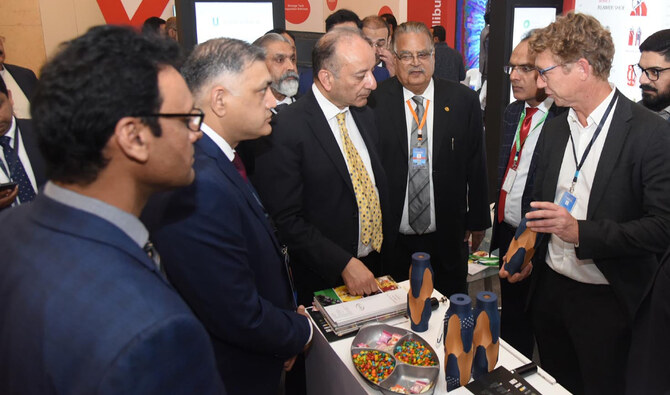
The statement by the petroleum minister came at the 30th Annual Technical Conference and Oil Show in Islamabad, which brought together experts, officials of regulatory bodies and industry stakeholders to discuss oil and gas exploration, and renewable energy resources.
Pakistan is currently focusing on indigenization, electrification and liberalization to advance the energy sector, and has identified Access to Energy, Provision of Affordable Energy and Sustainability of Energy as fundamental pillars of its strategy.
Speaking at the conference, Malik said a significant portion of Pakistan’s natural resources remained unexplored and invited international investors to capitalize on opportunities in these newly opened blocks, the state-run APP news agency reported.
“Pakistan is open for business and we will provide all necessary facilitation to investors,” the petroleum minister was quoted as saying.
Pakistan, which has been struggling with an economic crisis, imports most of its energy needs and is currently looking for ways to lessen the cost of power generation.
Malik said reducing energy prices for the underprivileged was one of the government’s top priorities and efforts were underway to increase local production.
“We are utilizing domestic resources for energy,” he said, adding that Pakistan possessed untapped shale and tight gas reserves.
The minister said the government was introducing a deregulation policy and aimed to open the oil sector under a price cap mechanism, stressing the importance of transitioning the sector to modern technology.
“Prosperity will not come by simply introducing one machine,” he said. “For sustainable growth, we must engage in science and research ourselves.”

Pakistan offers over 70 offshore and onshore blocks to foreign investors for oil and gas exploration
https://arab.news/8yp6b
Pakistan offers over 70 offshore and onshore blocks to foreign investors for oil and gas exploration
- Pakistan, which imports most of its energy needs, is currently looking for ways to lessen the cost of power generation
- The South Asian country is focusing on indigenization, electrification and liberalization to advance its energy sector
Sindh assembly passes resolution rejecting move to separate Karachi
- Chief Minister Shah cites constitutional safeguards against altering provincial boundaries
- Calls to separate Karachi intensified amid governance concerns after a mall fire last month
ISLAMABAD: The provincial assembly of Pakistan’s southern Sindh province on Saturday passed a resolution rejecting any move to separate Karachi, declaring its territorial integrity “non-negotiable” amid political calls to carve the city out as a separate administrative unit.
The resolution comes after fresh demands by the Muttahida Qaumi Movement (MQM) and other voices to grant Karachi provincial or federal status following governance challenges highlighted by the deadly Gul Plaza fire earlier this year that killed 80 people.
Karachi, Pakistan’s largest and most densely populated city, is the country’s main commercial hub and contributes a significant share to the national economy.
Chief Minister Syed Murad Ali Shah tabled the resolution in the assembly, condemning what he described as “divisive statements” about breaking up Sindh or detaching Karachi.
“The province that played a foundational role in the creation of Pakistan cannot allow the fragmentation of its own historic homeland,” Shah told lawmakers, adding that any attempt to divide Sindh or separate Karachi was contrary to the constitution and democratic norms.
Citing Article 239 of Pakistan’s 1973 Constitution, which requires the consent of not less than two-thirds of a provincial assembly to alter provincial boundaries, Shah said any such move could not proceed without the assembly’s approval.
“If any such move is attempted, it is this Assembly — by a two-thirds majority — that will decide,” he said.
The resolution reaffirmed that Karachi would “forever remain” an integral part of Sindh and directed the provincial government to forward the motion to the president, prime minister and parliamentary leadership for record.
Shah said the resolution was not aimed at anyone but referred to the shifting stance of MQM in the debate while warning that opposing the resolution would amount to supporting the division of Sindh.
The party has been a major political force in Karachi with a significant vote bank in the city and has frequently criticized Shah’s provincial administration over its governance of Pakistan’s largest metropolis.
Taha Ahmed Khan, a senior MQM leader, acknowledged that his party had “presented its demand openly on television channels with clear and logical arguments” to separate Karachi from Sindh.
“It is a purely constitutional debate,” he told Arab News by phone. “We are aware that the Pakistan Peoples Party, which rules the province, holds a two-thirds majority and that a new province cannot be created at this stage. But that does not mean new provinces can never be formed.”
Calls to alter Karachi’s status have periodically surfaced amid longstanding complaints over governance, infrastructure and administrative control in the megacity, though no formal proposal to redraw provincial boundaries has been introduced at the federal level.


