King Abdullah reaffirms Jordan’s stance on Palestinian cause, rejects displacement and resettlement

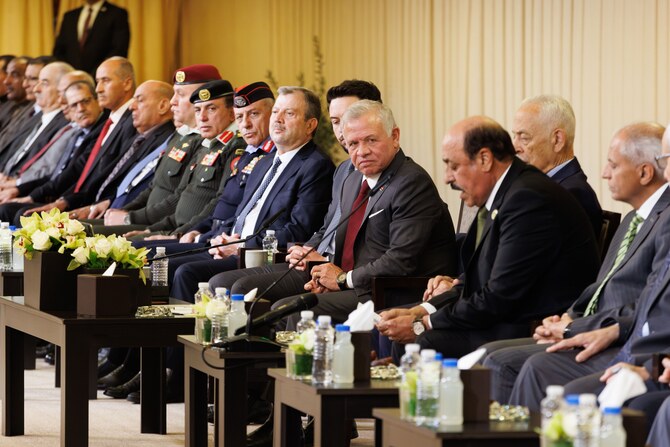
King Abdullah II, speaking at the Royal Hashemite Court during a meeting with military retirees on the occasion of Veterans Day, on Monday reiterated Jordan’s stance on the Palestinian cause, rejecting any form of displacement, resettlement, or the establishment of an alternative homeland. (X/@RHCJO)
Short Url
Updated 17 February 2025
Follow

King Abdullah reaffirms Jordan’s stance on Palestinian cause, rejects displacement and resettlement

  • Was speaking at Royal Hashemite Court during meeting with military retirees on the occasion of Veterans Day

AMMAN: King Abdullah II on Monday reiterated Jordan’s stance on the Palestinian cause, rejecting any form of displacement, resettlement, or the establishment of an alternative homeland, the Jordan News Agency reported.

Speaking at the Royal Hashemite Court during a meeting with military retirees on the occasion of Veterans Day and accompanied by his son Crown Prince Hussein, the king reaffirmed his long-standing position.

“For 25 years, I have been saying no to displacement, no to resettlement, no to the alternative homeland,” the king said.

Despite ongoing regional challenges, the king said he remained optimistic, attributing his conviction to the support of Jordanians, the Jordan Armed Forces-Arab Army, security agencies, and retired military personnel. He also praised veterans, acknowledging their continued readiness to serve the nation.

King Abdullah reflected on his recent visit to Washington, where he emphasized Jordan’s commitment to maintaining stability and protecting national interests during a meeting with US President Donald Trump.

He stressed the importance of reconstructing Gaza without displacing its residents and called for efforts to de-escalate tensions in the West Bank.

Reaffirming Jordan’s commitment to a just and lasting peace, the king underscored that a two-state solution remained the only viable path to stability in the region.

Maj. Gen. Ismail Al-Shobaki, speaking on behalf of the military retirees, praised King Abdullah’s leadership and commitment to Jordanian interests, as well as his support for Arab allies, particularly the Palestinian people.


High-level Turkish team to visit Damascus on Monday for talks on SDF integration

Updated 22 December 2025
Follow

High-level Turkish team to visit Damascus on Monday for talks on SDF integration

  • The visit by Turkiye’s foreign and defense ministers and its intelligence chief comes amid efforts by Syrian, Kurdish and US officials to show some progress with the deal

ANKARA: A high-level Turkish delegation will visit Damascus on Monday to discuss bilateral ties and the implementation of a deal for integrating the Kurdish-led Syrian Democratic Forces (SDF) into ​Syria’s state apparatus, a Turkish Foreign Ministry source said.
The visit by Turkiye’s foreign and defense ministers and its intelligence chief comes amid efforts by Syrian, Kurdish and US officials to show some progress with the deal. But Ankara accuses the SDF of stalling ahead of a year-end deadline.
Turkiye views the US-backed SDF, which controls swathes ‌of northeastern Syria, as ‌a terrorist organization and has ‌warned of ⁠military ​action ‌if the group does not honor the agreement.
Last week Foreign Minister Hakan Fidan said Ankara hoped to avoid resorting to military action against the SDF but that its patience was running out.
The Foreign Ministry source said Fidan, Defense Minister Yasar Guler and the head of Turkiye’s MIT intelligence agency, Ibrahim Kalin, ⁠would attend the talks in Damascus, a year after the fall of ‌former President Bashar Assad.

TURKEY SAYS ITS ‍NATIONAL SECURITY IS AT ‍STAKE
The source said the integration deal “closely concerned Turkiye’s national ‍security priorities” and the delegation would discuss its implementation. Turkiye has said integration must ensure that the SDF’s chain of command is broken.
Sources have previously told Reuters that Damascus sent a proposal to ​the SDF expressing openness to reorganizing the group’s roughly 50,000 fighters into three main divisions and smaller ⁠brigades as long as it cedes some chains of command and opens its territory to other Syrian army units.
Turkiye sees the SDF as an extension of the outlawed Kurdistan Workers Party (PKK) militant group and says it too must disarm and dissolve itself, in line with a disarmament process now underway between the Turkish state and the PKK.
Ankara has conducted cross-border military operations against the SDF in the past. It accuses the group of wanting to circumvent the integration deal ‌and says this poses a threat to both Turkiye and the unity of Syria.