

Saudi Arabia unveils $7.7bn mining investments in Wa’ad Al-Shamal

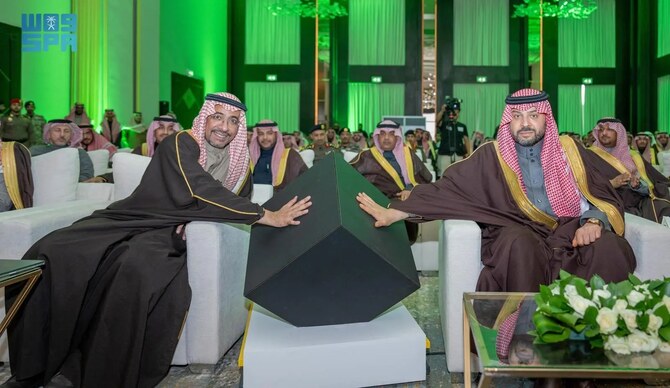
Prince Faisal bin Abdulaziz, governor of the Northern Borders region, right, inaugurated a series of industrial, developmental, and hospitality projects aimed at solidifying the city’s role as a major hub for the Kingdom’s mining industry. SPA
Short Url
Updated 17 February 2025
Follow

Saudi Arabia unveils $7.7bn mining investments in Wa’ad Al-Shamal

RIYADH: Saudi Arabia’s mining sector is poised for a major boost with nearly SR29 billion ($7.7 billion) in investments being directed toward the city of Wa’ad Al-Shamal.

Prince Faisal bin Abdulaziz, governor of the Northern Borders region, inaugurated a series of industrial, developmental, and hospitality projects aimed at solidifying the city’s role as a major hub for the Kingdom’s mining industry.

A major highlight of the announcement was the launch of Ma’aden’s Phosphate 3 project, backed by the Shareek program and an investment of SR28 billion.

This initiative is set to increase Saudi Arabia’s phosphate production capacity to 9 million tonnes annually, building upon the existing Phosphate 1 and Phosphate 2 projects, each producing 3 million tonnes. This expansion is expected to bolster the country’s industrial supply chain, generate new investment opportunities, and create employment within the sector.

The governor emphasized that these projects align with Saudi Vision 2030, which aims to expand the mining sector’s contribution to the national economy.

He highlighted that Wa’ad Al-Shamal has transformed into a model for integrated industrial cities, combining major industries, logistics services, and modern residential communities, which enhance its appeal to both local and international investors.

The event was attended by Minister of Industry and Mineral Resources Bandar Alkhorayef, Deputy Minister for Mining Affairs Khalid Al-Mudaifer, and other key officials from both the public and private sectors.

Additionally, the Saudi Authority for Industrial Cities and Technology Zones launched several new industrial, logistical, and service projects, with investments exceeding SR550 million. These projects include infrastructure development in the industrial zone, which spans 4.3 million sq. meters. As part of this initiative, 32 ready-built units have been established, consisting of 20 pre-built factories and 12 support units covering a combined area of 45,000 sq. meters.

Further key developments include a 132 kilovolt, 200 megavolt-amperes power substation, overhead transmission lines, and a 7-km bridge connecting the industrial zone to the international highway. These projects aim to improve logistics and energy reliability, creating an attractive environment for investments, particularly in the phosphate industry.

In addition, the governor inaugurated the expansion of Ma’aden’s residential city in Wa’ad Al-Shamal, adding 96 new residential units. This brings the total number of housing units to 579, supporting industrial and mining sector employees and their families.

To complement the region's infrastructure improvements, the Movenpick Wa’ad Al-Shamal Hotel, developed with an investment exceeding SR500 million, was officially opened. The five-star hotel is designed to cater to the growing accommodation demand from workers, investors, and visitors to the industrial city and Northern Borders region, further enhancing Wa’ad Al-Shamal’s position as an integrated industrial and investment hub.

As part of broader efforts to advance the mining sector, Alkhorayef, along with the deputy minister for mining affairs and other officials, visited several industrial and developmental projects in Wa’ad Al-Shamal and the Northern Borders region.

The tour included a visit to the Scientific Excellence School in Arar, where the minister reviewed modern training laboratories and met with students and faculty. Established through a partnership between Ma’aden and the Ministry of Education with an investment of approximately SR180 million, the initiative seeks to promote scientific education and develop expertise in STEM fields.

The minister also toured the Saudi Technical Institute for Mining in Arar, which has trained over 1,081 students, including 52 female graduates, in a range of specializations such as underground and surface mining, mining operations, and mechanical and electrical maintenance. Equipped with advanced mining simulation and training facilities, the institute plays a pivotal role in workforce localization and preparing Saudi talent for the mining industry.

The tour also included a visit to the Hazm Al-Jalamid mine, one of the Kingdom’s key phosphate mining sites, producing more than 11 million tonnes of phosphate ore annually.

The Northern Borders region is home to extensive mineral resources valued at approximately SR4.669 trillion.

It is a major source of phosphate, a critical element in global food security due to its role in agricultural fertilizer production. The region also contains high-quality deposits of coal, dolomite, limestone, and silica sand. It currently holds five phosphate ore reserve sites and 29 active mining licenses, including 15 for building materials and 14 for mineral extraction.


Saudi Arabia sets global benchmark in AI modernization

Updated 15 January 2026
Follow

Saudi Arabia sets global benchmark in AI modernization

  • Executives hail the Kingdom’s robust infrastructure and strategic workforce programs

RIYADH: Saudi Arabia is emerging as a global leader in artificial intelligence, according to executives from OpenText, one of the world’s largest enterprise information management companies. 

With 22 years of international AI experience, Harald Adams, OpenText’s senior vice president of sales for international markets, said the Kingdom’s modernization efforts are now setting a global standard.

“From my perspective, Saudi Arabia is not only leading the modernization towards artificial intelligence in the Middle East, I think it is even not leading it only in the MENA region. I think it is leading it globally,” Adams told Arab News.

In an interview, Adams and George Schembri, vice president and general manager for the Middle East at OpenText, discussed the Kingdom’s significant investments in AI during the inauguration of OpenText’s new regional headquarters in Riyadh.

“So for us (OpenText), from our perspective, it was a strategic decision to move our MENA headquarters to Saudi Arabia because we believe that we will see here a lot of innovation coming out of the country, we can replicate not only to the MENA region, maybe even further to the global level,” Adams said.

The new headquarters, located in the King Abdullah Financial District, will serve as a central hub for OpenText customers and partners across the Middle East. Its opening reflects a broader trend of tech giants relocating to Riyadh, signaling the Kingdom’s rise as a hub for global AI innovation.

Adams attributed Saudi Arabia’s lead in AI modernization to a combination of substantial financial backing, a unified national strategy, and a remarkable pace of execution.

“I mean, a couple of things, because the ingredients in Saudi Arabia are of course, quite interesting. On the one hand side, Saudi Arabia has deep pockets and great ambitions. And they are, I mean, and they are executing fast, yeah,” he said.
“So from that perspective, at the moment, what we see is that there are, especially on the government side, I can’t see any other government organizations globally moving faster into that direction than it is happening in Saudi Arabia. Not in the region, not even on a global level, they are leading the game,” he underlined.

Schembri added, “Saudi’s AI vision is one of the most ambitious in the world, and AI on a national scale is not good without trusted, secured, and governed, and this is where OpenText helps to enable the Saudi organizations to be able to deliver on the 2030 Vision.”

“The Kingdom’s focus on AI and digital transformation creates a powerful opportunity for organizations to unlock value from their information,” Schembri stated.
“With OpenText on the ground in Riyadh, our customers gain direct access to trusted global expertise combined with local insight — enabling them to manage information securely, scale AI with confidence, and compete on a global stage,” he added.

DID YOU KNOW?

• Saudi Arabia ranks 5th globally and 1st in the region for AI growth under the 2025 Global AI Index.

• The Kingdom is also 3rd globally in advanced AI model development, trailing only the US and China.

• AI is projected to contribute $235.2 billion — or 12.4 percent — to Saudi Arabia’s GDP by 2030.

The inauguration of OpenText’s new regional headquarters was attended by Canada’s Minister of International Trade and Economic Development, Maninder Sidhu, and Jean-Philippe Linteau, Canada’s ambassador to Saudi Arabia. 

Sidhu emphasized the alignment of Saudi Vision 2030 with Canada’s economic and innovation goals.

“His Highness (Crown Prince Mohammed bin Salman) and Vision 2030, there is a lot of alignment with Canada, as you know, with the economic collaboration, with his vision around mining, around education, tourism, healthcare, you look at AI and tech, there’s a lot of alignment here at OpenText Grand opening their regional headquarters,” Sidhu told Arab News.

Saudi Arabia’s AI ambitions are projected to contribute $235.2 billion — or 12.4 percent — to its GDP by 2030, according to PwC. The Saudi Data and AI Authority, established by a royal decree in 2019, drives the Kingdom’s national data and AI strategy.

One flagship initiative, Humain, chaired by Crown Prince Mohammed bin Salman, was launched in May 2025 under the Public Investment Fund. It aims to build a full AI stack — from data centers and cloud infrastructure to models and applications — positioning Saudi Arabia as a globally competitive AI hub. The project plans to establish a data center capacity of 1.8 GW by 2030 and 100 GW of AI compute capacity by 2026.

Saudi Arabia is also expanding international partnerships. In May 2025, Humain signed a $5 billion agreement with Amazon Web Services to accelerate AI adoption domestically and globally, focusing on infrastructure, services, and talent development.

The Kingdom ranked fifth globally and first in the Arab region for AI sector growth under the 2025 Global AI Index, and third worldwide in advanced AI model development, behind only the US and China, according to the Stanford University AI Index 2025.

Education is another pillar of Saudi AI strategy. Starting in the 2025-26 academic year, AI will be taught as a core subject across all public school grades, reaching roughly 6.7 million students. The curriculum will cover algorithmic thinking, data literacy, and AI ethics.

OpenText executives emphasized their commitment to supporting Vision 2030 and the national AI strategy through workforce development.

“OpenText has put a lot of investment in the Kingdom, right. We brought cloud to the Kingdom, we’ve opened our headquarters in the Kingdom, we’ve basically hiring Saudis in the Kingdom, We basically building, if you like, an ecosystem to support the Kingdom. And on top of that, what we’re doing is we’re putting a plan together, if you like, a program to look at how we can educate, if you like, the students at universities,” Schembri said.
“So this is something that we are looking into, we are basically investigating and to see how we can support the Saudi nationals when they come into the workplace. And I’m really excited. I have Harry who is, our leadership who’s supporting this program.”
“It’s something that we are putting together. It’ll take some effort. So it’s still in play because we want to make sure what we put it basically delivers on what we're trying to achieve based on the vision of Saudi,” he added.

“The younger generation is sooner or later either working for us or maybe for a partner or for maybe for a customer. So that’s why we are to 100 percent committed to enable all of that,” Adams said.