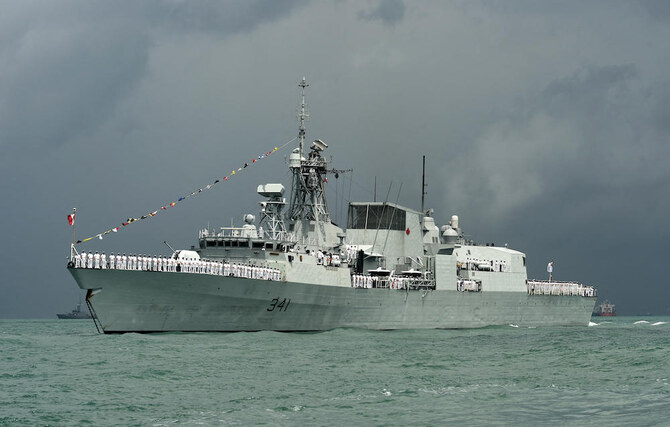
TAIPEI: Taiwan said it detected 24 Chinese military aircraft near the island on Sunday as a Canadian warship passed through the sensitive Taiwan Strait.
It was the first Canadian naval vessel to transit the waterway this year, Taiwan’s foreign ministry said, and came days after two US ships made the passage.
The United States and its allies regularly pass through the 180-kilometer (112-mile) Taiwan Strait to reinforce its status as an international waterway, angering China.
Beijing has never ruled Taiwan, but it claims the democratic island as part of its territory and has threatened to bring it under its control by force.
“The Royal Canadian Navy’s Halifax-class frigate HMCS Ottawa sailed through the Taiwan Strait on February 16,” Taiwan’s foreign ministry said in a statement.
“Canada has once again taken concrete action to uphold the Taiwan Strait’s freedom, peace and openness, demonstrating its firm stance that the strait is international waters,” it added.
Taiwan’s defense ministry said on Sunday that 24 Chinese aircraft, including fighter jets and drones, were detected carrying “joint combat readiness patrols” with military vessels around the island.
During the Canadian warship’s passage, China’s military radioed the ship and warned it to change course, Taiwanese media reported.
A US destroyer and an ocean survey ship traveled through the strait starting on February 10, drawing criticism from China’s military, which said it sent the “wrong signal and increased security risks.”
Data published by the Taiwan defense ministry showed 62 Chinese military aircraft were detected near the island in the 48 hours to 6:00 am local time on Wednesday, coinciding with the US ships’ transit.
Washington’s latest passage through the Taiwan Strait was the first time since US President Donald Trump took office in January.
It came after Trump and Japanese Prime Minister Shigeru Ishiba said they “opposed any attempts to unilaterally change the status quo (in the Taiwan Strait) by force or coercion.”


![]()

Taiwan detects 24 Chinese aircraft as Canadian ship transits waters
Short Url
https://arab.news/pqpdg
Taiwan detects 24 Chinese aircraft as Canadian ship transits waters
- It was the first Canadian naval vessel to transit the waterway this year
- During the Canadian warship’s passage, China’s military radioed the ship and warned it to change course


Latest updates


Recommended


© 2026 SAUDI RESEARCH & PUBLISHING COMPANY, All Rights Reserved And subject to Terms of Use Agreement.