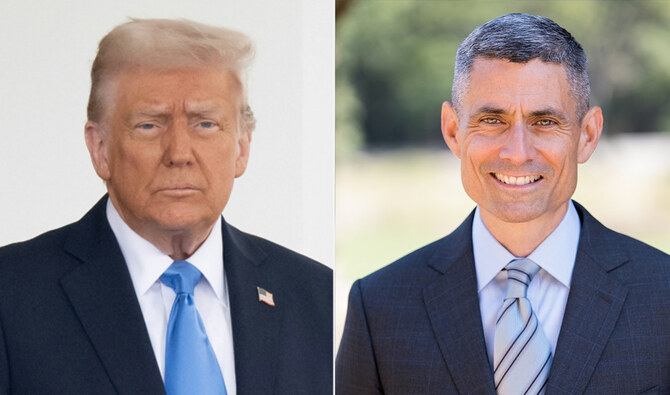
KARACHI: President Donald Trump’s nomination of an Indian-origin security expert, Paul Kapur, as the United States (US) assistant secretary of state for South Asian affairs could bring “renewed challenges” for Pakistan, but there would be no significant shift in the already restrained US policy toward Islamabad, analysts said on Saturday.
Pakistan and the US collaborated during the Cold War and in the fight against Al-Qaeda after 9/11, yet their relationship was also tested by divergent priorities on various issues. In recent years, Washington and Islamabad’s ties deteriorated as the former suspected the latter of supporting the Taliban in their 2021 takeover of Kabul, allegations which Islamabad rejected. Tensions rose further in 2022 when former Pakistan premier Imran Khan accused the Joe Biden administration of orchestrating his ouster via a parliamentary vote, a charge the US denied.
Kapur, who will succeed Donald Lu upon Senate confirmation, has long advocated for a closer US-India partnership and has been critical of Pakistan’s security policies. His appointment reflects a broader bipartisan consensus in Washington on prioritizing India as a key strategic partner, particularly in the Indo-Pacific.
Political analysts and foreign policy experts believe that while Kapur’s nomination underscores continuity in Washington’s South Asia approach, its policy positions suggest a “tougher stance toward Pakistan.”
“There is a growing bipartisan consensus in Washington on strengthening the US-India strategic partnership. Several Trump appointees, including Kapur, are advocates of a deeper relationship between both countries,” said Syed Hassan Akbar, a senior foreign policy specialist.
“How this reflects in policy will shape US-Pakistan relations going forward. But given the realities of our region we should not expect any significant departure in US policy toward Islamabad, which has been restrained ever since the US withdrawal from Afghanistan.”
Kapur is President Trump’s third top pick among Indian-origin Americans after Tulsi Gabbard and Kash Patel, who both have already been cleared by the US Senate as director of National Intelligence and head of the Federal Bureau of Investigation (FBI).
Akbar pointed out that Kapur has previously argued against US security assistance to Pakistan, saying that it would be perceived negatively in New Delhi and instead calling for a continued dialogue and limited economic engagement between Washington and Islamabad.
Abdul Basit, a former Pakistani high commissioner to India, echoed the concerns and said that Kapur’s appointment would likely increase pressure on Pakistan at an operational level even as the broader strategic dynamics remain unchanged.
“This is a strategic decision by the United States, and both Democrats and Republicans are committed to strengthening their partnership with India,” Basit said.
“But operationally, we will feel the impact.”
Pakistan’s diplomatic position remains weak due to a lack of economic leverage and a struggling diaspora engagement, according to Basit.
“Pakistan is not viewed as strategically significant, except in negative contexts such as terrorism, nuclear proliferation, and Afghanistan,” he said.
“Our embassy faces limitations and unless we mobilize Pakistani-Americans effectively, improving our diplomatic presence will be difficult.”
He stressed the importance of political stability in Pakistan, arguing that “unpredictability weakens foreign policy.”
“Political stability is crucial, predictability and consistency are key. Without it, the country will not be strong internally, and foreign policy will suffer as all these factors are interconnected,” the former diplomat said.
While Islamabad has exercised caution in commenting on Trump’s seemingly anti-Pakistan appointments, Syed Zulfikar Abbas Bukhari, a key figure in the Pakistan Tehreek-e-Insaf (PTI) opposition party, called Kapur’s nomination an “internal” US bureaucratic matter.
He, however, welcomed the departure of Donald Lu, whom PTI founder and former Pakistan prime minister Imran Khan had accused of orchestrating his removal from power via a parliamentary no-trust vote in 2022.
“This is the US’s internal matter of bureaucratic changes. It’s a welcome change as whatever Mr. Donald Lu touched, he destroyed. A lot of the unrest in the subcontinent is due to him,” Bukhari added.
Christopher Clary, an associate professor of political science at the US University at Albany, highlighted Kapur’s longstanding academic focus on Pakistan, noting that Trump’s South Asia envoy pick had portrayed Pakistan as a “uniquely dangerous state” due to its strategic choices.
“Kapur likely will be more skeptical of Pakistan than any previous incumbent of that office,” Clary wrote on X. “He has been involved for many years in exploring opportunities for US-India cooperation, but his academic work has had a greater Pakistan emphasis.”
With Kapur in the key position, analysts expect the US to continue its policy of limited engagement with Pakistan, while focusing on strategic alignment with India.
Akbar suggested Pakistan to prioritize its economic growth and regional stability to navigate the evolving geopolitical landscape.
“Pakistan’s focus should be on improving its economy and addressing challenges in our immediate neighborhood while ensuring that, at a minimum, crisis management mechanisms continue to operate with Washington,” he said.
Basit, meanwhile, said Pakistan must make proactive efforts to strengthen its diplomatic position.
“Unless we take serious steps to bring political stability at home and mobilize our diaspora in the US, we will have to face challenges in ties with America,” he said.


![]()

US President Trump’s South Asia envoy pick signals ‘renewed challenges’ for Pakistan — analysts
Short Url
https://arab.news/g7g2y
US President Trump’s South Asia envoy pick signals ‘renewed challenges’ for Pakistan — analysts
- Paul Kapur, Trump nominee for assistant secretary of state for South Asia, has been a vocal critic of Pakistan’s policies
- While Islamabad has not commented on the nomination, member of jailed ex-PM Imran Khan’s party calls it ‘welcome change’
Latest updates


Recommended


© 2026 SAUDI RESEARCH & PUBLISHING COMPANY, All Rights Reserved And subject to Terms of Use Agreement.