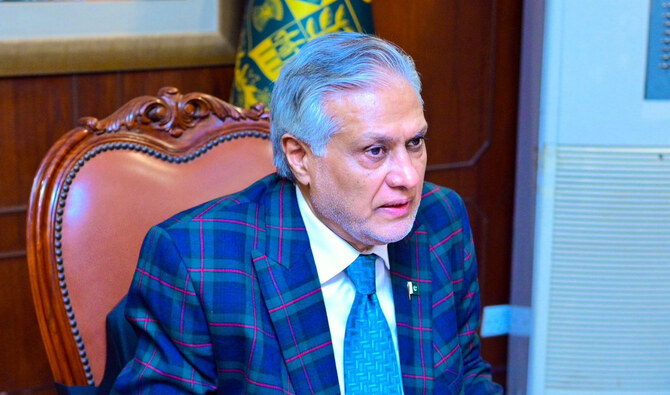
ISLAMABAD: Pakistan’s Deputy Prime Minister Ishaq Dar will travel to New York to attend a United Nations Security Council (UNSC) meeting on global governance and multilateralism next week, the foreign office announced on Friday.
The meeting will be chaired by Chinese Foreign Minister Wang Yi, as China holds the council’s rotating presidency for the month. The deliberations come at a time of growing concerns about multilateralism, particularly after United States President Donald Trump’s return to the White House.
During his previous term, Trump withdrew the US from key international agreements, challenged traditional alliances and took a more unilateral approach to foreign policy. His new administration’s stance on global governance and international institutions remains under close watch by world leaders.
“The Deputy Prime Minister and Foreign Minister of Pakistan, Senator Mohammad Ishaq Dar, will travel to New York to participate in the high-level meeting of the United Nations Security Council (UNSC) on ‘Practicing Multilateralism: Reforming and Improving Global Governance,’ scheduled to be held from 18th February 2025,” foreign office spokesperson Shafqat Ali Khan said on Friday.
“The meeting has been convened by China under its rotating presidency of the Security Council for the month of February 2025. It will be chaired by H.E. Wang Yi, the Foreign Minister of China,” he added.
Dar is also expected to hold bilateral meetings with foreign ministers from other states as well as senior UN officials on the sidelines of the event.
While it is customary for Pakistan’s top leadership, particularly its prime ministers, to attend the UN General Assembly session in New York every September, visits to participate in other meetings at the world body are relatively rare.
Pakistan was elected as a non-permanent member of the UNSC for the 2025-2026 term in June 2024 with 182 out of 193 votes.
It officially began its two-year tenure on January 1, 2025.


Pakistan’s deputy PM to attend Security Council meeting on multilateralism next week
https://arab.news/65rhb
Pakistan’s deputy PM to attend Security Council meeting on multilateralism next week

- Ishaq Dar will travel to New York to participate in the gathering convened by China
- Dar will hold meetings with foreign ministers from other states as well as UN officials

Pakistani, Bangladeshi officials discuss trade, investment and aviation as ties thaw
- Pakistan and Bangladesh were once one nation, but they split in 1971 as a result of a bloody civil war
- Ties between Pakistan, Bangladesh have warmed up since last year and both nations have resumed sea trade
ISLAMABAD: Pakistan's High Commissioner to Bangladesh Imran Haider on Sunday met Chief Adviser Muhammad Yunus in Dhaka, the latter's office said on, with the two figures discussing trade, investment and aviation.
Pakistan and Bangladesh were once one nation, but they split in 1971 as a result of a bloody civil war, which saw the part previously referred to as East Pakistan seceding to form the independent nation of Bangladesh.
Ties between Pakistan and Bangladesh have warmed up since former prime minister Sheikh Hasina’s ouster as a result of a student-led uprising in August 2024. Relations remain frosty between Dhaka and New Delhi over India’s decision to grant asylum to Hasina.
Pakistan has attempted to forge closer ties with Bangladesh in recent months and both South Asian nations last year began sea trade, followed by efforts to expand government-to-government commerce.
"During the meeting, both sides discussed ways to expand cooperation in trade, investment, and aviation as well as scaling up cultural, educational and medical exchanges to further strengthen bilateral relations between the two South Asian nations," Yunus's office said in a statement on X.
In 2023-24 Pakistan exported goods worth $661 million to Bangladesh, while its imports were only $57 million, according to the Trade Development Authority of Pakistan. In Aug. this year, the Pakistani and Bangladeshi commerce ministries signed a memorandum of understanding to establish a Joint Working Group on Trade, aiming to raise their bilateral trade volume to $1 billion in the financial year that began in July.
The Pakistani high commissioner noted that bilateral trade has recorded a 20 percent growth compared to last year, with business communities from both countries actively exploring new investment opportunities, according to the statement.
He highlighted a significant increase in cultural exchanges, adding that Bangladeshi students have shown strong interest in higher education opportunities in Pakistan, particularly in medical sciences, nanotechnology, and artificial intelligence. Haider also said that Dhaka-Karachi direct flights are expected to start in January.
"Chief Adviser Professor Muhammad Yunus welcomed the growing interactions between the two countries and emphasized the importance of increased visits as well as cultural, educational and people-to-people exchanges among SAARC (South Asian Association for Regional Cooperation) member states," the statement read.
"Professor Yunus also underscored the need to further boost Bangladesh–Pakistan trade and expressed hope that during Mr. Haider’s tenure, both countries would explore new avenues for investment and joint venture businesses."


