

Morocco’s history-making surfer Ramzi Boukhiam believes best is yet to come

1 / 4
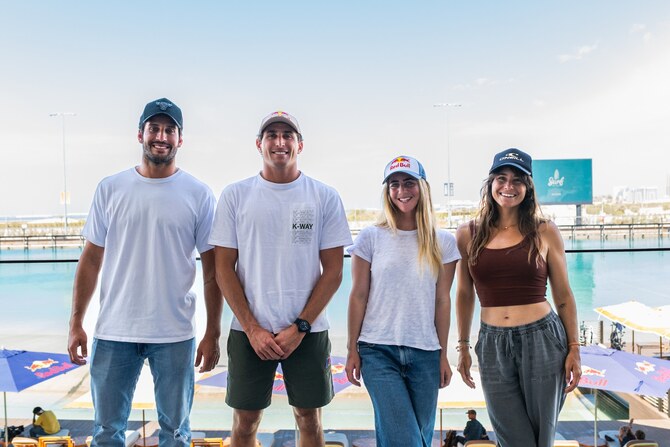
Morocco's history-making surfer Ramzi Boukhiam, a two-time Olympian, has high ambitions for his sophomore season on the WSL's Championship Tour. (Supplied/World Surf League)
2 / 4
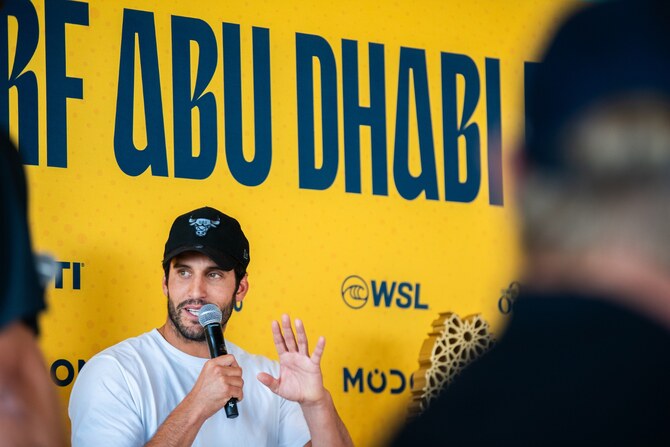
Morocco's history-making surfer Ramzi Boukhiam, a two-time Olympian, has high ambitions for his sophomore season on the WSL's Championship Tour. (Supplied/World Surf League)
3 / 4
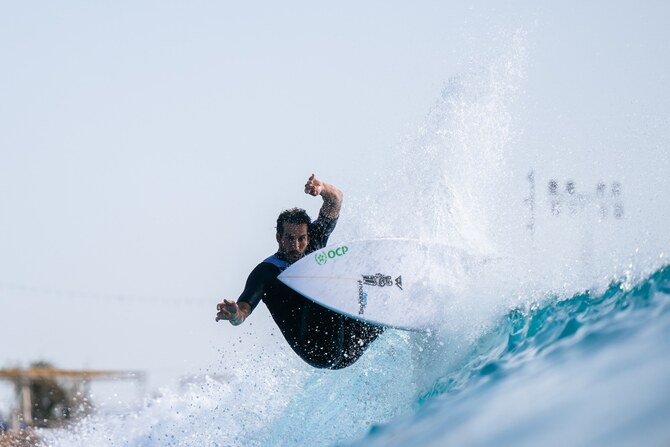
Morocco's history-making surfer Ramzi Boukhiam, a two-time Olympian, has high ambitions for his sophomore season on the WSL's Championship Tour. (Supplied/World Surf League)
4 / 4
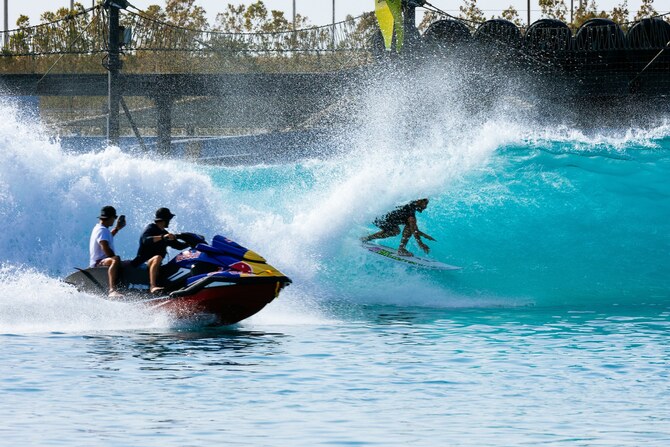
Morocco's history-making surfer Ramzi Boukhiam, a two-time Olympian, has high ambitions for his sophomore season on the WSL's Championship Tour. (Supplied/World Surf League)
Short Url
Updated 14 February 2025
Follow

Morocco’s history-making surfer Ramzi Boukhiam believes best is yet to come

  • Two-time Olympian has high ambitions for his sophomore season on the WSL’s Championship Tour
  • Last year was a big one for Boukhiam, not just because of his second appearance at the Olympics

ABU DHABI: Last summer at the Paris Olympics, Moroccan surfer Ramzi Boukhiam attacked one monster wave after another at Tahiti’s iconic Teahupo’o, going toe-to-toe with Brazilian Joao Chianca in one of the most memorable heats of the Games.
The duo traded perfect 8-to-10-foot barrels throughout the heat, with Boukhiam scoring a stunning 9.70 on one of his waves. But the Moroccan’s total, which combines the highest-scoring two waves per surfer, ended up being just 0.3 points short of Chianca’s tally and he missed out on a spot in the quarter-finals and a chance to fight for an Olympic medal.
“It was pretty much the conditions that I love, that I dream of. Perfect heats, at perfect Teahupo’o, big waves, barrels. And I was against Joao Chianca. He’s one of the best barrel riders in the world. And he’s a good friend. And I knew he charged a lot,” Boukhiam told Arab News on the sidelines of the ongoing Surf Abu Dhabi Pro at Hudayriyat Island in the UAE capital.
“We knew that both of us were going to go for it and bring the best out of each other. And we did. It was an amazing, amazing, amazing heat. And I was really bummed.
“I think it’s the toughest loss of my career. Even though I put on a show and it was amazing, but I still didn’t come home with a medal. So, at the end of the day, I was really sad. But I’m proud of my performance.”


It may have felt like he left Tahiti empty-handed, but Boukhiam walked away from his second appearance at the Olympics with scores of new fans, from the Middle East, North Africa and beyond.
The Paris Games gave surfing a wider platform compared to when the sport made its Olympics debut in Tokyo three years earlier.
Opting to stage the competition in Tahiti, the Paris Olympics showcased surfing at its best, with massive barrels and elite-level ripping on full display.
“When you see those big, perfect barrels, even if you don’t understand nothing about surfing, you’re going to be like, wow! You know? It gets you. It captivates you,” Boukhiam said.
“So, I really feel like these Olympics were way bigger for surfing than the other one. And we really showed what surfing is all about. I wish I had the medal. But it is what it is. It was a nice one.”
Last year was a big one for Boukhiam, not just because of his second appearance at the Olympics. The Agadir native spent 10 years battling on the Qualifying Series before he finally clinched a spot for the 2023 Championship Tour, or CT, of the World Surf League, or WSL, only to get injured and break his ankle in training just before the start of the new season.
He got his chance a year later when he was handed the replacement slot for 2024 and a couple of withdrawals made way for the first Arab surfer to compete on the WSL’s CT, the highest-level of competition in the world of professional surfing.
Boukhiam finished his rookie campaign ranked 12th in the world and he has loftier targets for his sophomore season, which began at Pipeline in Hawaii a couple of weeks ago before landing on Abu Dhabi shores this weekend for the first CT event to be staged in the Middle East.
“My first year, I had a lot of fun,” Boukhiam said. “And I was super proud of a few moments in the year where my back was against the wall and I managed to step it up and turn the situation around and come out with big results and just boost of confidence, coming back from my injury and everything.
“So, I was pretty happy and proud of myself after a nice year.”
An interference call in the round of 32 saw Boukhiam finish 17th at Pipeline last week and he admits it was a tough pill to swallow given he had high hopes for the opening event of the 2025 season.
“It really felt like I let an opportunity go by to have a really, really good result. So it hurt a lot,” he said.
Boukhiam quickly put the disappointment behind him on landing in the UAE for a historic inaugural Surf Abu Dhabi Pro, and is excited to compete in front of Moroccan and Arab fans.
“Honestly, it’s super cool. And I’m sure I’m going to see some Moroccan flags the day of my heat. I know a lot of friends and a lot of Moroccans that live here in Dubai and in Abu Dhabi as well. So, I hope they’ll come around and check it out and support,” he said.
“Hopefully it’s going to motivate the kids from here in the Middle East. Maybe a champion is going to come from here soon. And you guys have good waves close by. You know, Sri Lanka and everything. So, yeah, it’s a perfect start for the region. Having the best surfers on the planet in your home. I’m super happy.”


Winning his first CT event is high up on Boukhiam’s bucket list for 2025, and he’s also hoping to finish the year in the top five.
“I know I can do it. It’s really hard, but I know I can do it. So, I’m going to go for it,” said Boukhiam, whose best CT finish so far was clinching third at the Tahiti Pro last year after defeating surfing great Kelly Slater in the quarter-finals.
At 31, Boukhiam believes his best days are still ahead of him. He feels he’s finally coming into his own competing against the world’s best and isn’t putting any limits on his ambitions.
Could a third Olympics appearance be in the cards for him at LA 2028?
“If my body lets me, for sure, I’m thinking about it,” he said.
“I feel fresh, honestly. I feel the strongest I’ve ever been. My surfing is there. I feel like I’m almost still improving a little bit, which is not usual. At 31, normally you start going down. But I feel like I’m getting better and stronger. So, Alhamdulillah, yeah. Why not? Why not?
“I’m going year by year and event by event. I just want to do good in the CT. And if I’m ready for the Olympics, I’ll be ready, inshallah.”
Boukhiam was born in Agadir to a Moroccan father and Dutch mother. He lost his father at the age of 11 and later moved with his mother and brother to Biarritz, France — the epicenter of European surfing.
After a strong junior career and a decade toiling on the Qualifying Series, Boukhiam, who is back based in Agadir, is finally where he belongs, competing against the best surfers on the planet.
Asked what his advice would be for Arab surfers looking to follow in his footsteps, Boukhiam said: “I know it’s cliche, but keep going, because that’s exactly what I did. I had a good junior career, and then I had ups and downs for more than eight, nine, 10 years on the Challengers and all that stuff, and then finally qualified at 29,” he said.
“So I kept pushing with a lot of injuries, a lot of stuff. I know it’s cliche, but keep pushing, believe, and keep improving.
“Forget about what everyone is doing. Do you, and do the best of you, and try to be the best of you every day, and keep going, and try to do the maximum so you have no regrets. I think that’s the mindset you need to have.”


Expressions of disquiet concerning cricket’s power base

Updated 29 January 2026
Follow

Expressions of disquiet concerning cricket’s power base

  • Increasing number of players, coaches may be prepared to oppose overconcentration of power in game

Last week’s crisis over Bangladesh’s participation in the upcoming men’s T20 World Cup ended with the International Cricket Council’s decision to replace Bangladesh with Scotland. In a show of support for Bangladesh, the Pakistan Cricket Board indulged in saber rattling by suggesting that it may boycott the tournament.

This is unlikely and would invite severe repercussions, effectively creating a schism in cricket. The stance may be interpreted as a continuation of Pakistan’s ongoing challenge to India’s hegemony of the game.

In a sign of the way in which views have polarized, Jason Gillespie, a former Australian cricketer and international coach, posted the following on X: “Has there been an explanation from the ICC why Bangladesh could not play their matches outside of India? From memory, India refused to play Champions Trophy matches in Pakistan and were allowed to play those matches outside of Pakistan. Can someone make this make sense?”

Among the plentiful responses were many from Indian sources, who were not kindly disposed towards Gillespie’s question. He took the post down, saying: “I got abused for asking a simple question.”

On the surface it may appear to be a simple question, but it hits at the heart of a complex issue. Gillespie’s critics have been quick to seize on the fact that he was, for six months in 2024, coach of the Pakistan national men’s Test team and that he will be the coach of the new Kingsman Hyderabad franchise in the Pakistan Super League in April. This involvement has been interpreted as evidence of bias against India.

Another respected player, Jason Holder, former captain of the West Indies, expressed some forthright thoughts in a podcast earlier this month. One of these related to the selection of Pakistani players in franchise leagues. He commented that it was sad that “certain Pakistanis can’t be involved in certain teams because they are owned by Indian owners.” Holder also expressed his sadness at the impact on cricket of relations between India and Pakistan.

Separately, Moeen Ali, of England, went further in an interview given while playing in the Bangladesh Premier League in January. His view is that the ICC does not act like a neutral guardian of the game, effectively serving the interests of “one cricket nation.” Ali added that everyone inside the game knows “who actually runs things,” but few are willing to say so publicly.

Neither did he directly, but we are safe to assume the glaringly obvious — that he was referring to India. It is understandable that many within the game are reluctant to rock the boat, partly out of fear about the opprobrium which follows, and to which Azeem Rafiq can testify.

Gillespie has been the source of social media abuse and Holder has also been subject to negative comment. He has played for franchises owned by Indians in India, South Africa, the UAE and the Caribbean. Ali has done likewise and it is noticeable that in December 2025 he announced that will play in the Pakistan Super League in April 2026, rather than the Indian Premier League, where he has represented three franchises since 2018. The league is now adopting an Indian, youth-driven strategy, which is reducing opportunities for experienced overseas players. In a surprise announcement this week, Ali announced that he will play for Yorkshire in the T20 Blast in 2026. This reverses his decision during 2025 to retire from English domestic cricket.

Opportunities for cricketers to play in franchise leagues are still on the increase. Almost 11 months ago I was fortunate to interview Abhishek Bachchan, who had been revealed as a co-owner of the European T20 Premier League. The league, which is approved by the ICC, consists of a partnership between the national cricket boards of Ireland, Scotland and the Netherlands. At the time of the interview the intention of the owners was to hold the first edition of the event between July 15 and Aug. 3, 2025.

In my column, following the interview, I suggested that the ETPL’s promoters had their work cut out, given that there were only five months to go until mid-July. It was clear that discussions with players and their agents were underway, as were those with potential franchisees and investors. At the time that space was crowded because the focus of these stakeholders was on the sale of equity in The Hundred. Postponement of the ETPL was announced in early June 2025. In the intervening months, time has been well spent leading to last week’s announcement that the ETPL will launch in August 2026.

Exact dates and format have not been revealed, but it is understood that late August to mid-September is the preferred option. The original idea was to hold the league prior to The Hundred, which occupies most of August. Instead, it is now planned to open after the 2026 Hundred concludes on Aug. 16. Originally a six-franchise league was proposed, based on teams in Dublin, Belfast, Edinburgh, Glasgow, Amsterdam and Rotterdam. This remains the case and, to date, three teams have been confirmed for Amsterdam, Belfast and Edinburgh.

It was a surprise to learn the identities of the owners. The rights to own the Amsterdam Flames have been acquired by a trio consisting of Steve Waugh, the former Australian captain; Jamie Dwyer, one of Australia’s greatest-ever male hockey players; and Tim Thomas, former CEO of the Centre for Australia-India Relations.

Another Australian cricketer, a current one, Glenn Maxwell, will own the Belfast-based Irish Wolves franchise, along with Rohan Lund, formerly CEO of the NRMA Group in Australia. In Edinburgh, the rights for the Castle Rockers lie with two former New Zealand cricketers, Kyle Mills and Nathan McCullum, older brother of Brendon McCullum, the current coach of the England men’s cricket team.

None of these individuals appear to have had any previous involvement in the ownership of franchise teams. Indeed, Waugh said that he has “always been selective about where I invest my time and energy in cricket. In many ways it marks a return to the game for me — but in a very different role. This is about helping uphold the standards and spirit of cricket while supporting its growth into Europe, which remains the game’s last great frontier.”

A stated aim of the ETPL promoters is to develop local talent. This was echoed by Kyle Mills, who referred to a partnership with Otago Cricket Board in New Zealand. This is intended to bring a pipeline of young talent through to the Rockers, along with the potential to develop local players and inspire the next generation to take up cricket. Each of the three franchises has secured big-name Australian and New Zealand cricketers for the inaugural competition.

So far, there is a different feel to the ETPL. As yet, the franchises are not funded by existing franchise owners in other leagues, some of which are dependent on Indian money. The Big Bash League is heading for privatization in Australia and there is little doubt that there will be strong interest from Indian investors. However, if an increasing number of players and coaches are prepared to express their disquiet about the overconcentration of power in the game, and alternative investors emerge, then the engulfing of cricket by one nation may be challenged.