

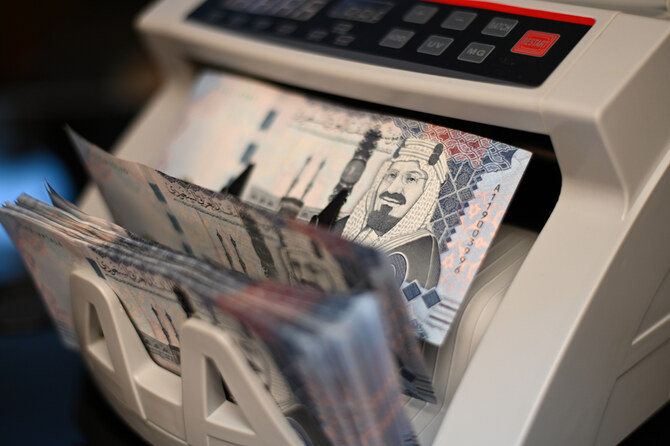

RIYADH: Saudi Arabia’s top 10 listed banks recorded all-time high net profits in 2024 of SR79.64 billion ($21.23 billion), reflecting a 13.84 percent annual increase, according to data from the Saudi Exchange.
The robust performance was driven by strong lending growth, declining interest rates, and increased participation in debt markets.
Saudi National Bank, known as SNB AlAhli, led the sector, accounting for 26.6 percent of total banking profits at SR21.19 billion, followed closely by Al Rajhi Bank, which contributed 24.8 percent, reaching SR19.72 billion.
These two banks constituted about 51.4 percent of the sector’s total profits.
Among the banks with the highest annual growth, Arab National Bank topped the list with a 21.98 percent rise in net profits to SR4.97 billion. Bank AlJazira followed with a 20.69 percent increase, reaching SR1.23 billion, despite holding the smallest share of sector profits at 1.5 percent.
Total assets for the top 10 Saudi banks surged to SR4.21 trillion in 2024, marking a 13.6 percent increase year on year. SNB AlAhli held the largest asset base at SR1.1 trillion, followed by Al Rajhi Bank at SR974.39 billion, with both banks collectively accounting for 49 percent of the sector’s total assets.
Al Rajhi Bank recorded the fastest asset growth, expanding by 20.58 percent, followed by Saudi Investment Bank, which grew by 20.53 percent to reach SR156.67 billion.
Saudi Arabia’s banking sector is poised to sustain its profitability in 2025, bolstered by strong credit growth and corporate lending tied to Vision 2030 projects, according to an S&P Global report released in January.
The financial services agency projected that bank lending would expand by 10 percent, driven primarily by corporate loans as the Kingdom continues to invest heavily in large-scale economic initiatives.
The outlook remains positive as stable credit growth, supported by easing interest rates and a favorable economic environment, is expected to maintain banks’ profitability, with return on assets estimated to remain between 2.1 percent and 2.2 percent.
The report further highlighted that banks may increasingly turn to international capital markets to finance Vision 2030-related investments, ensuring a steady flow of liquidity. Meanwhile, mortgage lending is also anticipated to rise, supported by lower borrowing costs and demographic trends fueling demand for residential properties.
Saudi banks have also maintained a dominant presence in the stock market, leading Tadawul’s trading activity in 2024’s fourth quarter with a 17 percent market share, surpassing the materials and energy sectors.
Bank loans and main growth drivers
Saudi banks’ total loans and advances to customers grew by 14.41 percent year on year in 2024, reaching SR2.81 trillion, while deposits rose by 7.87 percent to SR2.68 trillion during the same period.
Al Rajhi Bank led in loan issuance, providing SR693.4 billion, a 16.8 percent increase from the previous year, followed by SNB AlAhli with SR654.25 billion and Riyadh Bank with SR274.4 billion.
With the Saudi riyal pegged to the US dollar, the Kingdom’s central bank, known as SAMA, mirrors Fed rate movements. After interest rates peaked at 6 percent in 2024, they began to decline in September, reducing borrowing costs.
According to SAMA, 11.28 percent of total bank loans — 21 percent of corporate loans— were allocated to real estate, a key enabler of the Kingdom’s infrastructure expansion.
Saudi Investment Bank posted the highest loan growth rate at 23.18 percent, reaching SR99.47 billion, followed by Saudi First Bank with a 20.10 percent increase to SR259.35 billion.
Deposits and funding strategies
Bank deposits for the top 10 Saudi banks reached SR2.68 trillion in 2024, with Al Rajhi Bank holding the highest share at SR628.24 billion, followed by SNB AlAhli at SR579.76 billion.
The strongest deposit growth was seen in Riyadh Bank, which expanded by 20.21 percent to SR306.42 billion, followed by Bank AlJazira with a 15 percent increase to SR108.19 billion.
As lending growth outpaces deposit expansion, Saudi banks have increasingly turned to the debt capital market to fund their credit expansion.
According to Fitch Ratings, Saudi banks have significantly increased their international debt issuance since 2020, aligning with their long-term growth strategies and foreign-currency funding needs.
The GCC banking sector is projected to issue more than $30 billion in US dollar-denominated debt in 2025, following a record $42 billion in 2024, according to Fitch.
This surge is primarily driven by nearly $23 billion in maturing debt, lower US interest rates, and sustained regional credit demand, particularly in Saudi Arabia and the UAE.
In 2024, GCC banks represented 18 percent of all emerging-market bank debt issuance in US dollars — a figure that rises to 36 percent when excluding Chinese banks. Strong global investor confidence, supported by stable oil prices projected around $70 per barrel in 2025, has further strengthened regional debt markets.
Short-term certificates of deposit emerged as a key instrument in GCC bank funding strategies, accounting for 21 percent of total debt issuance in 2024.


