



RED SEA: Overwater villa resorts continue to attract holiday goers around the world, but the Kingdom’s latest beach resort, Shebara, on the Red Sea, is breaking the mold with its futuristic designs.
It’s rare that a resort’s architecture is seen as its biggest draw, but that is exactly what Killa Design, the studio behind Dubai’s iconic Museum of the Future, has managed to achieve, with its silver stainless-steel pods that dot the ocean in a necklace-like curve 25 kilometers off Saudi Arabia’s coastline.
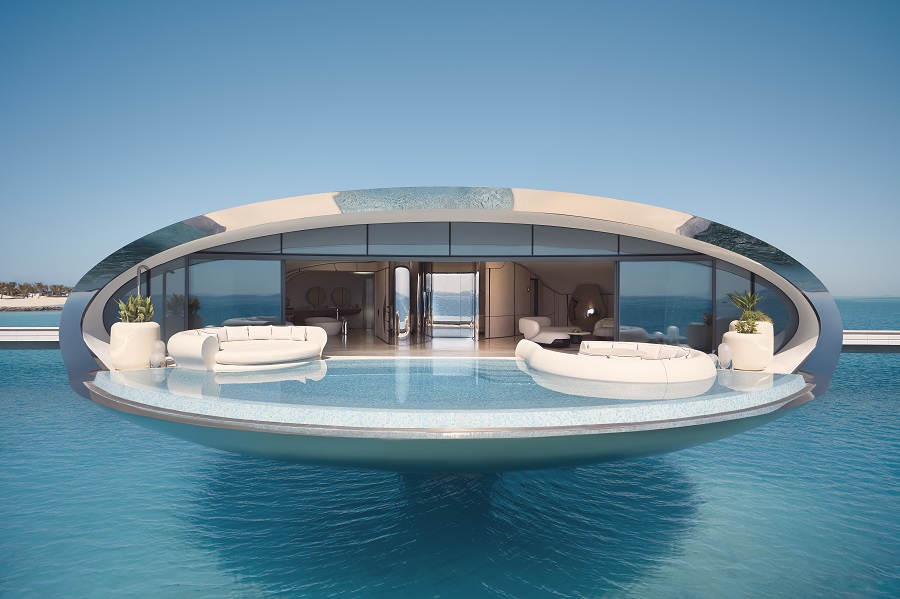
The silver stainless-steel pods dot the ocean in a necklace-like curve 25 kilometers off Saudi Arabia’s coastline. (Supplied)
Most visitors will arrive from elsewhere in the Kingdom via the Red Sea International Airport. Currently an efficient two-hall operation — until developers build a larger airport set to welcome international flights — beach-ready tourists arrive at Shebara via a 30-40-minute boat ride or a 30-minute seaplane flight that departs from nearby the airport, which currently serves domestic flights from Jeddah and Riyadh.
Sunlight reflects off the resort’s 73 orb-like villas as guests approach, with the mirrored surface of each pod changing from sunlight to sunset. Both the Beach Villas and the Overwater Villas are available with one or two bedrooms.
The resort, which is reportedly powered entirely by an on-site solar farm, has all the amenities you would expect for the SAR9,000 (just under $2,400) nightly price tag (for a one-bedroom Beach Villa), but, as we said, it’s the spacious living spaces themselves that are the highlight. The luxe spa, well-kitted out gym and water sport offerings are really just there to complement the rooms, both the exteriors and interiors of which are worthy of a Bond film.
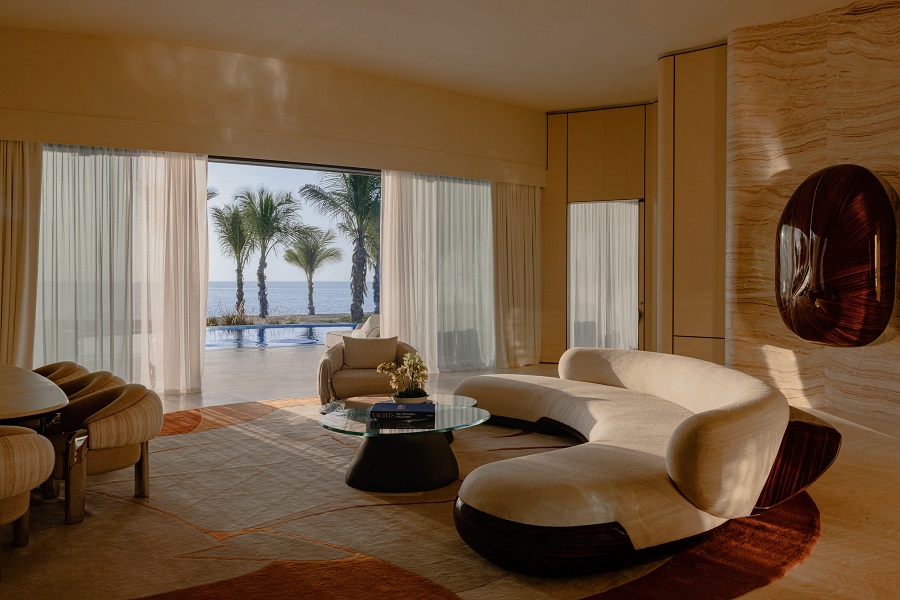
The interiors — by Studio Paolo Ferrari — are a masterclass in experiential living. (Supplied)
The interiors — by Studio Paolo Ferrari — are a masterclass in experiential living: steel curves, pops of burnt orange, and leather-clad curved walls may not be to everyone’s taste but it’s an experience — one that comes with a reflective button-operated bar that sits like a giant beetle near the living area.
A fully equipped kitchenette is a plus point for guests keen to use the various Nespresso gadgets. Trek over to the bathroom — even the one-bed Overwater Villa is a roomy 188 sq. meters — and you’ll be treated to a free-standing bathtub and separate, curved shower room.
From the lights to the air conditioning and patio doors, it’s all touch screen or button-controlled. Hitting a switch triggers a swoosh as the French doors open to reveal endless blue sea, with a small dipping pool and two outdoor seating areas on a marble-clad deck. For guests seeking a little extra privacy while taking a dip, it should be noted that the overwater villas’ deck pool and sea-skimming overwater hammock area are not shielded from view.
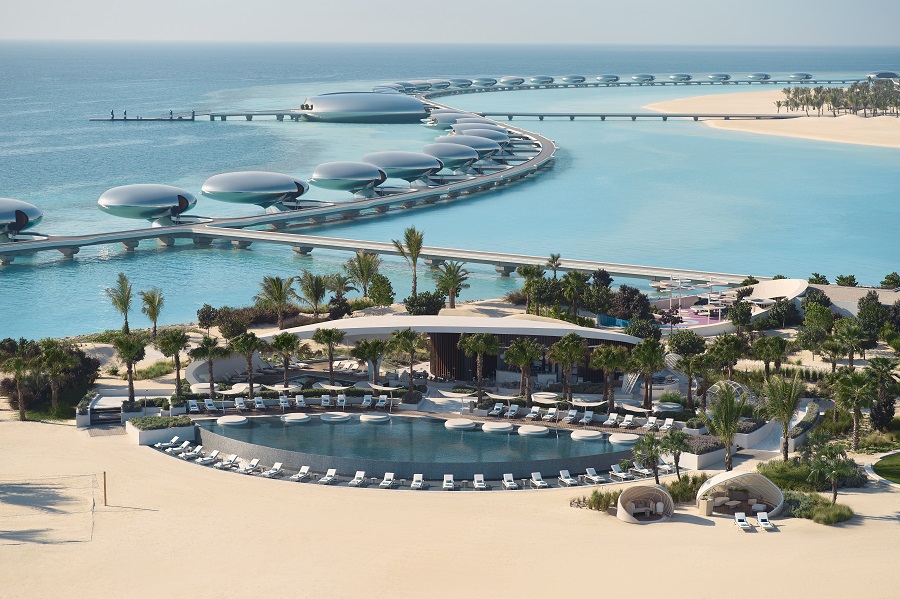
While there are similar resorts the world over, the architecture and fresh take on beach living make Shebara well worth a visit. (Supplied)
Guests travelling in larger groups are able to reserve an entire islet — the Beachfront Crown Villas Ensemble option, which includes a three-bedroom villa and three one-bedroom villas. The Beachfront Royal Villas Ensemble on the separate Sheybarah Island, featuring a private dock, is also available. This option boasts a four-bedroom villa and three one-bedroom villas.
Walk or catch a buggy through beautifully landscaped soft dunes to the spa and you’ll be treated to a menu of massage, facial and hammam options. The post-treatment relaxation area, with the usual sauna-and-steam room mod cons, is a little on the small side.
Dining options include iki.roe, serving modern Japanese-Nikkei cuisine; Ariamare, led by restaurateur Chef Marco Garfagnini whose menu offers Mediterranean flavors; Lunara, an international brasserie; and Saria Pool Bar & Grill, a beachside venue specializing in Levantine cuisine. Solera, an adults-only pool bar, is the ideal spot to watch a spectacular sunset with a mocktail in hand.
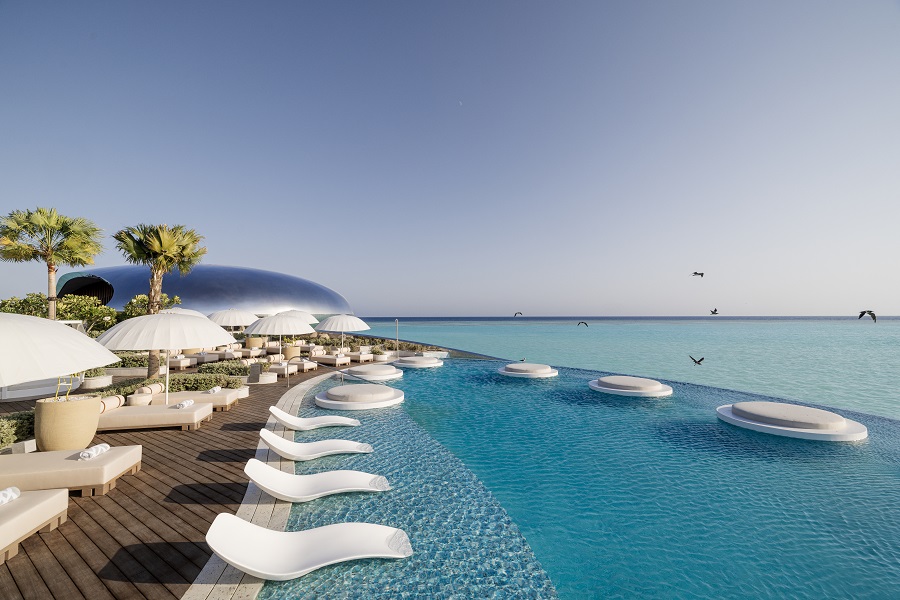
Solera, an adults-only pool bar, is the ideal spot to watch a spectacular sunset with a mocktail in hand. (Supplied)
All in all, it’s as luxurious as it gets. But it has to be said that sea resorts do have to contend with more than their fair share of wear and tear due to the weather conditions they face. It is perhaps unfair to expect the resort’s many glass and steel surfaces to be crystal clear and brilliant all the time, but if we were nitpicking — and at this price point, we surely must — more attention could be paid to the details in the public areas as it all feeds into the experience. That being said, the rooms themselves are pristine.
While Mother Nature does battle with the resort’s maintenance staff on a daily basis, she’s also the source of one of Shebara’s most stunning offerings; the snorkeling at this resort is a must as the Red Sea is famous for its diverse marine life, clear blue-green waters and colorful coral.
While there are similar resorts the world over, the architecture and fresh take on beach living make Shebara well worth a visit.


