LONDON: At first whiff, it sounds repulsive: sniff the essence of an ancient corpse.
But researchers who indulged their curiosity in the name of science found that well-preserved Egyptian mummies actually smell pretty good.
“In films and books, terrible things happen to those who smell mummified bodies,” said Cecilia Bembibre, director of research at University College London’s Institute for Sustainable Heritage. “We were surprised at the pleasantness of them.”
“Woody,” “spicy” and “sweet” were the leading descriptions from what sounded more like a wine tasting than a mummy sniffing exercise. Floral notes were also detected, which could be from pine and juniper resins used in embalming.
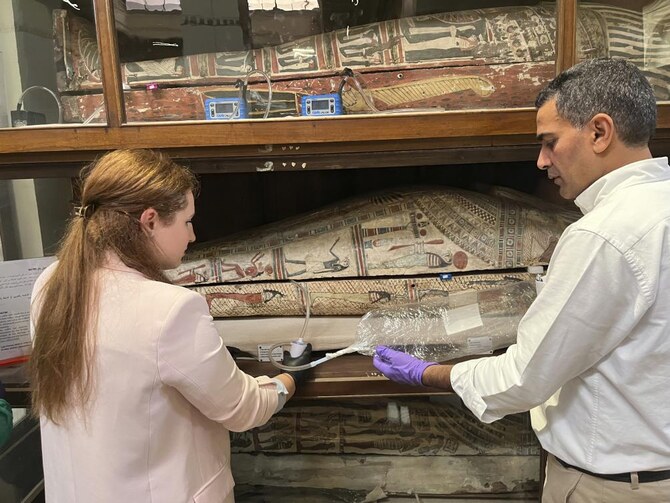
The study published Thursday in the Journal of the American Chemical Society used both chemical analysis and a panel of human sniffers to evaluate the odors from nine mummies as old as 5,000 years that had been either in storage or on display at the Egyptian Museum in Cairo.
The researchers wanted to systematically study the smell of mummies because it has long been a subject of fascination for the public and researchers alike, said Bembibre, one of the report’s authors. Archaeologists, historians, conservators and even fiction writers have devoted pages of their work to the subject — for good reason.
Scent was an important consideration in the mummification process that used oils, waxes and balms to preserve the body and its spirit for the afterlife. The practice was largely reserved for pharaohs and nobility and pleasant smells were associated with purity and deities while bad odors were signs of corruption and decay.
Without sampling the mummies themselves, which would be invasive, researchers from UCL and the University of Ljubljana in Slovenia were able to measure whether aromas were coming from the archaeological item, pesticides or other products used to conserve the remains, or from deterioration due to mold, bacteria or microorganisms.
“We were quite worried that we might find notes or hints of decaying bodies, which wasn’t the case,” said Matija Strlič, a chemistry professor at the University of Ljubljana. “We were specifically worried that there might be indications of microbial degradation, but that was not the case, which means that the environment in this museum, is actually quite good in terms of preservation.”
Using technical instruments to measure and quantify air molecules emitted from sarcophagi to determine the state of preservation without touching the mummies was like the Holy Grail, Strlič said.
“It tells us potentially what social class a mummy was from and and therefore reveals a lot of information about the mummified body that is relevant not just to conservators, but to curators and archaeologists as well,” he said. “We believe that this approach is potentially of huge interest to other types of museum collections.”
Barbara Huber, a postdoctoral researcher at Max Planck Institute of Geoanthropology in Germany who was not involved in the study, said the findings provide crucial data on compounds that could preserve or degrade mummified remains. The information could be used to better protect the ancient bodies for future generations.
“However, the research also underscores a key challenge: the smells detected today are not necessarily those from the time of mummification,” Huber said. “Over thousands of years, evaporation, oxidation, and even storage conditions have significantly altered the original scent profile.”
Huber authored a study two years ago that analyzed residue from a jar that had contained mummified organs of a noblewoman to identify embalming ingredients, their origins and what they revealed about trade routes. She then worked with a perfumer to create an interpretation of the embalming scent, known as “Scent of Eternity,” for an exhibition at the Moesgaard Museum in Denmark.
Researchers of the current study hope to do something similar, using their findings to develop “smellscapes” to artificially recreate the scents they detected and enhance the experience for future museumgoers.
“Museums have been called white cubes, where you are prompted to read, to see, to approach everything from a distance with your eyes,” Bembibre said. “Observing the mummified bodies through a glass case reduces the experience because we don’t get to smell them. We don’t get to know about the mummification process in an experiential way, which is one of the ways that we understand and engage with the world.”


![]()

The scent of the mummy. Research discovers ancient Egyptian remains smell nice
Short Url
https://arab.news/9jabt
The scent of the mummy. Research discovers ancient Egyptian remains smell nice
- “Woody,” “spicy” and “sweet” were the top descriptions
- They studied mummies as old as 5,000 years from the Egyptian Museum in Cairo


Latest updates


© 2026 SAUDI RESEARCH & PUBLISHING COMPANY, All Rights Reserved And subject to Terms of Use Agreement.