
RIYADH: Saudi Arabia’s multi-project developer Red Sea Global currently employs 70 percent of its workforce from the local population, according to the firm’s group chief financial officer.
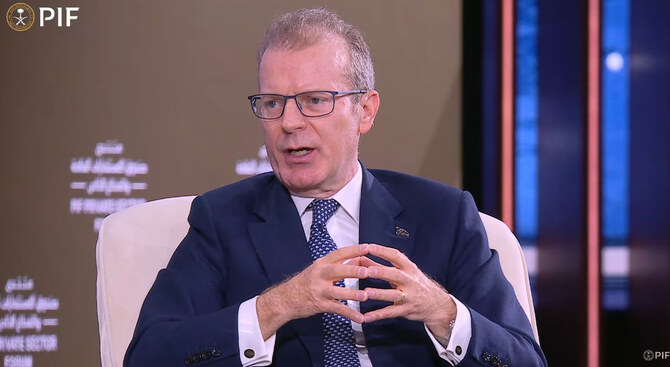
Speaking at the PIF’s Private Sector Forum in Riyadh on Feb.13, Martin Greenslade said that the Kingdom’s leisure tourism industry witnessed substantial growth in recent years, as the country welcomed 17.5 million tourists in 2024, representing a rise of 656 percent compared to 2019.
These developments align with Saudi Arabia’s National Tourism Strategy, which aims to attract 150 million tourists by the end of this decade.
“In our company, we are around 70 percent Saudis. When it comes to the hotels and the workforce, that is something we are scaling rapidly by providing opportunities to as many people as we can,” said Greenslade.
He added: “Saudi Arabia is witnessing a massively growing environment of leisure tourism. Over the last five years, leisure tourists increased in Saudi Arabia by over 600 percent, 17.5 million visitors a year, just for leisure tourism. If we add all the other tourists, we are well over 100 million. So, we are on a sweet spot of growth.”
Regarding the number of visitors to the Red Sea, Greenslade revealed that the figures are still in the thousands as hotels are currently under development, adding that they will grow significantly in the coming years.
He added that 92 percent of visitors to the Red Sea are from the Gulf Cooperation Council region, with the majority being Saudi citizens.
“Right now, we only have these few hotels opened, and they have a very limited number of keys. So, the number of tourists is in the thousands. And they have largely come from the Gulf Cooperation Council. So, there have been some challenges with international tourism; the events in Gaza are challenging. But we are putting on more international flights,” said Greenslade.
He added that Shura Island, which falls within the Red Sea, will see the opening of 11 hotels in 2025, while seven hotels will be opened in AMAALA this year.
During the talk, the Red Sea official added that the company has paid over $20 billion in contracts to suppliers, and around 70 percent of that has gone to Saudi-based organizations.
Greenslade said about the potential spending in 2025: “I do not want to give the exact amount this year, but we are spending billions of dollars a year on developing this destination. Some of those are funded through debt financing and some of those from the PIF.”
Greenslade added that developing the residential side of the Red Sea is very important, as it is one of the best ways to attract private investments.
He highlighted that individuals wishing to consider the Red Sea a second home can also buy a residential unit.
“When you finish the visit to Red Sea, you feel so sad to leave, and if you never want to leave, you can buy your own residence,” said Greenslade.
He mentioned that tourists visiting the Red Sea will have an unforgettable experience.
“If you want to go to somewhere truly breathtaking, somewhere iconic, somewhere very different from anywhere else on earth, you book a ticket to the Red Sea. You would fly and land at the brand-new airport. The airport in the Red Sea has a runway large enough to take any plane,” said Greenslade.
He added: “Tourists visiting the Red Sea will get an electric vehicle to reach the seaplane terminal or boat where they will be guided to an island. These islands are incredible, the corals are fantastic, the snorkeling is amazing.”
The official further said that the company is eyeing to plant 50 million mangroves in the Red Sea project, aimed at ensuring sustainability.
He also highlighted that resorts in the Red Sea are fully powered using solar energy, and the same initiative will also be taken in AMAALA.
“We want to redefine how tourism interacts with the environment. We call it regenerative tourism. Mangroves are very important. We are looking to plant and preserve around 50 million mangroves. Mangroves are extremely important to coastal protection and for the wildlife that settles in and around it,” said Greenslade.
He added: “We are aiming to increase biodiversity by 30 percent. So, we have got an enormous nursery, a million sq. feet building, one of the largest nurseries in the world. We will see some 30 million plants go through there.”