

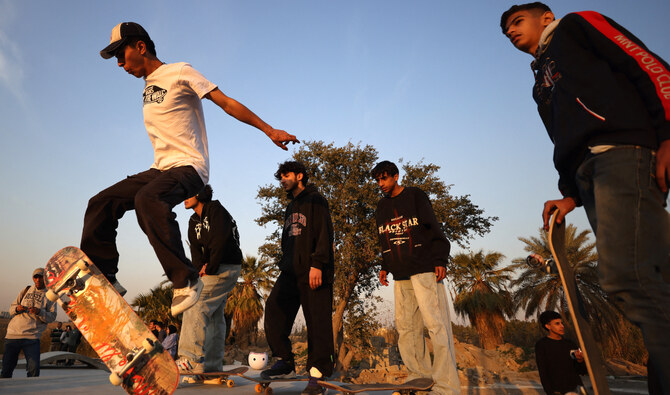

DUBAI: In a city long defined by conflict and uncertainty, a new skatepark in Baghdad is giving young Iraqis a space to express themselves, find community, and momentarily escape the pressures of everyday life.
The project, funded by Germany and France and supported by the Iraqi Ministry of Youth and Sports, reflects a growing recognition of the need to invest in the country’s youth — many of whom have spent their entire lives navigating war, economic hardship, and political instability.
The skatepark, which opened on Feb. 1, is the first of its kind in the Iraqi capital. Located near Al-Shaab International Stadium and tucked away from public view, it offers a safe haven for skateboarders, BMX riders, and inline skaters of all skill levels.
It was built by Make Life Skate Life, a Belgian-American charity that has constructed similar facilities in Morocco, India, and in the Kurdistan Region of Iraq’s northern city of Sulaymaniyah.
“For five years, we tried to secure land for this project,” said Arne Hillernes, founder of Make Life Skate Life. “After witnessing scores of Iraqi youngsters drive six hours to Sulaymaniyah to enjoy the Suli Skatepark, I knew this was something that Baghdad needed.”

The skatepark, which opened on Feb. 1, offers a safe haven for skateboarders, BMX riders, and inline skaters of all skill levels. (AFP)
The new skatepark in Baghdad, which has been designated as the 2025 Arab Capital of Sports, is more than just ramps and rails — it represents a shift in how Iraq is catering to its younger generation.
The facility, which is free to use, provides a structured, creative outlet for young men and women in a country where public recreational spaces are limited.
For many Iraqi youth, years of war and economic struggle have left them with few opportunities. Poverty and joblessness remain significant challenges, while some young men face recruitment efforts from armed militias that promise income and status in exchange for allegiance.
For others, the daily stress of financial hardship at home is overwhelming.
“Sometimes I feel the need to escape my house,” Mehdi, a 17-year-old Baghdad local, told Arab News. “I take my younger brother with me as the situation at home can sometimes be tense. My parents don’t seem to mind. I think they believe it’s better we are out playing sports than causing trouble or pledging allegiance to one of the armed groups.”

Iraqi security forces deploy to disperse protesters during a demonstration against the government’s employment policy near the parliament building on June 7, 2022. (AFP)
The park’s appeal extends to female skaters as well, despite the lingering societal resistance to women in sports.
“Finding a place in Baghdad to build a free and public skatepark was incredibly challenging,” said Safeen Mohammed from Suli Skatepark. “It took more than five years of persistence, but finally the dream of hundreds of skaters living in Baghdad has come true. The skateboarding community in Iraq will grow from here.”
The launch of the skatepark comes at a crucial time, as Iraq’s government attempts to engage with its young population in more meaningful ways. The Ministry of Youth and Sports, which helped facilitate the project, has also been involved in initiatives aimed at improving employment prospects and civic engagement for young Iraqis.
Among these initiatives is the Job Search Club, a program launched in partnership with the UN’s International Labor Organization and Prospects, an initiative aimed at enhancing youth employability.
Additionally, the ministry has teamed up with the UN to establish Iraq’s first Youth Advisory Council, designed to ensure that young people have a voice in shaping government programs and policies.

The park’s appeal extends to female skaters as well, despite the lingering societal resistance to women in sports. (AFP)
Such efforts have been welcomed, particularly in the wake of the October 2019 protests, when thousands of young Iraqis took to the streets demanding reform.
Frustrated by high unemployment, corruption, and poor public services, these demonstrators faced violent crackdowns, with more than 500 people killed and thousands more injured.
Although the movement succeeded in forcing the resignation of former Prime Minister Adil Abdul-Mahdi and securing parliamentary seats for youth-driven political parties, many of the grievances that fueled the protests remain unresolved.
Iraq has one of the world’s youngest populations, with more than half of its 42 million people under the age of 25, according to the World Bank. Despite the country’s gradual economic recovery, opportunities for young people remain scarce, with unemployment at 14.2 percent.
The situation is further exacerbated by climate pressures, which have disrupted farming livelihoods, rising living costs, and a struggling education system.

In October 2019, frustrated by high unemployment, corruption, and poor public services, thousands of young Iraqis took to the streets demanding reform. (AFP)
For years, militia groups have sought to exploit this vulnerability, recruiting disillusioned young men with promises of stability, money, and respect. Iran-backed armed groups like Kataib Hezbollah and Harakat Al-Nujaba have been particularly notorious for such recruitment efforts.
The presence of a skatepark may seem like a small step in comparison to these challenges, but for many young Iraqis, it represents a much-needed alternative to a bleak and uncertain future.
“I think this is the first time I feel seen by the leaders in government,” said Mehdi. “Usually, we feel like ghosts in our own cities, but this time they have actually done something for us.”
At the skatepark’s opening, Ishtar Obaid, a member of Iraq’s Olympic Committee, highlighted its significance beyond sports.
“This will provide a safe and welcoming environment for all our youth to express themselves and engage in physical activity,” she said. “It represents more than just a place to skate — it is a space for creativity, connection, and hope.”

The presence of a skatepark may seem like a small step in comparison to these challenges, but for many young Iraqis, it represents a much-needed alternative to a bleak and uncertain future. (AFP)
Hillernes, reflecting on the project’s completion, believes the skatepark will be a launching pad for a new era of youth engagement in Iraq.
“Skateboarding is not just a sport. It builds community,” he said. “The more spaces we create like this, the more young people will have a reason to stay engaged in something positive.”
For Baghdad’s youth, this skatepark is not just a recreational facility — it is a symbol of possibility, a glimpse of a future where their needs are acknowledged, and their potential is nurtured.
As Iraq continues on its path toward stability and development, initiatives like this serve as a reminder that addressing the aspirations of young people is essential to securing a more peaceful and prosperous future for the country.


