

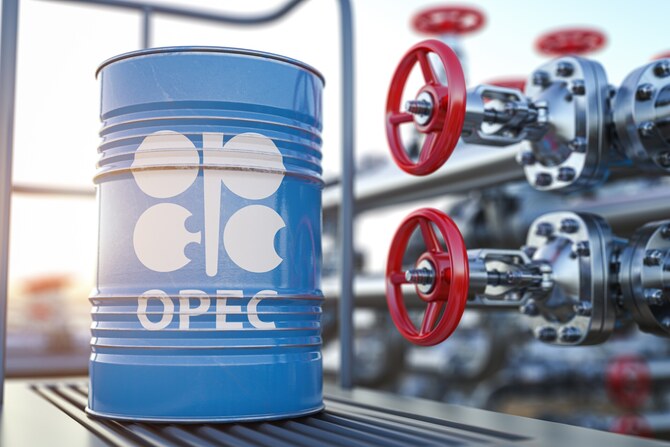
OPEC sticks to 2025, 2026 global oil demand growth forecasts

OPEC’s view on oil demand is at the higher end of industry forecasts and it expects oil use to keep rising in coming years. File
Short Url
Updated 12 February 2025
Follow

OPEC sticks to 2025, 2026 global oil demand growth forecasts

LONDON: OPEC on Wednesday stuck to its forecast for relatively strong growth in global oil demand in 2025, saying air and road travel would support consumption and potential trade tariffs were not expected to impact economic growth.

In a monthly report, it said world oil demand will rise by 1.45 million barrels per day in 2025 and by 1.43 million bpd in 2026. Both forecasts were unchanged from last month.

OPEC’s view on oil demand is at the higher end of industry forecasts and it expects oil use to keep rising in coming years, unlike the International Energy Agency which see demand peaking this decade as the world switches to cleaner fuels.

In the report, OPEC said the trade policy of US President Donald Trump has added more uncertainty into markets, potentially creating supply-demand imbalances that are not reflective of market fundamentals, but it made no change to its 2025 economic growth forecast.

“It remains to be seen how and to what extent potential tariffs and other policy measures will play out,” OPEC said in the report. “So far, they are not anticipated to materially impact the current underlying growth assumptions.”

Oil was steady after the OPEC report was released with Brent crude trading lower towards $76 a barrel.

The IEA sees 2025 demand growth at 1.05 million bpd, lower than OPEC, although the gap between the two on 2025 is much smaller than it was for 2024 when the split reached a record high driven by differences over the pace of the energy transition.

OPEC+, which groups OPEC and allies such as Russia, has implemented a series of output cuts since late 2022 to support the market. Its current plan calls for oil output to be gradually increased from April.


KAIA records busiest week with new operational records

Updated 7 sec ago
Follow

KAIA records busiest week with new operational records

JEDDAH: King Abdulaziz International Airport started 2026 on a strong note, handling 5.45 million passengers in January, a 7.3 percent increase over the same month last year.

Flight movements reached 29,200, up 11 percent, while total baggage throughput rose 8 percent to 6.6 million items.

The airport recorded its busiest operational week from Jan. 11 to 17, serving 1.28 million travelers.

Passenger numbers peaked on Jan. 17, marking the airport’s busiest day ever with 195,300 travelers and 1,089 flights, underscoring the efficiency of its operations and the capacity of its infrastructure to accommodate growing travel demand.

These results reflect Jeddah Airports Co.’s ongoing efforts to enhance the passenger experience, expand travel options, and manage rising air traffic in line with the National Aviation Program and Saudi Vision 2030.

Since its establishment in 2022, the company, known as JEDCO, has overseen the management and operations of KAIA, driving the implementation of the Aviation Program under the National Transport and Logistics Strategy.

In 2025, the airport reached a historic milestone, welcoming 53.4 million passengers, the highest annual total ever recorded at a Saudi airport, placing it among the world’s mega airports in terms of traffic.

The airport handled a total of 310,000 flights and 60.4 million bags, representing a 12 percent increase compared to 2024. It also handled 9.57 million Zamzam water containers and 2,968 cargo flights.

This achievement reflects the airport’s qualitative transformation and its position as a regional hub and national gateway connecting the Kingdom to the world. It also highlights its role in facilitating the movement of visitors and pilgrims, promoting tourism in line with the goals of Vision 2030, diversifying the economy, and providing a distinguished travel experience.

The January milestone at KAIA is part of a broader success story for Saudi airports, with 2025 statistics showing unprecedented growth in the Kingdom’s air traffic, surpassing regional averages and cementing Saudi Arabia’s status as one of the world’s fastest-growing and most advanced aviation markets.

Passenger numbers rose 9.6 percent, fueled by tourism, international events, and expanding global connectivity.

This growth reflected both increased capacity and enhanced connectivity, with Saudi airports handling approximately 140.9 million passengers, 76 million international and 65 million domestic passengers. Flight movements rose 8.3 percent to around 980,400, highlighting the sector’s sustained recovery.

KAIA accounted for 38 percent of total passenger traffic, averaging 146,000 passengers daily and operating at 107 percent of capacity. King Khalid International Airport handled 29 percent of passengers, with a daily average of 112,000. Madinah and Dammam airports also recorded historic surges, operating at 137 percent and 112 percent of capacity, respectively.