

White House correspondents protest access denial over ‘Gulf of Mexico’ naming issue

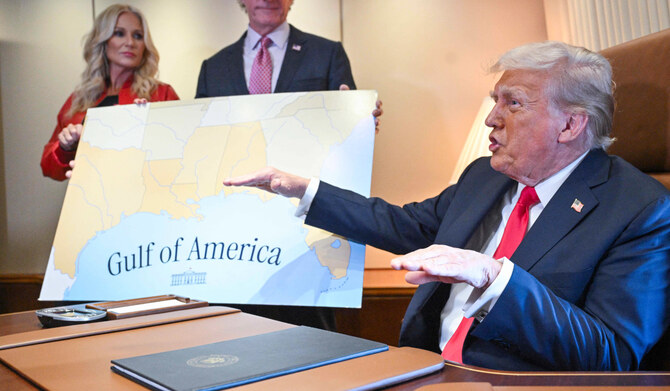
US President Donald Trump speaks to the press before signing a proclamation renaming the Gulf of Mexico as the Gulf of America aboard Air Force One, as it flies over the Gulf enroute to New Orleans, Louisiana on Febrary 09, 2025. (AFP)
Short Url
Updated 12 February 2025
Follow

White House correspondents protest access denial over ‘Gulf of Mexico’ naming issue

  • AP Executive Editor Julie Pace said in a statement earlier that its reporter had been blocked from attending an Oval Office event after being informed by the White House it would be barred unless it aligned its editorial standards with Trump’s order

WASHINGTON: The White House Correspondents’ Association protested a decision by the White House on Tuesday to bar an Associated Press reporter from an event with President Donald Trump over the news agency’s decision to continue referring to the Gulf of Mexico.
Trump signed an executive order in January directing the Interior Secretary to change the name to the Gulf of America.
“The White House cannot dictate how news organizations report the news, nor should it penalize working journalists because it is unhappy with their editors’ decisions,” Eugene Daniels, president of the association, said on Tuesday in a statement posted on X.
“The move by the administration to bar a reporter from the Associated Press from an official event open to news coverage today is unacceptable,” Daniels said.
AP Executive Editor Julie Pace said in a statement earlier that its reporter had been blocked from attending an Oval Office event after being informed by the White House it would be barred unless it aligned its editorial standards with Trump’s order.
“It is alarming that the Trump administration would punish AP for its independent journalism,” Pace said, adding that limiting access violated the First Amendment of the US Constitution guaranteeing freedom of the press.
The AP says in its stylebook that the Gulf of Mexico has carried that name for more than 400 years and, as a global news agency, the AP will refer to it by its original name while acknowledging the new name Trump has chosen.
The White House did not immediately respond to requests for comment on the statements by the WHCA and the AP. Mexico’s foreign ministry also did not immediately respond to a request for comment on Tuesday.
Like the US, Mexico has a long coastline circling the body of water. Mexican President Claudia Sheinbaum in January jokingly suggested North America, including the United States, be renamed “Mexican America” — a historic name used on an early map of the region.
Most news organizations, including Reuters, call it the Gulf of Mexico although, where relevant, Reuters style is to include the context about Trump’s executive order.


Saudi gaming industry has promising future, says Qiddiya executive

Updated 48 min 29 sec ago
Follow

Saudi gaming industry has promising future, says Qiddiya executive

  • Mike Milanov said that the industry had surpassed the combined industries of film, television, music and sports worldwide
  • Milanov added that Saudi Arabia had talented teams with strong skills in esports and game development

RIYADH: Saudi Arabia is uniquely positioned for a highly promising future in the gaming sector, which is valued at $323 billion globally, according to the head of gaming at Saudi entertainment megaproject Qiddiya.

Mike Milanov, the company’s head of gaming and esports, spoke during the session “The Global Era of Gaming: How It Became the New Frontier for Media and Entertainment” at the Saudi Media Forum 2026 in Riyadh.

The industry, he said, had surpassed the combined industries of film, television, music and sports worldwide and was growing globally at an annual rate of 3 percent to 9 percent, expected to reach about $623 billion by 2035

He added that future generations held different perspectives and levels of engagement, as gaming represented a form of digital advancement and a powerful tool for connection.

Milanov also highlighted how Saudi Arabia had talented teams with strong skills in esports and game development, along with significant creative and innovative energy that supported building relationships both locally and globally.

He further noted that Qiddiya City spanned nearly 330 sq. km, and that more than 86 percent of Saudis identified themselves as gamers, reinforcing the Kingdom’s position as one of the world’s largest gaming and esports markets.

Karen Starr, vice president of marketing, branding and creative at Activision Publishing, also spoke during the panel and emphasized the major role gaming played across social media platforms.

She described this influence as positive for brand building, especially given the young audiences that followed gaming brands.

Starr added that the sustainability of major gaming brands depended on continuous engagement, community-building, and adapting content locally to maintain cultural relevance.

She explained that gaming had evolved into an ongoing media experience based on constant interaction and long-term audience connection.

She also said that gaming today had become a global media force that had surpassed traditional channels, shaping culture, content and audience engagement over time.

Meanwhile, Shelley Williams, executive vice president of sales at F1 Arcade Simulation, spoke about how gaming experiences were built on a sense of belonging and participation, which helped to create stronger infrastructure and extended media experiences.

She said that shared audience experiences opened the door to new ecosystems and further game development, supporting long-term content sustainability.