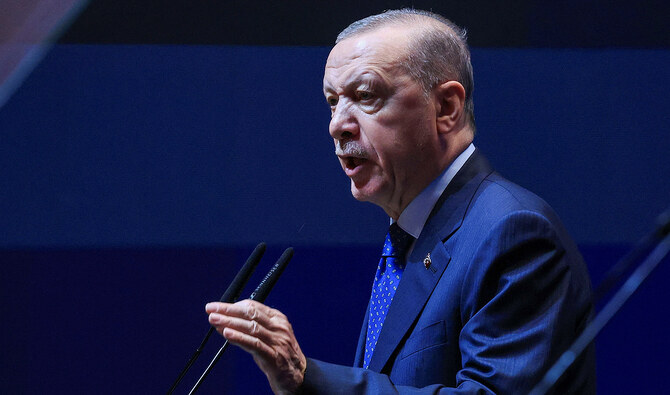
ISLAMABAD: Turkish President Recep Tayyip Erdogan will visit Pakistan with a high-level delegation from Feb.12-13, Pakistan’s foreign office said on Tuesday, during which he will co-chair the session of a high-level strategic cooperation council focusing on bilateral trade, investment and other priority sectors between the two countries, and oversee the signing of several agreements.
The Pakistan-Turkiye High Level Cooperation Council (HLSCC) was established in 2009 as a framework for consultations at the highest political level between the two sides. Several joint standing committees under the HLSCC cover vital sectors such as trade, investment, banking, finance, culture, tourism, energy, defense, agriculture and others.
Six sessions of the HLSCC have been conducted since it was founded, with the last one held in Islamabad from Feb. 13-14, 2020.
Erdogan’s high-level delegation will comprise ministers, senior officials and corporate leaders, the foreign office said.
“During the visit, Prime Minister Shehbaz Sharif and President Erdogan will co-chair the 7th Session of the Pakistan-Turkiye High Level Strategic Cooperation Council (HLSCC),” the foreign office said. “At the conclusion of the Session, a Joint Declaration and a number of important agreements/MoUs are expected to be signed. The two leaders will also address a joint press stakeout.”
Erdogan will hold bilateral meetings with Sharif and President Asif Ali Zardari, the foreign office said, adding that the Turkish president will address the Pakistan-Turkiye Business and Investment Forum with Sharif. The forum will bring together leading investors, companies and businesspersons from both sides, the statement said.
“The visit of Turkish President and the holding of the 7th Session of the HLSCC would serve to further deepen the brotherly relations and enhance multifaceted cooperation between the two countries,” the foreign office said.
Turkiye and Pakistan enjoy cordial relations with one another that has expanded to cooperation in several sectors between the two nations. Both agreed to enhance the bilateral trade volume to $5 billion last year in May when Turkish Foreign Minister Hakan Fidan arrived in Pakistan’s capital on a two-day visit.
Pakistan has been eagerly reaching out to international partners and close allies since last year in its quest to escape a prolonged macroeconomic crisis by strengthening cooperation in business, investment and other sectors.
Pakistan’s economic crisis has drained its financial resources, weakened its national currency and triggered inflation in the country. The South Asian country has repeatedly stated its desire to achieve sustainable economic growth through foreign trade and investment, long-term reforms and by promoting exports.


![]()

Erdogan to visit Pakistan from Feb. 12-13 to strengthen cooperation in bilateral trade and investment
Short Url
https://arab.news/pav4x
Erdogan to visit Pakistan from Feb. 12-13 to strengthen cooperation in bilateral trade and investment
- Turkish president to co-chair Pakistan-Turkiye High Level Cooperation Council session with PM Shehbaz Sharif, says FO
- HLSCC focuses on trade, investment, banking, finance, culture, tourism, energy, defense, agriculture and other sectors
Latest updates


Recommended


© 2026 SAUDI RESEARCH & PUBLISHING COMPANY, All Rights Reserved And subject to Terms of Use Agreement.