PM says Pakistan prioritizing skill development, increased funding on International Day of Women in Science

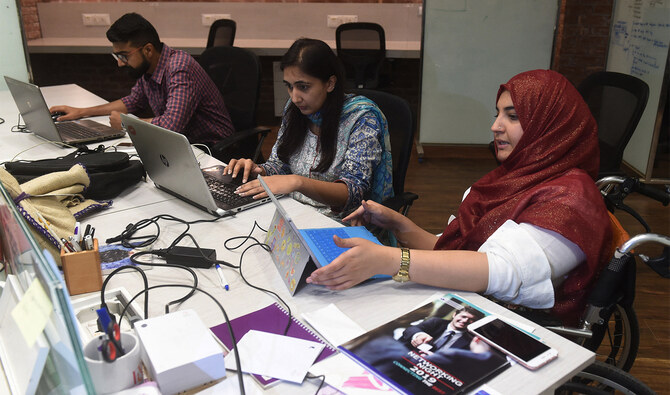
In this photograph taken on May 24, 2019, Tanzila Khan (R), founder of 'Girly Things', an application-based start-up which provides delivery service for women related products, works at a desk at the National Incubation Centre (NIC), a start-up incubator, in Lahore. (AFP/File)
Short Url
Updated 11 February 2025
Follow

PM says Pakistan prioritizing skill development, increased funding on International Day of Women in Science

  • International community marks day on Feb. 11 to highlight gender gap in all levels of science and technology
  • Pakistan PM says government undertaking initiatives to train women in robotics, AI and digital solutions

ISLAMABAD: Pakistan’s Prime Minister Shehbaz Sharif said on Tuesday that empowering females is a “national priority” and essential for the nation’s economic well-being and development, as the world marks International Day of Women and Girls in Science. 

The world marks Feb. 11 each year as the International Day of Women and Girls in Science to highlight the significant gender gap in all levels of science, technology, engineering and mathematics (STEM) disciplines around the world. 

In conservative Pakistan, some rural areas are still ruled by a patriarchal system of male village elders who wield significant influence in their communities and bar women from seeking educational and employment opportunities. 

“For us empowering women and girls in science is a national priority and an all-out effort is being made to create an enabling environment and providing equal opportunities, to ensure that women become key drivers of progress and innovation in the 21st century,” Sharif said in a message shared by the Prime Minister’s Office (PMO). 

He said the Pakistani government has prioritized programs that focus on skill development, support for women-led start-ups and greater access to research funding. 

“Initiatives include training in robotics, AI and digital solutions, scholarships and programs encouraging innovation and entrepreneurship,” the PMO said. 

Sharif highlighted the underrepresentation of women in science and technology, noting that they make up less than 30 percent of the world’s researchers and only 22 percent in the field of AI, citing data from the UNESCO Institute for Statistics.

Despite the challenges in conservative Pakistan, some women have made significant contributions to science globally. Dr. Nergis Mavalvala, a Pakistani American astrophysicist, was part of the team that achieved the scientific milestone of detecting gravitational waves, ripples in space and time hypothesized by physicist Albert Einstein a century ago. Dr. Tasneem Zehra Husain, a theoretical physicist, science writer and educator, made headlines around the world when she became the first Pakistani woman to earn a PhD in string theory. 


IMF hails Pakistan privatization drive, calls PIA sale a ‘milestone’

Updated 6 sec ago
Follow

IMF hails Pakistan privatization drive, calls PIA sale a ‘milestone’

  • Fund backs sale of national airline as key step in divesting loss-making state firms
  • IMF has long urged Islamabad to reduce fiscal burden posed by state-owned entities

KARACHI: The International Monetary Fund (IMF) on Saturday welcomed Pakistan’s privatization efforts, describing the sale of the country’s national airline to a private consortium last month as a milestone that could help advance the divestment of loss-making state-owned enterprises (SOEs).

The comments follow the government’s sale of a 75 percent stake in Pakistan International Airlines (PIA) to a consortium led by the Arif Habib Group for Rs 135 billion ($486 million) after several rounds of bidding in a competitive process, marking Islamabad’s second attempt to privatize the carrier after a failed effort a year earlier.

Between the two privatization attempts, PIA resumed flight operations to several international destinations after aviation authorities in the European Union and Britain lifted restrictions nearly five years after the airline was grounded following a deadly Airbus A320 crash in Karachi in 2020 that killed 97 people.

“We welcome the authorities’ privatization efforts and the completion of the PIA privatization process, which was a commitment under the EFF,” Mahir Binici, the IMF’s resident representative in Pakistan, said in response to an Arab News query, referring to the $7 billion Extended Fund Facility.

“This privatization represents a milestone within the authorities’ reform agenda, aimed at decreasing governmental involvement in commercial sectors and attracting investments to promote economic growth in Pakistan,” he added.

The IMF has long urged Islamabad to reduce the fiscal burden posed by loss-making state firms, which have weighed public finances for years and required repeated government bailouts. Beyond PIA, the government has signaled plans to restructure or sell stakes in additional SOEs as part of broader reforms under the IMF program.

Privatization also remains politically sensitive in Pakistan, with critics warning of job losses and concerns over national assets, while supporters argue private sector management could improve efficiency and service delivery in chronically underperforming entities.

Pakistan’s Cabinet Committee on State-Owned Enterprises said on Friday that SOEs recorded a net loss of Rs 122.9 billion ($442 million) in the 2024–25 fiscal year, compared with a net loss of Rs 30.6 billion ($110 million) in the previous year.