

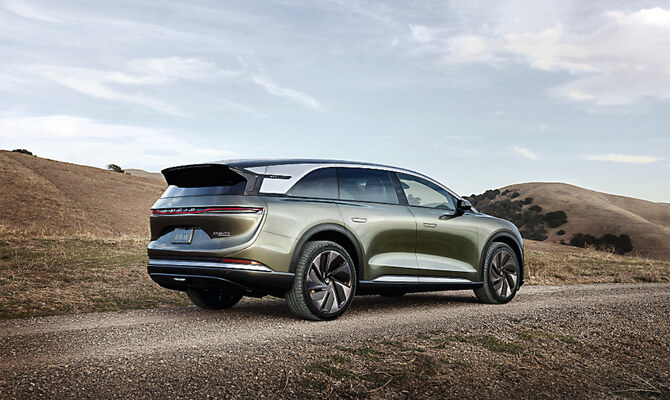
Lucid Gravity SUV hits the market in Saudi Arabia

Lucid Gravity provides the interior space and practicality of a full-size SUV within the exterior footprint of a mid-size SUV.
Short Url
Updated 10 February 2025
Follow

Lucid Gravity SUV hits the market in Saudi Arabia

Lucid Group, Inc., a maker of advanced electric vehicles, announced that the Lucid Gravity Grand Touring is now available to order in Saudi Arabia at Lucid locations and online via the Lucid Saudi Arabia website.

The Grand Touring delivers an exceptional combination of sophistication, versatility, interior space, and range, making it the perfect choice for discerning customers across the Kingdom, who can now select vehicle configurations.

“The Lucid Gravity is the world’s most advanced SUV and we are delighted to bring it to the Kingdom,” said Faisal Sultan, vice president and managing director Middle East at Lucid. “It provides a sophisticated space for up to seven adults, game-changing versatility, and an unparalleled driving experience. Best of all, it is available for order in Saudi Arabia via the company studios and website right now.”

Lucid Gravity is a groundbreaking new class of SUV, conceived from the ground up without compromise. Enabled by Lucid’s revolutionary technology, Lucid Gravity provides the interior space and practicality of a full-size SUV within the exterior footprint of a mid-size SUV.

The full Lucid Gravity product line includes Lucid Gravity Grand Touring, starting at SR487,715 ($130,000), equipped with dual electric motors delivering 828 horsepower and more than 700 km of projected range on a single charge.

Lucid Gravity Grand Touring can be configured in two exterior colors, including the launch color Aurora Green Metallic, and with a variety of wheel designs and sizes ranging from 22 and 23 inches. The standard Stealth Appearance features dark polished and painted finishes on exterior surfaces and trim. For those who prefer brighter trim, the optional Platinum Appearance applies a silver luster to exterior accents and trim.

The Lucid Gravity is offered with five interior themes, each incorporating sustainable and premium materials to evoke a different part of the world-renowned state of California’s iconic landscape. The Mojave theme, available in standard PurLuxe and premium PurLuxe versions, evokes the Mojave Desert with bio-PVC upholstery and black ash or walnut wood trim. 

The Yosemite PurLuxe Premium captures the spirit of Yosemite National Park with light, earth-toned upholstery and black and walnut wood accents.

The Tahoe and Ojai themes, both featuring Nappa leather and premium natural grain leather on heated and ventilated 18-way power front seats with massage, draw inspiration from Lake Tahoe and the Ojai Valley, respectively. All themes emphasize luxurious comfort and environmental consciousness.

The Lucid Gravity comes standard with two rows of seats for up to five occupants. An optional three-row version seats up to seven adults with ample space still available for cargo.



New energy vehicles drive next phase of mobility in Saudi Arabia

Updated 06 February 2026
Follow

New energy vehicles drive next phase of mobility in Saudi Arabia

Saudi Arabia stands at a defining moment in its mobility transformation. Under Vision 2030, the Kingdom is accelerating its transition toward cleaner, smarter and more connected transport systems.
New energy vehicles are at the center of this shift, offering a pathway to a more sustainable automotive ecosystem. Yet while consumer interest is rising rapidly, converting intent into everyday adoption will depend on how effectively the wider mobility system evolves alongside electric vehicles.
Recent nationwide research by Al-Futtaim highlights the strength of this momentum. More than 70 percent of Saudi residents surveyed are already familiar with NEVs, while nearly eight in 10 say they would consider purchasing one as their next vehicle. Most notably, 80 percent expect to buy an electric vehicle within the next three years, signaling that the transition is moving from aspiration to reality.
Despite this optimism, important barriers remain. Range anxiety continues to be the most frequently cited concern, alongside high purchase prices and long charging times. Practical considerations dominate purchasing decisions, with affordability and access to charging infrastructure outweighing environmental motivations. These findings underline a pressing reality: consumers will embrace NEVs at scale only when electric mobility feels as convenient, reliable and accessible as conventional driving.
For industry leaders, this represents both an opportunity and a responsibility. Jerome Saigot, managing director of Al-Futtaim BYD KSA, said: “Saudi Arabia is building the foundations for a future-ready mobility system under Vision 2030. The opportunity now is to connect the dots, bringing together vehicles, charging infrastructure, consumer education and service capability to unlock confident, large-scale adoption of new energy vehicles.”
Charging networks therefore play a central role in supporting adoption, but they are not the only requirement. NEV uptake is closely linked to how cities are planned, how people commute and how transport systems connect.
Emerging mobility models also point to a more connected future. High levels of openness to mobility-as-a-service, autonomous vehicles and shared transport indicate that Saudi consumers are receptive to innovation. However, these technologies will succeed only if they are embedded within systems that link vehicles, infrastructure, data and urban design.
Successful electric mobility ecosystems need to be built around coordinated rather than isolated initiatives. Electric vehicles perform best when supported by reliable charging, smart traffic management, efficient public transport and well-designed urban environments. In this context, NEVs benefit directly from parallel investment in rail, bus networks, digital platforms and active mobility infrastructure.
Encouragingly, public confidence in Saudi Arabia’s long-term mobility vision remains strong. More than 85 percent of respondents surveyed by Al-Futtaim believe the Kingdom is on track to lead in future mobility. Consumers also clearly identify priorities for continued progress, including expanding charging infrastructure, improving mass transportation and strengthening regulatory frameworks.
For policymakers, investors and industry players, the message is clear. The next phase of mobility transformation must focus on alignment: aligning infrastructure with consumer expectations, aligning innovation with everyday needs, and aligning public and private investment around shared outcomes.
Saudi Arabia’s mobility transition is no longer a distant ambition. It is unfolding now, shaped by confident consumers, ambitious institutions and accelerating technological change. By building connected systems that place people at their center, the Kingdom can ensure that electric mobility becomes a lasting part of its sustainable future.
To explore these insights and recommendations in more detail, download The Future of Mobility in Saudi Arabia.