

Pakistan says over 45 million children vaccinated in first countrywide anti-polio drive of 2025

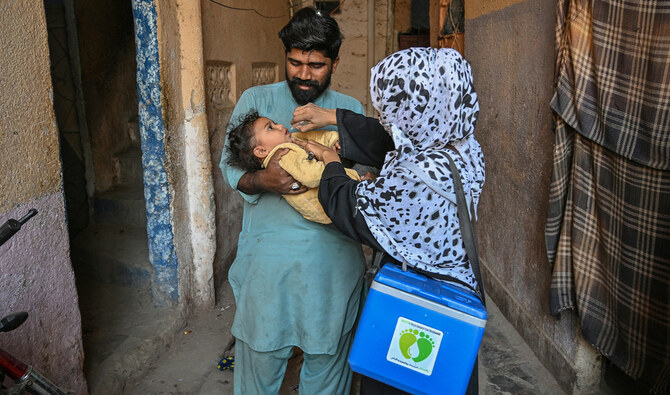
A health worker (R) administers polio drops to a child on the first day of a nationwide polio vaccination campaign, in Karachi on February 3, 2025. (AFP/File)
Short Url
Updated 12 February 2025
Follow

Pakistan says over 45 million children vaccinated in first countrywide anti-polio drive of 2025

  • Pakistani authorities conducted countrywide immunization campaign from Feb. 3-9
  • South Asian country has so far reported only one polio cases while last year it recorded 74

ISLAMABAD: Pakistan’s state media recently announced that over 45 million children were vaccinated against polio in the first countrywide national immunization campaign of the year conducted from Feb. 3-9, as Islamabad attempts to put a stop to rising cases of the infection. 

Polio is a paralyzing disease with no cure and to ensure immunity, health experts say it is crucial that all children under five complete the oral polio vaccine series. The South Asian country last year reported 74 polio cases in 2024, a sharp increase from just six cases in 2023. 

The Pakistan polio program runs several mass vaccination drives annually. This year’s first anti-polio drive was conducted from Feb. 3 to 9. On Jan. 22, the country reported its first case of the disease in 2025 in the Dera Ismail Khan district of northwestern Khyber Pakhtunkhwa province.

“The Ministry of Health said more than 45 million children have been vaccinated during the National Polio Immunization Campaign,” the state-run Associated Press of Pakistan (APP) said.

“During this polio campaign, more than 400,000 trained polio workers visited door to door to perform their services.”

Dr. Mukhtar Bharath, Prime Minister Shehbaz Sharif’s Coordinator for Health, said it is a “national and moral” responsibility of parents to get their children under the age of five vaccinated against polio.

He said the complete eradication of polio was the government’s top priority, highlighting that the “war against polio” was being fought with “full force and consistency.”

Bharath said measures were being strengthened to improve polio immunization campaigns across the country.

Of the 73 cases recorded last year, 27 were from southwestern Balochistan, 22 from northwestern Khyber Pakhtunkhwa (KP), 22 from southern Sindh, and one each from Punjab and Islamabad. 

Pakistan and Afghanistan are the last two countries where polio remains endemic. In the early 1990s, Pakistan reported around 20,000 cases annually but in 2018 the number dropped to eight cases. 

Pakistan’s polio program began in 1994, but efforts to eradicate the virus have been hampered by vaccine misinformation, opposition from some religious hard-liners who view immunization as a foreign plot, and frequent attacks on polio vaccination teams by militant groups.


Pakistan denies role in Afghan regime change, says military operation will continue

Updated 6 sec ago
Follow

Pakistan denies role in Afghan regime change, says military operation will continue

  • Pakistan, Afghanistan have been embroiled in military conflict since last week after Afghan forces launched retaliatory attacks against Islamabad
  • Pakistan not targeting indiscriminate sites but specific infrastructure, installations being used to support “terrorist groups,” says security official

ISLAMABAD: Islamabad is not seeking a regime change in Afghanistan, state media reported this week quoting a senior security official, who vowed that Pakistan’s military operation against Afghan forces will continue until the Taliban government stops facilitating militants. 

The statement comes in response to the ongoing military conflict between Afghanistan and Pakistan, which began after Afghan forces on Thursday launched attacks in retaliation for Pakistani airstrikes earlier this month.

Since then, Pakistan has carried out military operations along the border, with Information Minister Attaullah Tarar claiming the killing of 435 Afghan forces and the capture of 31 Afghan positions. Afghanistan, on the other hand, has also claimed capturing several Pakistani military posts along the border and carrying out strikes targeting military bases in Pakistan. Arab News could not independently verify these claims.

“He clarified that Pakistan has nothing to do with any change of government in Afghanistan, calling it an internal choice of the Afghan people,” state broadcaster Radio Pakistan reported on Monday, citing a senior security official who spoke on condition of anonymity.

Islamabad accuses the Afghan Taliban government of sheltering militants, particularly the Tehreek-e-Taliban Pakistan (TTP) in Afghanistan and facilitating their attacks against Pakistan.

Afghanistan has denied these charges and urged Pakistan to focus on resolving its security challenges internally without blaming Kabul.

The official said the Afghan Taliban will have to either pick sides between Pakistan or the “terrorist groups” operating from their soil.

“A senior Pakistani security official has said that ‘Operation Ghazab Lil-Haq’ will continue until the Afghan Taliban government provides verifiable assurances to Pakistan that it will stop facilitating Fitna Al-Khwarij and Fitna Al-Hindustan,” Radio Pakistan reported.

Pakistan’s government and military use the terms “Fitna Al-Khwarij” for the TTP and “Fitna Al-Hindustan” for separatist militant outfits that operate mostly in southwestern Balochistan province. Islamabad accuses its chief rival India of supporting these militant groups, charges that New Delhi has always denied. 

The security official rejected Afghanistan’s claims Pakistan has killed numerous civilians in its operations. 

“He stressed that Pakistan is not targeting indiscriminate sites but only specific infrastructure and installations being used to support terrorist groups,” the state broadcaster said. 

The latest cross-border fighting ended a ceasefire brokered by Qatar and Turkiye in October. The two sides failed to reach a permanent agreement during talks in Istanbul.

Despite the ongoing tensions, Pakistan’s President Asif Ali Zardari on Monday reiterated Islamabad’s calls for talks with Afghanistan. 

“We have never walked away from dialogue,” he said.