

Pakistan’s foreign minister discusses humanitarian crisis in Gaza with Malaysian counterpart

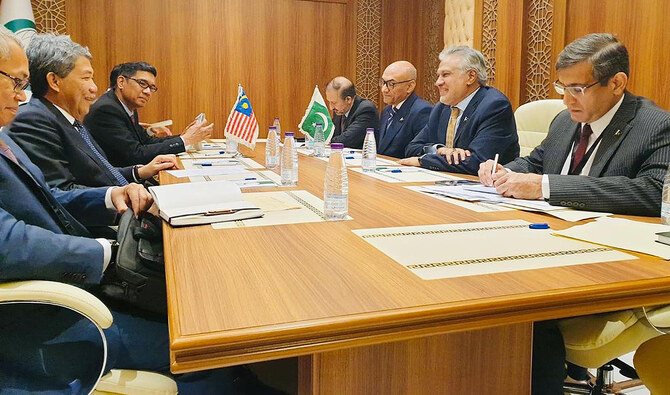
Pakistan’s Foreign Minister Ishaq Dar (second from right) meets his Malaysian counterpart Dato’ Seri Utama Hajji Mohamad bin Hajji Hasan (second from left) on the sidelines of an OIC session in Jeddah, Saudi Arabia, on August 7, 2024. (PID/File)
Short Url
Updated 10 February 2025
Follow

Pakistan’s foreign minister discusses humanitarian crisis in Gaza with Malaysian counterpart

  • Development takes place amid US President Trump’s controversial comments on relocating Palestinians from Gaza
  • Ishaq Dar expresses support for convening OIC Council of Foreign Ministers meeting to discuss Palestine crisis 

ISLAMABAD: Pakistan’s Foreign Minister Ishaq Dar discussed the humanitarian crisis in Gaza with his Malaysian counterpart and expressed steadfast support for the Palestinian cause on Monday, the foreign office said in a statement, amid calls by US President Donald Trump to relocate people from Gaza to Egypt and Jordan. 

Dar previously spoke to the foreign ministers of Iran and Egypt on Sunday to drum up support for Palestinians in Gaza. His interactions come after last week’s comments by Trump in which he floated the idea of US administration over Gaza, envisioning rebuilding the devastated territory into the “Riviera of the Middle East” after resettling Palestinians elsewhere, namely Egypt and Jordan.

The remarks have prompted global backlash, mostly from Arab countries who have firmly rejected the proposal and insisted on a two-state solution with an independent Palestinian state alongside Israel. 

Dar spoke to Malaysian Foreign Minister Dato’ Seri Utama Hajji Mohamad bin Hajji Hasan over the phone to discuss the humanitarian crisis in Gaza and the overall situation of the Middle East region, the foreign office said. 

“The Deputy Prime Minister/Foreign Minister expressed Pakistan’s steadfast support for the Palestinian people and their just cause,” the statement said. “He also conveyed Pakistan’s support for the convening of an Extraordinary OIC meeting of the Council of Foreign Ministers to discuss this urgent issue.”

The development also takes place ahead of Egypt hosting a summit of Arab nations on Feb. 27 to discuss “the latest serious developments” concerning Palestinian territories, its foreign ministry said on Sunday.

Aid trucks have flooded into Gaza after an uneasy ceasefire between Hamas and Israel began on Jan. 19, raising hopes that the war that led to seismic shifts in the Middle East may be headed toward an end. The truce, however, is fragile. 

Israel has said it won’t agree to a complete withdrawal from Gaza until Hamas’ military and political capabilities are eliminated. Hamas says it won’t hand over the last hostages until Israel removes all troops from the territory.

During the 42-day first phase of the ceasefire, Hamas is gradually releasing 33 Israeli hostages captured during its Oct. 7, 2023, attack that sparked the war in exchange for the release of nearly 2,000 Palestinian prisoners and a flood of humanitarian aid to Gaza. The deal also stipulates that Israeli troops will pull back from populated areas.

In the second phase, all remaining living hostages would be released in return for a complete Israeli withdrawal from Gaza and “sustainable calm.” 


Pakistan says defense pact with Saudi Arabia elevated brotherly ties to ‘new heights’

Updated 25 February 2026
Follow

Pakistan says defense pact with Saudi Arabia elevated brotherly ties to ‘new heights’

  • Pakistan, Saudi Arabia signed strategic defense pact last year pledging aggression against one will be treated as attack on both
  • Deputy PM Ishaq Dar says enduring bonds with Islamic and Arab nations form vital pillar of Pakistan’s foreign policy 

ISLAMABAD: Deputy Prime Minister Ishaq Dar said on Wednesday that Pakistan’s defense pact with Saudi Arabia elevated its brotherly ties with the Kingdom to “new heights,” stressing that close ties with Arab and Islamic nations form a key pillar of Islamabad’s foreign policy. 

Pakistan and Saudi Arabia signed a Strategic Mutual Defense Agreement on Sept. 17 last year, pledging that aggression against one country would be treated as an attack on both, enhancing joint deterrence and formalizing decades of military and security cooperation.

Both nations agreed in October 2025 to launch an economic cooperation framework to strengthen trade and investment ties. 

“In the Middle East, our landmark Strategic Mutual Defense Agreement with Saudi Arabia has elevated our brotherly ties to new heights,” Dar said while speaking at the Pakistan Governance Forum 2026 event in Islamabad. 

The Pakistani deputy prime minister was speaking on the topic “Navigating International Relations Amidst Changing Geo-Politics.”

Dar noted that Pakistan has reinforced partnerships with other Middle Eastern nations such as the UAE, Qatar, Jordan, Oman, Egypt and Bahrain. He said these partnerships have yielded “concrete agreements” in investment, agriculture, infrastructure, and energy sectors. 

“Our enduring bonds with Islamic and Arab nations form a vital pillar of our foreign policy, and we will continue to expand our partnerships across Asia, Latin America, and Africa,” he said. 

Dar pointed out that the presidents of Kazakhstan, Uzbekistan and Kyrgyzstan have undertaken visits to Pakistan in recent months, reflecting Central Asian nations’ desire to boost cooperation with Islamabad.

On South Asia, the Pakistani deputy PM said Pakistan has successfully transformed its fraternal ties with Bangladesh into “a substantive partnership.”

“Similarly, the trilateral mechanism involving China, Pakistan, and Bangladesh has been launched with a view to expanding and deepening regional cooperation and synergy,” the Pakistani minister said. 

He said Islamabad has strengthened its “all-weather” partnership with China via the second phase of the multi-billion-dollar China-Pakistan Economic Corridor agreement and “unwavering support” from both sides for each other’s core interests. 

Dar said Pakistan had also reinvigorated its partnership with the US, advancing cooperation in trade, technology, investment, and regional stability. 

“This calibrated approach has enhanced our ability to navigate complexity with skill and confidence, ensuring that our national interests are served without compromising our core foreign policy principles,” he said.