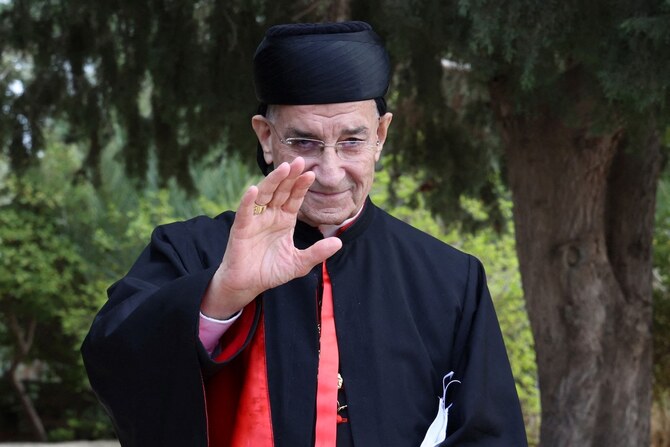

BEIRUT: Lebanon’s Maronite Patriarch Bechara Al-Rahi has warned that the country risks “slipping into degradation,” and called on its leaders to end what he described as national “stagnation.”
Delivering a sermon in St. George Cathedral in Beirut on Sunday to celebrate the Feast of St. Maron, the patron saint of the Maronites, Al-Rahi urged Lebanon’s political leaders and state institutions to “end the procrastination, the undermining of the judiciary, the loss of sovereignty and dignity, and the violation of the constitution.”
He added: “People are suffocating from the stagnation. Offer them a solution.”
Al-Rahi warned that “the real danger facing Lebanon is slipping into the axis of degradation.
“As much as we must remain neutral in a positive way, we must align ourselves with the axis of civilization, renaissance, and progress.”
He said: “Neutrality is more about preserving Lebanon’s unity than ensuring its survival. Neutrality equals internal security and foreign defense.”
Al-Rahi’s comments came a day after Lebanon formed a new government led by Prime Minister Nawaf Salam, a move that ended a two-year political deadlock in the country.
Salam and President Joseph Aoun attended the celebrations on Sunday along with Parliament Speaker Nabih Berri.
Following the Cabinet formation, Aoun said that the government did not include ministers affiliated with political parties.
“They will be cohesive, united, and work as a strong team to undoubtedly serve all Lebanese because their goal is only the interest of Lebanon,” he said.
Aoun said that the formation of the “reform and rescue government was based on competence, experience, specialization, and the ministers’ good reputation.”
The US, France, and the UK congratulated Lebanon on the government formation.
French President Emmanuel Macron personally phoned Aoun and Salam, and called on the new prime minister to carry out essential economic reforms.
According to the Elysee’s statement, Macron emphasized that “it is important that all parties collaborate to implement the ceasefire agreement in Lebanon.”
He also called on Israel to continue its withdrawal.
Macron affirmed France’s willingness to help establish stability on the Syrian–Lebanese borders.
The Lebanese government will carry out its duties until May 2026 when the next parliamentary elections will be held.
Most of the ministers appointed in Salam’s Cabinet graduated from the American University of Beirut, Universite Saint-Joseph de Beirut, or other leading American and French universities.
Both ministers proposed by Hezbollah and the Amal Movement are doctors at the American University of Beirut Medical Center.
Dr. Rakan Nassereddine, a specialist in arterial surgery, is the new minister of health.
The 36-year-old surgeon, who is from Hermel, is the youngest minister in the government.
Dr. Mohammed Haidar, director of nuclear medicine at AUBMC, has been appointed minister of labor.
The government is set to hold a meeting next Tuesday to form the committee tasked with drafting the ministerial statement.
The US Embassy in Lebanon welcomed the formation of the government.
In a statement, it urged “the drafting of a ministerial declaration that would assist Lebanon overcome the crisis and chart a course toward achieving its objectives.”
In reviewing the biographies of the appointed ministers, it is evident that a primary characteristic of the prevailing government is the expertise in the portfolios assigned to them.
The Foreign Minister, Youssef Raji, has held various diplomatic positions in Jordan, Ivory Coast, Morocco, and at the UN in Geneva, Belgium, and Washington.
Yassine Jaber, the minister of finance, is a former minister and MP representing the Shiite seat in the Nabatieh and southern regions.
He has been active in the construction sector in Lebanon since 1978 and continues to be involved to this day.
Gen. Michel Menassa, minister of defense, is a retired officer who served for several decades in the Lebanese Army.
He later became the Inspector General at the Ministry of Defense before his retirement.
Interior Minister Ahmed Al-Hajjar, a retired brigadier-general in the Internal Security Forces, was formerly head of the Internal Security Forces Institute.
Minister of Economy Amer Bizat is an investment expert who previously held the position of global head of Emerging Markets Fixed Income at BlackRock.
He also held portfolio management roles at UBS and Morgan Stanley Investment Management.
Joseph Saddi, the energy minister, previously worked at Strategy&.