

Pakistan sees Saudi fast-food giant Al Baik’s entry boosting jobs, bilateral trade

Customers place orders at the Al Baik restaurant in Jeddah, Saudi Arabia, on January 10, 2021. (AlBaik/Facebook)
Short Url
Updated 09 February 2025
Follow

Pakistan sees Saudi fast-food giant Al Baik’s entry boosting jobs, bilateral trade

  • The commerce minister meets Saudi business leaders in Jeddah, inviting them to invest in Pakistan
  • Jam Kamal says both sides have seen a 22% increase in trade volume that now stands at $700 million

ISLAMABAD: Federal Minister for Commerce Jam Kamal Khan expressed hope on Saturday the investment of Saudi fast-food chain Al Baik in Pakistan would help generate employment opportunities, as he met Saudi businessmen in Jeddah to explore ways to enhance bilateral trade.
Al Baik, a popular Saudi brand specializing in fried chicken, has a strong following among Pakistani travelers to the Kingdom. The company signed a memorandum of understanding last year to enter the Pakistani market, capitalizing on its existing popularity.
Pakistan and Saudi Arabia have witnessed a 22% increase in bilateral trade volume that currently stands at $700 million. Saudi Arabia also remains Pakistan’s largest source of remittances, with $7.4 billion sent by expatriate workers last year.
During the visit, the commerce minister met Al Baik’s owner, Rami Abu Ghazaleh, who confirmed the company’s decision to open outlets in Pakistan, indicating that the agreement had reached its final stages.
“Al Baik’s arrival in Pakistan will create employment opportunities,” Khan said, according to an official statement. “Pakistan offers a favorable business environment and invites Saudi investors to explore opportunities.”
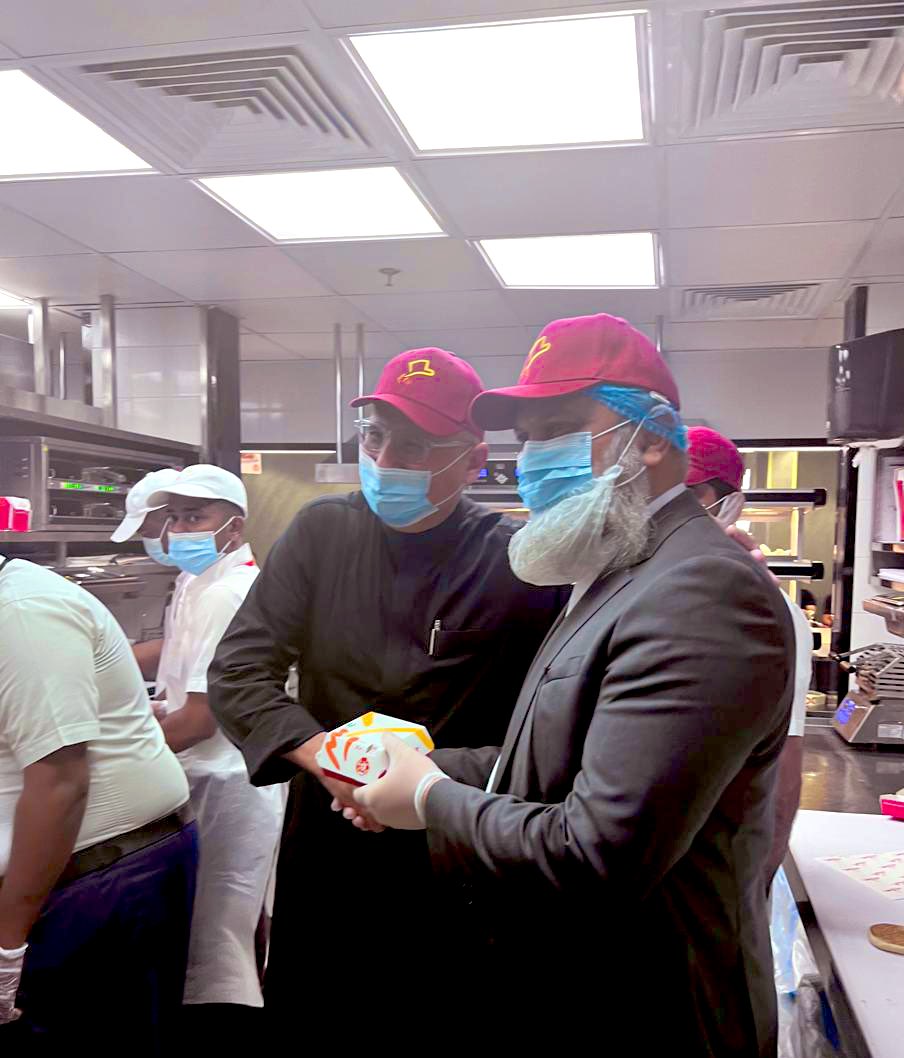


Pakistan Minister of Commerce Jam Kamal Khan (R) gestures with Rami Abu Ghazalah, CEO and co-owner of Saudi fast food chain AlBaik, during a visit to an outlet in Jeddah on February 7, 2025. (X/@jam_kamal)

Khan also highlighted the significant role played by Pakistani workers in Saudi Arabia’s economy and discussed his country’s new policy of granting visa-free entry with a 90-day stay for the nationals of Gulf Cooperation Council countries, facilitating greater business and labor mobility between the two states.
Beyond Al Baik, the minister engaged with other Saudi business leaders as well who showed interest in investing in Pakistan’s energy, information technology, agriculture and construction sectors.
He also invited them to attend upcoming trade events in his country.
Pakistan has been working to strengthen business-to-business (B2B) ties with Saudi Arabia.
During Prime Minister Shehbaz Sharif’s visit to Riyadh last October, both sides signed 34 agreements worth $2.8 billion to enhance private sector collaboration and commercial partnerships. Pakistani officials have since been following up on the commitments made between the two sides.


Pakistan stresses increasing trade, economic engagement with Europe amid EU-India deal 

Updated 09 February 2026
Follow

Pakistan stresses increasing trade, economic engagement with Europe amid EU-India deal 

  • Deputy PM Ishaq Dar chairs meeting to review measures to strengthen Pakistan-EU economic and trade cooperation
  • Free trade agreement grants Indian exporters sweeping tariff-free access to EU, Pakistan’s second-largest export market

ISLAMABAD: Pakistan’s Deputy Prime Minister and Foreign Minister Ishaq Dar on Monday stressed the importance of deepening trade and economic engagement with the European Union (EU) amid the bloc’s recent free trade agreement with India. 

India and EU last month announced they had successfully concluded negotiations for a free trade agreement with the EU, which Indian Prime Minister Narendra Modi described as the “mother of all trade deals.” The agreement grants Indian exporters sweeping tariff-free access to the EU, Pakistan’s second-largest export market. European Commission President Ursula von der Leyen said the deal created a free trade zone of two billion people.

The main concern for Pakistan is that the India-EU deal may significantly reduce Islamabad’s tariff advantage under the EU’s Generalized Scheme of Preferences Plus, which allows duty-free access for many Pakistani exports in return for commitments on labor rights, human rights and governance. Pakistan’s foreign office, however, has said it continues to view its trade relationship with the EU, particularly under the GSP Plus framework, as mutually beneficial.

Dar chaired a high-level inter-ministerial meeting to review measures aimed at strengthening Pakistan’s economic and trade cooperation with EU on Monday, the foreign ministry said. 

“DPM/FM underscored the importance of deepening and expanding trade and economic engagement with the EU, noting that the EU remains a key economic partner for Pakistan, particularly under the GSP Plus framework,” the statement said. 

He highlighted that Pakistan has successfully completed four biennial GSP Plus reviews, reaffirming Islamabad’s commitment to fully meeting its obligations under the scheme to expand mutually beneficial trade opportunities.

The meeting was attended by the federal minister of law and senior officials as well as Pakistan’s ambassador to the EU. 

The development takes place as Pakistan’s exports dwindle. After rising 5 percent to $32.1 billion last fiscal year, the Pakistan Bureau of Statistics reported that exports fell 9 percent to $15.2 billion in the first half of the current year through December. 

Pakistani industrialists and financial analysts have urged the government to reduce domestic production costs, particularly high power tariffs. EU accounts for a substantial share of Pakistan’s exports, particularly textiles and garments. 

“The EU-India FTA will have a definite impact on Pakistan’s textile exports to the EU,” said Shankar Talreja, the head of research at Karachi-based Topline Securities Ltd, told Arab News last month. 

“Pakistani companies’ competitive advantage to compete against a giant like India needs to be restored in the form of regionally aligned energy tariffs and policy certainty.”