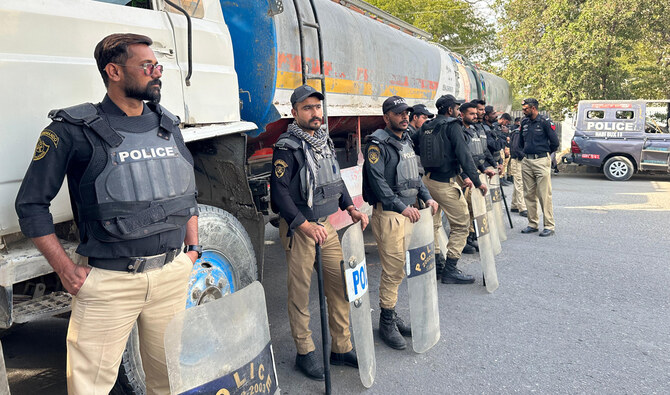
KARACHI: Pakistan police on Saturday arrested multiple opposition members ahead of a planned protest by jailed former prime minister Imran Khan’s Pakistan Tehreek-e-Insaf (PTI) and Jamaat-e-Islami (JI) opposition parties to mark the first anniversary of the Feb. 8, 2024 national election, which they say were rigged to benefit their opponents.
Pakistan’s general election was marred by a mobile Internet shutdown and unusually delayed results. The polls threw up a hung National Assembly and were followed by weeks of protests by opposition parties over allegations of rigging and vote count fraud.
The caretaker government, which oversaw the electoral exercise, and the Election Commission of Pakistan (ECP), deny the charges, however, the US House of Representatives and several European countries have called on Islamabad to open a probe into the allegations — a move Pakistan has thus far rejected.
Last month, Khan called on PTI leaders and supporters to mark Feb. 8 as a “Black Day” and hold protests across the country to raise their voice against alleged election irregularities. Khan’s announcement was followed by a similar call from JI leader Hafiz Naeem-ur-Rehman over the “stolen mandate.”
“Disgusting to see Meher Bano Qureshi, her MPA [member of provincial assembly] and workers being arrested for taking part in a peaceful protest [in Multan],” PTI’s Sayed Zulfikar Bukhari said on X, sharing footage of Qureshi and others inside what appeared to be a police van.
The PTI also confirmed the arrest of its member, Khawaja Farooq, and others by police in Azad Kashmir.
Opposition supporters have taken to streets in several cities across the country to register their protest on Saturday evening, following the circulation of video messages by their leaders that urged supporters to mobilize.
Khan’s PTI planned to hold a major protest rally at Minar-e-Pakistan, a historical monument in Lahore that symbolizes the country’s independence, but it was denied official permission by the Punjab provincial administration, led by the ruling Pakistan Muslim League-Nawaz (PML-N) party.
The PML-N administration also imposed Section 144 of the Code of Criminal Procedure, banning large gatherings across the province to prevent political demonstrations. The PTI is also expected to hold a rally in Swabi, located in the northwestern Khyber Pakhtunkhwa province, where the party remains in power.
Meanwhile, the JI plans to stage a protest outside the ECP office in Karachi. The party did not win any National Assembly seats in the general elections but secured two provincial seats in the Sindh Assembly and one in the Balochistan Assembly.
PTI candidates contested the Feb. 8 elections as independents after the party was barred from the polls. While they won the most seats, they fell short of the majority needed to form a government, which was instead formed by a coalition of rival political parties led by Prime Minister Shehbaz Sharif.


![]()

Police arrest opposition members ahead of protest to mark anniversary of Pakistan national polls
Short Url
https://arab.news/mejw7
Police arrest opposition members ahead of protest to mark anniversary of Pakistan national polls
- Pakistan’s general election was marred by a mobile Internet shutdown and unusually delayed results, throwing up a hung parliament
- Ex-PM Imran Khan, Jamaat-e-Islami’s Hafiz Naeem-ur-Rehman asked their supporters to mark Feb. 8 as a ‘Black Day’ by holding protests


Latest updates


© 2026 SAUDI RESEARCH & PUBLISHING COMPANY, All Rights Reserved And subject to Terms of Use Agreement.