

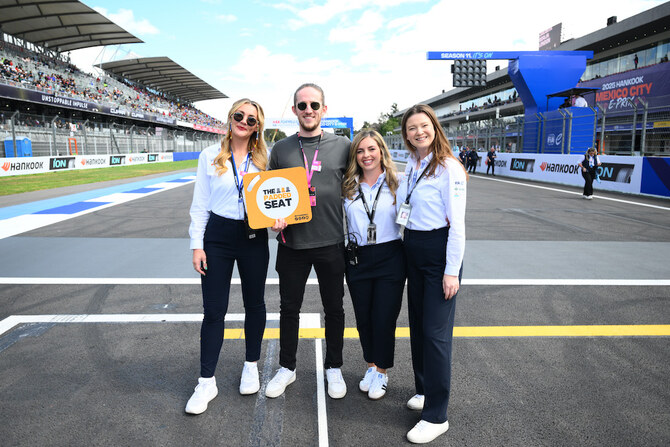

DUBAI: When the Jeddah E-Prix’s double-header takes place over Feb. 14-15, few people will be as busy as Darcey Lingley — with the exception of the drivers tearing around the track, perhaps.
The director of operations at Formula E has been with the organization for about a decade and after six years of hosting the race in Diriyah, she will be overseeing the latest edition of the race at its new location at Jeddah Corniche Circuit.
As someone involved with the ABB FIA Formula E Championship from its earliest days, Lingley has had a closer look than most at just how the race-day experience, in Saudi and elsewhere, has developed in recent years.
“I’m very fortunate,” Lingley told Arab News. “I’ve seen every iteration of our Saudi Arabian events. So I was there in that very first one (2018), and I have to say, especially where we were able to race, in Diriyah, has been very special over the last few years.
“We know we’re very privileged with the location. The growth of the event, popularity, the interest, knowledge, sharing of the sport in the market, has really grown. With that has also been the investment and opportunity to bring bigger, better shows.”
She added: “It’s really led the way for a lot of our other events in terms of entertainment and how we can really bring the sport into a slightly different phase to the business. So it’s been great.”
The all-electric racing series was launched in 2014 with 10 teams competing against each other in 11 races across 10 locations. In the ongoing 2024-25 campaign, Formula E’s 11th season, 11 teams are taking part in 17 races in 11 different countries.
In that time, Lingley has seen how fan engagement has grown across the growing number of events.
“I think, from a fan’s perspective, what we’ve seen is just knowledge growth in the market,” she said.
“In many of our events, people are still getting to know Formula E. But I think really from a fan’s perspective, through the entertainment and engaging and driving fans to come to our events for more than just motorsport, it has been really great. And also from a VIP perspective with celebrities and influencers, and we’ve had celebrity chefs in our Emotion Club hospitality.
“The beauty of our hospitality experience is that you’re mixing with those CEOs, celebs and influencers within that same space. So it really feels quite interactive and engaging. And that has only just grown year on year.”
Lingley and her team expect the two races in Jeddah to be the biggest of the Formula E calendar, as they were in Diriyah.
She said: “I think for us, the Saudi Arabia event for VIP hospitality is definitely our largest out of the calendar season. For context, that’s 3,500 guests in our Emotion Club as opposed to 1,000 we have in most other markets. So I think that really shows that level of engagement and excitement there. Jeddah Corniche Circuit I think will help facilitate that scale of guest attendance and help us grow it for future seasons as well.
“I think that with our ambitions to grow the entertainment program, and the fan-focused experiences also, it’s a fantastic venue that’s only going to help us (improve) that as well.”
The larger Jeddah crowds can expect plenty of post-race entertainment, as attendees in recent years have experienced.
Lingley added: “I think our concerts over the years have equally only grown in popularity and have developed and improved. With the Backstreet Boys, completely iconic, last season, but also Martin Garrix and OneRepublic, amongst many other names we’ve had over the seasons.”
This year, the post-race concerts are to be headlined by Akon and Lil Baby on consecutive nights.
With the Jeddah E-Prix now less than a week away, Lingley and her team are fully focused on another hectic weekend, when all their planning and preparation comes to fruition.
She said: “We’re live on race day. We’re hosting. This is the day that we’re kind of gearing up for.
“It’s not like many departments in the business, which should be ‘feet up’ if everything’s gone well. For us, that is the day where it all comes together. So for me, that’s supporting the team with opening the gates on time, ensuring that everything’s prepared, making sure of everyone’s reserved areas.
“The nuances of all of those guest experiences are ironed out in those itineraries for all of the client groups, (including) the behind-the-scenes tours, electric laps, grid procedures.
“We’ve got enough staff and everyone’s briefed well. But to be honest, (race day) is spending a lot of time talking to a lot of people, whether that’s our staff or the guests, our team’s partner sponsors, just making sure everyone’s got all the support they could possibly need. All being well, I spend a lot of time talking, which is not a challenge for me.”
Beyond attendances at events, Lingley says the popularity of Formula E continues to rise globally, thanks to the expansion into new markets, especially in Asia.
She said: “I’ve been in Formula E for 10 years now, just over, so I’ve really seen that curve of engagement and how the championship has grown exponentially.
“It’s truly impressive how it’s grown year on year, and I think despite challenges with COVID-19, for the nature of the business that we were and the age we were as a company, it’s impressive and incredible how much we’ve continued to grow.
“What I see on the hospitality side in particular is that we’ve never had more external engagement to want to get into our events. Historically we’ve always been geared towards our sponsors, championship teams, our partners, because they’re our primary audience.
“But what’s really exciting about season 11 and beyond is just the nature and interest of B2C, B2B, other companies, and just individuals who want to pay to come and have that exclusive experience, and I think that really says everything.”


