


KARACHI: Shereen Abdullah remembers the exact moment she decided to take on the mission to conserve and protect Karachi’s butterfly population.
It was 2004 and she was visiting plant nurseries in the Pakistani port city with her son Hamza, a toddler who wanted to see caterpillars and understand how the insects become butterflies through the process of metamorphosis.
One gardener’s dismissive remark – “Madam, they are just insects, we kill them” – sent chills down Abdullah’s spine.
“I still get goosebumps,” Abdullah, popularly known as ‘The Butterfly Lady’ in Karachi, told Arab News at a sanctuary for the winged insects she has set up in her home. “And that day I decided I have to do something about it.”
That “something” was a conservation program built on three Rs, rescue, raise, and release, with Abdullah and her team of young environmental stewards working tirelessly to rehabilitate the city’s butterfly population — one caterpillar at a time.
Warmer temperatures are making life harder for butterflies around the world, as food is scarcer, flowering periods are shorter, and experts now suspect butterflies may be getting smaller.
The butterfly life cycle is a fascinating four-stage transformation, beginning as a tiny egg laid on a host plant that hatches into a voracious caterpillar focused on eating and growing. The caterpillar then enters the pupa or chrysalis stage, a period of dramatic metamorphosis where it reorganizes its body into a butterfly. Finally, a fully-formed butterfly emerges from the chrysalis, dries its wings, and takes flight, ready to reproduce and continue the cycle.
Abdullah’s journey to save Karachi’s butterflies began with awareness sessions on butterfly lifespans, the first of which was held on Earth Day in 2007. Her efforts grew over time, and she set up a butterfly club in Karachi in 2016. In 2024, she joined the Butterfly Effect Program, a nonprofit experiential learning initiative that trains children to become environmental stewards who rescue caterpillars and raise butterflies.
Butterfly Effect has built its first conservatory at Karachi’s Church Mission School (CMS), the alma mater of Muhammad Ali Jinnah, the founder of Pakistan. A second conservatory has been established at a government school in Islamabad and a third is in the works in the city of Narowal in Punjab province.
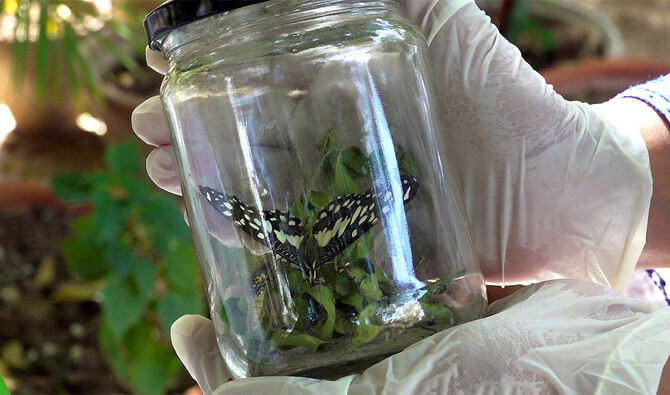
Caterpillars are typically rescued in the egg or caterpillar stage, with Butterfly Effect students learning to carefully collect them from their host plants and nurture them in clean, well-ventilated jars, feeding them the same leaves they were rescued from.
“We felt happiness for the first time,” said Muhammad Yousuf Mansoor Bhojani, a student of grade nine who is involved in the program, describing the joy of raising a caterpillar into a butterfly and then releasing it into the wild.
“It was so light, and by the grace of Allah, it was so beautiful that I didn’t want to let it go.”
Abdullah’s own children, including her now 22-year-old son Hamza, have grown up learning to love butterflies.
“For them, there is no wow factor,” she said. “It is like they have grown up with butterflies. They always say butterflies are like our siblings.”
“ECOSYSTEM LOSS”
According to a 2020 study in the Journal of Bioresource Management, from nearly 20,000 species of butterflies known globally, nearly 400 species of moths and butterflies have been recorded in Pakistan.
“Very interestingly, when I started this work, the count of butterfly species…there were 20,000 species [around the world],” Abdullah said. “And now if you see, the number comes to 17,000, 16500 … So, in these twenty years, there is a decline. And the decline is not just in population but we are losing a lot of species as well.”
Rehan Khan, who has been photographing butterflies for 28 years, said he had witnessed the decline of the species firsthand in Pakistan.
“The natural colors of these butterflies are so beautiful that I feel compelled to shoot them,” Khan said. “But over time, this has been decreasing significantly.”
Javed Ahmed Mahar, the chief of the Sindh wildlife department, said he attributed the decline to habitat loss and the use of agricultural pesticides, emphasizing the role of butterflies as important pollinators that help plants reproduce and also provide food for other animals.
“Look, if butterflies are not present in our ecosystem or around us, it’s not just a loss of beauty but also a significant ecosystem loss,” Mahar explained.
And that is why rescuing the species is so important for Abdullah.
“I say the single rescue of a caterpillar is impactful because one caterpillar changes into a butterfly and that butterfly lays hundreds of eggs,” she explained. “So ideally, one butterfly is capable of producing 15 more butterflies.”


