

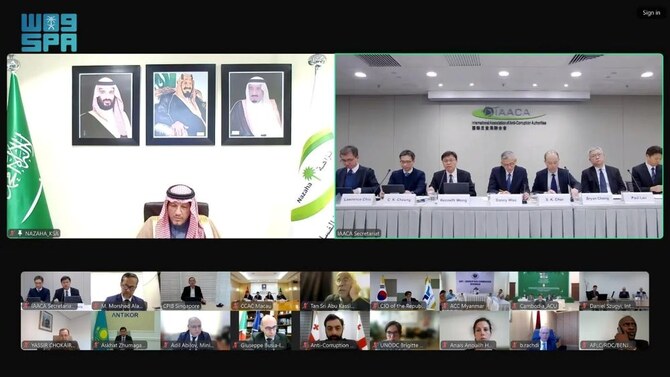
Saudi Arabia elected member of executive committee of IAACA

Saudi Arabia, represented by Nazaha, participated in the 14th general meeting of the International Association of Anti-Corruption Authorities (IAACA), which took place via videoconference. (SPA)
Short Url
Updated 06 February 2025
Follow

Saudi Arabia elected member of executive committee of IAACA

  • Saudi Arabia, represented by Nazaha’s President Mazin Al-Kahmous, was elected as a member of the executive committee of the IAACA
  • Al-Kahmous praised the vital role of the IAACA in promoting international cooperation, transparency, and integrity across nations

RIYADH: Saudi Arabia, represented by the Oversight and Anti-Corruption Authority which is otherwise known as Nazaha, participated in the 14th general meeting of the International Association of Anti-Corruption Authorities, which took place on Thursday via a videoconference.

In the course of the meeting, Saudi Arabia, represented by Nazaha’s President Mazin Al-Kahmous, was elected as a member of the executive committee of the IAACA, the Saudi Press Agency reported. 

The move reflects the international community’s recognition of the Kingdom’s efforts and global status in combating corruption, mainly at the international level.

Al-Kahmous praised the vital role of the IAACA in promoting international cooperation, transparency, and integrity across nations.

He spoke of the association’s mission to facilitate knowledge and expertise exchange among countries and institutions dedicated to combating corruption, as well as to develop effective strategies for addressing the issue locally and internationally.

The Nazaha president also stressed the importance of building a network of international partners to support the implementation of laws and policies related to transparency and accountability.

Al-Kahmous reiterated the Kingdom’s commitment to working alongside member states and all stakeholders to make meaningful and effective contributions toward achieving the objectives of the IAACA.

The IAACA is an independent non-political and anti-corruption organization with over 180 agencies from different countries. It seeks to promote the implementation of the UN Convention against Corruption and achieve the UN’s Sustainable Development Goals to reduce corruption and bribery in all forms by 2030.


Saudi deputy FM attends OIC ministers’ meeting on Somalia situation

Updated 8 sec ago
Follow

Saudi deputy FM attends OIC ministers’ meeting on Somalia situation

JEDDAH: Saudi Arabia Vice Minister of Foreign Affairs Waleed Elkhereiji has reaffirmed the Kingdom’s full support for Somalia’s sovereignty, unity and territorial integrity, while strongly rejecting any actions that undermine the country’s stability.

Speaking at an extraordinary meeting of foreign ministers from member states of the Organization of Islamic Cooperation, Elkhereiji condemned the declaration of mutual recognition between Israeli occupation authorities and the Somaliland region, describing it as a unilateral separatist move that violated international law, the UN Charter and the OIC Charter.

He stressed the Kingdom’s categorical rejection of any attempts to impose parallel entities that contradict Somalia’s unity and territorial integrity, or that seek to divide or diminish its sovereignty. Elkhereiji also reiterated Saudi Arabia’s support for Somalia’s legitimate state institutions and its commitment to preserving the country’s stability and the security of its people.

Elkhereiji called on the OIC and its member states to adopt a firm and unified Islamic position rejecting any recognition of, or engagement with, separatist entities in Somalia. He urged coordinated action in international forums to affirm Somalia’s unity and prevent what he described as dangerous precedents that could threaten the sovereignty of OIC member states.

He further called for holding the Israeli entity fully responsible for any political or security consequences resulting from such actions, and for rejecting any cooperation arising from the declaration of mutual recognition.

During the meeting, he also reiterated the Kingdom’s position on the Palestinian cause, emphasizing its centrality and Saudi Arabia’s support for efforts to secure a ceasefire in the Gaza Strip. He said this would enable the Palestinian people to exercise their right to self-determination and establish an independent state along the 1967 borders, with East Jerusalem as its capital.