China, Pakistan urge Afghanistan to act against militants as Zardari seeks stronger economic ties

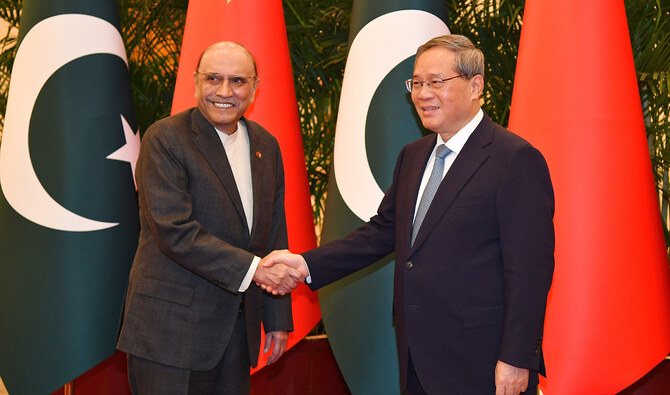
Pakistani President Asif Ali Zardari (left) meets Chinese Premier Li Qiang in Beijing, China, on February 5, 2025. (AP)
Short Url
Updated 06 February 2025
Follow

China, Pakistan urge Afghanistan to act against militants as Zardari seeks stronger economic ties

  • Pakistan recognizes commitment to ensuring safety of Chinese workers, calls it ‘foremost responsibility’
  • President Zardari meets Chinese Premier Li Qiang, seeks enhanced people-to-people exchanges

ISLAMABAD: China and Pakistan on Thursday called on Afghanistan’s administration to take “visible and verifiable” steps to address militant threat, according to a joint statement, as President Asif Ali Zardari discussed enhanced economic collaboration and people-to-people ties during a meeting with Chinese Premier Li Qiang.

Zardari is on a five-day visit to Beijing, where he also met Chinese President Xi Jinping a day earlier and invited him to visit Pakistan. His engagements with Chinese officials come amid Beijing’s growing concerns over the security of its nationals working in Pakistan, many of whom are involved in China-Pakistan Economic Corridor (CPEC) projects and have been targeted in a series of attacks in recent years.

During his meeting with Xi, Zardari acknowledged that Pakistan’s relationship with China had “gone through ups and downs” but said it would not be undermined by militant violence.

Most of the attacks against the Chinese workers have been attributed to groups such as Tehreek-e-Taliban Pakistan (TTP) and Balochistan Liberation Army (BLA), which Pakistan says operate from neighboring Afghanistan. Kabul denies the allegation.

“The two sides [Pakistan and China] agreed to maintain close communication and coordination on the issue of Afghanistan, and play a constructive role in helping Afghanistan achieve stable development and integrate into the international community,” said the joint statement released by Pakistan’s foreign office.

“They called on the Interim Afghan Government to take visible and verifiable actions to dismantle and eliminate all terrorist groups based in Afghanistan which continue to pose a serious threat to regional and global security, and to prevent the use of Afghan territory against other countries,” it added.

The statement also highlighted Pakistan’s commitment to ensuring the safety of Chinese workers, calling it the country’s “foremost responsibility.”

“The Pakistani side reiterated its strongest condemnation of the terrorist attacks in Pakistan involving Chinese personnel,” it said, adding that the government would continue to investigate these incidents and bring the perpetrators to justice.

“It will also further increase input into security, and take targeted and enhanced measures to effectively ensure the safety and security of Chinese personnel, projects and institutions in Pakistan,” the statement said.

Separately, the Pakistani president met with Chinese Premier Li at the Great Hall of the People, reaffirming Islamabad’s commitment to deepening its “All-Weather Strategic Cooperative Partnership” with Beijing.

“The President highlighted the pivotal role of the China-Pakistan Economic Corridor (CPEC) in promoting regional connectivity and economic growth and expressed appreciation for China’s continued support toward Pakistan’s development agenda,” a statement from Pakistan’s presidency said.

Discussions between the two leaders focused on the expansion of cooperation under “CPEC 2.0,” with an emphasis on renewable energy, science and technology, infrastructure and agriculture.

They also explored ways to enhance trade and investment through business-to-business linkages.

Both sides underscored the importance of strengthening people-to-people and cultural exchanges to build a “China-Pakistan Community of Shared Future in the New Era,” the statement added.


Pakistan to launch AI screening in January to target fake visas, agent networks

Updated 5 sec ago
Follow

Pakistan to launch AI screening in January to target fake visas, agent networks

  • New system to flag forged-document travelers before boarding and pre-verify eligibility
  • Move comes amid increasing concern over fake visas, fraudulent agents, forged papers

ISLAMABAD: Pakistan will roll out an AI-based immigration screening system in Islamabad from January to detect forged documents and prevent illegal overseas travel, the government said on Thursday. 

The move comes amid increasing concern over fake visas, fraudulent agents and forged papers, with officials warning that such activity has contributed to deportations, human smuggling and reputational damage abroad. Pakistan has also faced scrutiny over irregular migration flows and labor-market vulnerability, particularly in the Gulf region, prompting calls for more reliable pre-departure checks and digital verification.

The reforms include plans to make the protector-stamp system — the clearance required for Pakistani citizens seeking overseas employment — “foolproof”, tighten labor-visa documentation, and cancel the passports of deportees to prevent them from securing visas again. The government has sought final recommendations within seven days, signalling a rapid enforcement timeline.

“To stop illegal immigration, an AI-based app pilot project is being launched in Islamabad from January,” Interior Minister Mohsin Naqvi said following a high-level meeting chaired by him and Minister for Overseas Pakistanis Chaudhry Salik Hussain.

Naqvi said the new screening technology is intended to determine travelers’ eligibility in advance, reducing airport off-loads and closing loopholes exploited by traffickers and unregistered agents.

The interior minister added that Pakistan remains in contact with foreign governments to improve the global perception and ranking of the green passport, while a uniform international driving license will be issued through the National Police Bureau.

The meeting also approved zero-tolerance measures against fraudulent visa brokers, while the Overseas Pakistanis Ministry pledged full cooperation to streamline the emigration workflow. Minister Hussain said transparency in the protector process has become a “basic requirement,” particularly for labor-migration cases.

Pakistan’s current immigration system has long struggled with document fraud, with repeated cases of passengers grounded at airports due to forged papers or agent-facilitated travel. The launch of an AI screening layer, if implemented effectively, could shift the burden from manual counters to pre-flight verification, allowing authorities to identify risk profiles before departure rather than after arrival abroad.

The reforms also come at a moment when labor mobility is tightening globally. Gulf states have begun demanding greater documentation assurance for imported labor, while European and Asian destinations have increased scrutiny following trafficking arrests and irregular-entry routes from South Asia. For Pakistan, preventing fraudulent departures is increasingly linked to protecting genuine workers, reducing deportation cycles and stabilizing the country’s overseas employment footprint.