

Former Saudi ambassador to US condemns Trump’s ‘mad ethnic cleansing plan’ for Gaza

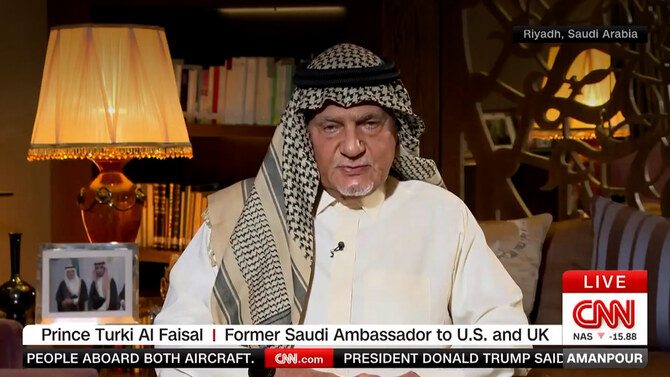
Former Saudi ambassador to the US Prince Turki Al-Faisal speaks to CNN international anchor Christiane Amanpour. (Screenshot)
Short Url
Updated 06 February 2025
Follow

Former Saudi ambassador to US condemns Trump’s ‘mad ethnic cleansing plan’ for Gaza

  • Prince Turki Al-Faisal says proposed resettlement of Palestinians would lead to more bloodshed
  • Warns US leader will receive ’an earful’ from Saudi leadership if he visits Kingdom

LONDON: Donald Trump’s plan for the US to take control of Gaza and force Palestinians to leave the enclave would be “ethnic cleansing” that would spark conflict and bloodshed, Prince Turki Al-Faisal, Saudi Arabia’s former ambassador in Washington, said on Wednesday.

In an interview with CNN, Prince Turki, who is also a former head of the Kingdom’s intelligence services, angrily rejected the US president’s comments, which included a threat to send US troops to help turn Gaza into the “Riviera of the Middle East.”

Prince Turki said he expected Arab and Muslim countries, along with other nations and Europe, to take up the issue at the UN to show that the world opposed “this mad ethnic cleansing plan.”

“It is a fantasy to think that ethnic cleansing in the 21st century can be condoned by a world community that stays on its behind, and does not respond to that,” Prince Turki told presenter Christiane Amanpour. “The problem in Palestine is not the Palestinians. It is the Israeli occupation. And this has been clear and understood by everybody.”

Prince Turki said Trump’s comments upended previous US policy that favored a two-state solution based on land for peace.

He said Trump’s plan was based on the position of Israeli extremist politician Itamar Ben-Gvir, “the ultimate ethnic cleanser,” who recently resigned as national security minister over the Gaza ceasefire.

Trump’s words were a “total acceptance of the Israeli position by the American government,” Prince Turki said, adding that this approach had been gaining support in US political circles over the past two years.

Prince Turki said that if Trump visited Saudi Arabia, he is likely to receive “an earful” from the Saudi leadership about “not just the wisdom of what he is proposing, but the downright unfairness and injustice.”

Trump has had close relations with Saudi Arabia and made the Kingdom his first foreign visit during his first term. Prince Turki said Crown Prince Mohammed bin Salman had pledged last month to invest $600 billion in the US.

Saudi Arabia’s foreign ministry strongly condemned threats to displace Palestinians from their land and reiterated the Kingdom’s position that there would be no normalization of relations with Israel until the establishment of an independent Palestinian state with East Jerusalem as its capital.

“This has been the position of Saudi Arabia from the beginning,” Prince Turki said.

He said that Trump’s Gaza plan on top of the “destruction and the devastation” of the territory during Israel’s campaign would only lead to more support for militant groups such as Hamas.

“Everybody has been telling the Israelis that if you repress these people, that if you punish them, if you inflict death and destruction and mayhem and genocide on them, all you are going to do is create more opposition,” Prince Turki said.

“That’s why they want to use ethnic cleansing to get the people out of the territory.

“So, their policy is clear cut and, unfortunately, we hear this reflected now in what Mr. Trump has said.”


Saudi Arabia charts new heights in quality of life

Updated 8 sec ago
Follow

Saudi Arabia charts new heights in quality of life

  • Report highlights urban transformation, economic growth, human-centric development in five major cities

Riyadh: The Quality of Life Program Center has released its latest report, “Cities of Possibility: The Evolution of Quality of Life in Saudi Arabia.”

Based on surveys of citizens, residents, and visitors, the report provides a detailed look at the Kingdom’s progress in building human-centric urban environments under Vision 2030.

Focusing on Riyadh, Jeddah, Alkhobar, Madinah, and Abha, the report introduces a pioneering assessment framework, the Saudi Press Agency reported on Wednesday.

The model evaluates urban success across four pillars: prosperity and opportunity, personal and social growth, lifestyle and recreation, and sustainable and safe foundations.

It offers a data-driven analysis of Saudi Arabia’s transformation, highlighting milestones that surpass many original Vision 2030 targets, the SPA added.

Economically, the labor market has improved dramatically, with unemployment falling from 12.3 percent in 2016 to 6.8 percent in the first quarter of 2025.

Women’s economic empowerment has surged, with female workforce participation reaching 36.4 percent in the first quarter of 2025, surpassing the 2030 target of 30 percent, the report stated.

Beyond the labor market, Saudi Arabia is strengthening its position in investment and infrastructure. A 67 percent year-on-year increase in investment licenses helped the Kingdom rank 13th globally in the 2025 Kearney FDI Confidence Index.

These economic gains are matched by improvements in human development: life expectancy has risen from 74 to 79 years, and rapid digital transformation puts the Kingdom second among G20 nations in the International Telecommunication Union’s 2024 ICT Regulatory Tracker Index.

With a trillion-dollar national investment in the tourism and entertainment sectors, the Kingdom has greatly expanded access to world-class culture, sports, and leisure.

Hosting the Formula 1 Saudi Arabian Grand Prix, the Esports World Cup, and the Dakar Rally has cemented the Kingdom’s global reputation, paving the way for mega-events such as Expo 2030 Riyadh and the 2034 FIFA World Cup.

Quality of Life Program Center CEO Khalid Al-Baker highlighted the strategic importance of these developments, saying that quality of life is a national priority and a driver for social cohesion, global talent attraction, and sustainable prosperity.

Al-Baker said this progress reflects the leadership’s commitment to putting people at the center of development.